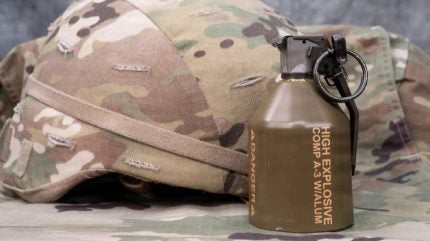
US Army approves M111 hand grenade for full material release

The US Army has granted full material release for the M111 Offensive Hand Grenade (OHG), marking the first time since 1968 that a new lethal hand grenade has reached this stage.

Army Technology
75
3 min read
0 views
US Army approves M111 hand grenade for full material release

The M111 will replace the body and fuze of the Mk3A2 hand grenade series, which entered service in 1968.

The US Army M111 marks the first new lethal hand grenade to achieve FMR since 1968. Credit: U.S. Army photo by Christopher Arthur.

The US Army has granted full material release for the M111 Offensive Hand Grenade (OHG), marking the first time since 1968 that a new lethal hand grenade has reached this stage.

The new OHG will replace the Mk3A2 series, which is now restricted due to its asbestos body.

Discover B2B Marketing That Performs

Combine business intelligence and editorial excellence to reach engaged professionals across 36 leading media platforms.

Find out more

Developed by the Capabilities Program Executive Ammunition and Energetics (CPE A&E) alongside the US Army Combat Capabilities Development Command (DEVCOM) Armaments Center at Picatinny Arsenal, the M111 features a plastic casing that is 100% consumed during detonation.

The M111 employs blast overpressure (BOP) as its main mechanism rather than fragmentation, aiming to provide increased operational safety and enhance combat readiness.

According to the US Army, BOP effects can deliver significant impact to enemy personnel and equipment in confined spaces without producing fragmentation, reducing risks in close-quarter urban environments.

In open terrain, soldiers will continue to use the M67 fragmentation grenade to maximise lethal fragment effects, while in enclosed or restricted areas such as buildings or structures, the M111 will be deployed to leverage its blast overpressure capabilities.

GlobalData Strategic Intelligence

US Tariffs are shifting - will you react or anticipate?

Don’t let policy changes catch you off guard. Stay proactive with real-time data and expert analysis.

By GlobalData

CPE A&E close combat systems project manager colonel Vince Morris said: “One of the key lessons learned from the door-to-door urban fighting in Iraq was the M67 grenade wasn’t always the right tool for the job. The risk of fratricide on the other side of the wall was too high. But a grenade utilising BOP can clear a room of enemy combatants quickly leaving nowhere to hide while ensuring the safety of friendly forces.”

The M111 grenade and its training version, the M112, use the same five-step arming process as the M67 and M69 models, which allows soldiers to train with procedures that mirror those used in combat.

Both the M111 and M112 also share fuzes with their respective predecessors, enabling the Army to reduce costs through shared production lines and greater economies of scale.

Additionally, government-owned intellectual property for both grenades allows the Army to open production contracts to competition across the industrial base, increasing opportunities for multiple suppliers.

Morris added: “By standardising the arming process and the fuzing, the Army saves taxpayer money without sacrificing lethality on the battlefield. This is the kind of acquisition reform that is currently underway throughout the Army acquisition enterprise. We are taking advantage of that initiative to drive down costs while increasing combat effectiveness.”

Original Source

Army Technology

Share this article

Related Articles

Japan launches third and fourth Sakura-class OPVs for JMSDF
🔬Weapons & Technology
Naval News

Japan launches third and fourth Sakura-class OPVs for JMSDF

The Japan Maritime Self-Defense Force (JMSDF) is procuring compact patrol ships at a rapid pace to strengthen maritime surveillance around Japan amid growing regional security pressures, particularly China’s expanding maritime activities. On March 13, Japanese shipbuilder Japan Marine United (JMU) l

hace 1 día5 min
🔬
🔬Weapons & Technology
Defence Blog

HDT Robotics deploys Hunter WOLF UGVs for operational testing

HDT Robotics announced that it has deployed several Hunter WOLF unmanned ground vehicles for military training and operational evaluation activities, introducing soldiers to the robotic platform in field-based scenarios. The deployment is intended to familiarize military operators with the Hunter WO

hace 1 día1 min
🔬
🔬Weapons & Technology
USNI News

U.S. Forces, Partner Nations Defend Against Maritime Drones in Exercise Cobra Gold

U.S. forces and partner nations trained to defend against swarms of maritime drones during exercise Cobra Gold 2026 in Thailand, according to a Tuesday announcement from defense company QinetiQ. QinetiQ Target Systems Canada provided 10 Hammerhead Uncrewed Surface Vehicles Targets (USV-T), deploying

hace 1 día1 min
Australia to expand Bluebottle USV vessel fleet with $125m investment
🔬Weapons & Technology
Naval Technology

Australia to expand Bluebottle USV vessel fleet with $125m investment

The Australian government has announced an A$176m ($125m) contract with Ocius Technology for 40 additional domestically designed and manufactured Bluebottle uncrewed surface vessels (USVs). The post Australia to expand Bluebottle USV vessel fleet with $125m investment appeared first on Naval Technol

hace 1 día3 min