17 hours ago
Paris Gourtsoyannis,Westminster correspondent, BBC Scotlandand
Steven McKenzie,Highlands and Islands reporter
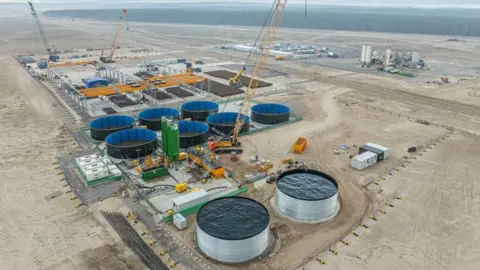
Ming Yang proposed building a wind turbine manufacturing plant at Ardersier.

17 hours ago
Paris Gourtsoyannis,Westminster correspondent, BBC Scotlandand
Steven McKenzie,Highlands and Islands reporter

 Haventus
An investment worth £1.5bn, creating 1,500 jobs in cutting-edge clean energy, and revitalising a disused former oil and gas port in the Highlands - it sounds too good to be true.
Normally, investment and jobs on that scale would have politicians of all parties lining up to shake hands and sign deals.
But when it comes to Chinese investment, things are a bit more complicated.
 HIE
HIE
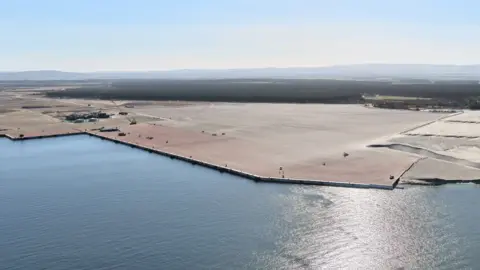
A yard at Ardersier on the Moray Firth coast near Nairn was opened in the 1970s to build offshore platforms for what was the newly-established North Sea gas and oil industry.
At its height the yard, employed about 4,500 people - but it closed in 2001 as demand dropped.
For years the 450-acre (182ha) site lay vacant as the UK's largest brownfield port.
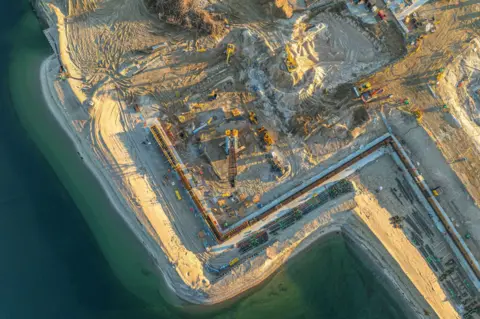
Today it is being redeveloped and forms part of the Inverness and Cromarty Firth Green Freeport.
The yard has been cleared of old infrastructure, there is a new roundabout on the A96 to ease traffic to the site and big new fancy sign.
Ming Yang announced last year its plans to invest in the yard, but the UK government said it needed to assess whether the proposals were "safe and secure".
We don't know the details of the national security concerns that have led to the rejection of Ming Yang's plans. The company says it hasn't been told, either.
But in general terms, concerns about Chinese investment in critical infrastructure are broad. Fears have been raised that the technology itself could be used to allow spying and industrial espionage.
The Conservative shadow Scottish secretary Andrew Bowie has raised the prospect of China being able to "spy on British seas, defence submarine programmes and the layout of our energy infrastructure" if Chinese turbines are erected off the coast.
Critics of Chinese investment say ultimate control of any foreign project lies with the country's communist government - even when the company involved is in private rather than state hands, as is the case with Ming Yang. It has denied all claims of improper influence or spying.
 Haventus
When it comes to China and national security, there are obviously bigger forces at play, too.
The Ming Yang proposal was on the UK government's desk for a year-and-a-half, and in that time, unconfirmed reports suggest that US government officials warned British counterparts about the risks of saying "yes".
It wouldn't be the first time: the US actively campaigned against Huawei's involvement in European telecoms projects, as part of its broad effort to combat the rise of the world's newest superpower.
British relations with China have gone through a series of dramatic shifts in recent years.
Under David Cameron, the UK government pursued what it called a "golden age" of cooperation, symbolised by the cosy pint shared between the then-prime minister and China's President Xi Jinping at a pub near the Chequers estate in 2015.
Under later Conservative prime ministers, relations cooled significantly, as the UK government considered whether to label China a "threat" to economic and national security.
The label was never formally adopted, but Rishi Sunak said China posed an "epoch-defining challenge".
That period coincided with a series of warnings over China's state surveillance. In 2022, MI5 took the unprecedented step of naming a Chinese lawyer with links across different political parties as carrying out "political interference activities".
In 2023, there were claims the Chinese government was operating clandestine "police stations" out of businesses in London and Glasgow, to spy and suppress dissent.
The following year, the UK's intelligence agency GCHQ said it was "highly likely" a Chinese state-affiliated entity had broken into the Electoral Commission's computer systems.
And last year, the trial of two former parliamentary staffers accused of spying for China collapsed, leading to a blame game between the UK government and prosecutors, and widespread concern among MPs.
More recently, Labour PM Sir Keir Starmer has tried to revive relations with China, in search of hard-to-find economic growth.
But Ming Yang's investment at Ardersier was clearly seen as too risky to permit.
That decision has been fiercely criticised by the SNP-led Scottish government, with the Deputy First Minister Kate Forbes claiming it was "simply sabotage of Scotland's industrial future".
Ming Yang's plans always enjoyed the SNP's support, but the fact this news comes on the eve of a Scottish election campaign, and in the middle of a fresh energy crisis, gives the issue extra political force.
Ironically for UK ministers, the decision came on the same day as another announcement by the Danish company Vestas, that it would build a wind turbine factory in Scotland and create 500 new jobs, provided it secures enough orders.
Despite the scale of Scotland and the UK's wind energy potential, there are currently no factories in this country building the highest-value part of a wind turbine, the nacelle.
The charge has long been that Scottish industrial jobs and investment have been forgotten in the rush to develop wind power, with turbines being built from imported components.
Labour came to power at Westminster promising to change that, with new rules and incentives around locally-based supply chains.
But ministers won't deliver on that pledge of a green industrial revolution at any cost, it seems - not when the price is national security.

In these turbulent times, focusing on the World Trade Organization’s 14th ministerial conference (MC14) in Yaounde, Cameroon, is a bit like trying to focus on a picnic sitting alongside a bar brawl, or listening to a lesson in pruning bonsai while a lumberjack takes a chainsaw to a giant redwood. Bu

Balendra Shah won the election by a landslide promising change to Nepalis who are angry at corruption.

Kenya secured trade and infrastructure financing deals during Chinese Vice-President Han Zheng’s visit this week, but analysts cautioned that deepening ties were complicated by rising debt and Nairobi’s balancing act between global powers. The “early harvest” Economic Partnership Agreement between t

Fadiah Nadwa Fikri urged some in Singapore to "adopt her brand of radical advocacy", authorities say.