Ukrainian women such as Nataliya Fesyuk take on a central role in wartime, keeping society running in the background – a portrait of one who steps in to help, listens, stands with others, and carries what the war leaves behind.
Kyiv Post
75
12 min read
0 views
In Kharkiv, where Russian drones strike residential neighborhoods with little warning, women like Nataliya Fesyuk have become part of the city’s unseen infrastructure – supporting civilians and soldiers alike as the war grinds on.
A few streets are still blocked off in Kharkiv’s Kholodnohirskyi district. Two or three hours earlier, a Russian Shahed drone struck this residential neighborhood in the west of the city. Burned-out cars stand between the apartment blocks, while police vehicles remain parked near the impact site. Firefighters move through the area, and emergency workers stand beside small tents where tea, snacks and psychological support are being offered. In the surrounding buildings, windows blown out by the blast are already being covered with wooden boards. It is the kind of scene Kharkiv knows too well by now: damage, shock, and almost immediately, people stepping in for one another.
Workers unload wooden OSB boards in Kharkiv’s Kholodnohirskyi district to cover windows shattered by a Russian drone strike earlier that day. April 2026 (Photo by Korbinian Leo Kramer)
Residents and municipal workers gather in Kharkiv’s Kholodnohirskyi district following a Russian drone strike. Cleanup and repair work began almost immediately after the attack. April 2026 (Photo by Korbinian Leo Kramer)
A playground in Kharkiv’s Kholodnohirskyi district beside burned vehicles damaged in a Russian Shahed drone strike. April 2026 (Photo by Korbinian Leo Kramer)
A burned-out car beside a playground in Kharkiv’s Kholodnohirskyi district after a Russian Shahed drone struck the residential neighborhood. Residents and municipal workers gathered within hours to begin clearing the area. April 2026 (Photo by Korbinian Leo Kramer)
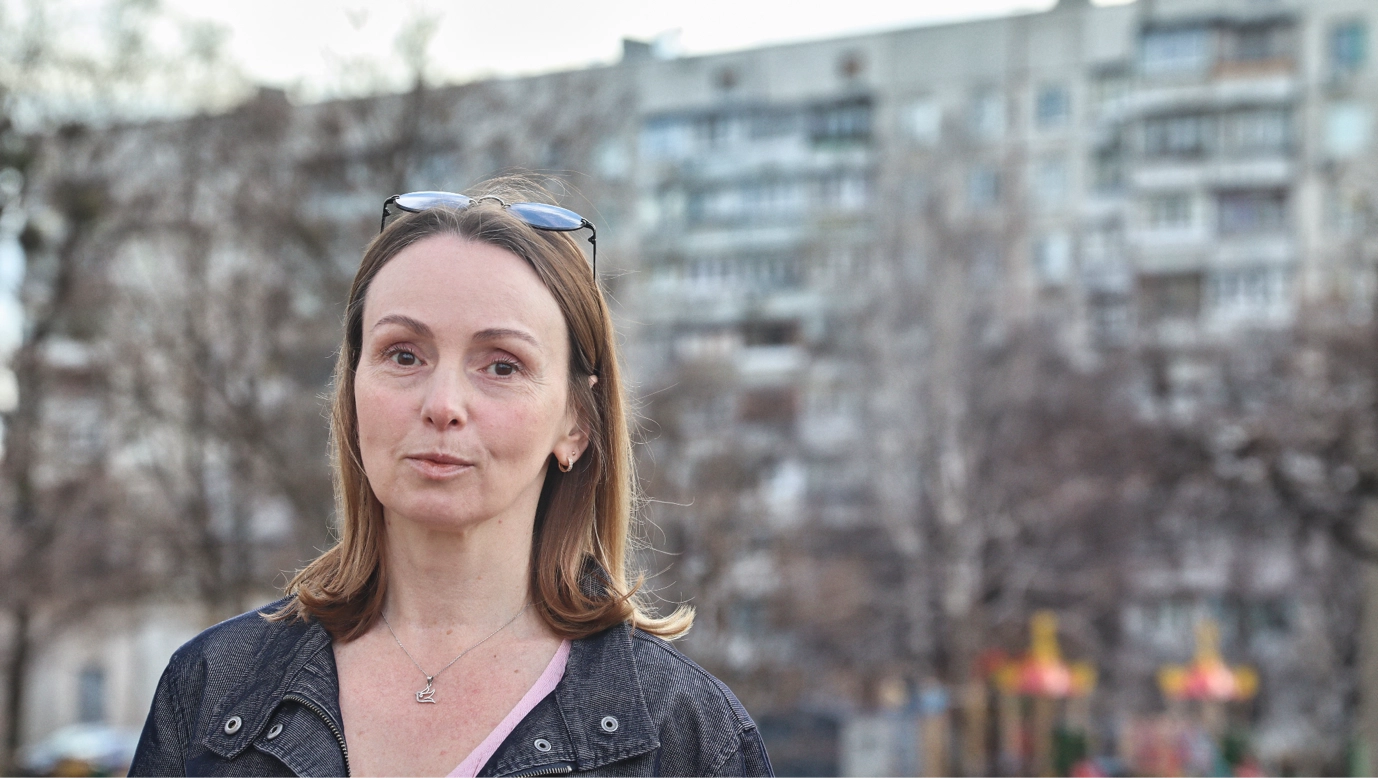
A little later, Nataliya Fesyuk sits at the edge of a small park. Around her, apartment blocks, bare trees, strollers and benches – the quiet markers of an ordinary neighborhood. The air raid siren returns in the background, but nobody around appears surprised. Children run and shout across the playground. At a coffee stand, the woman behind the counter mentions that there are more people in the area than usual today. Not because they came to stare, she says, but because they came to help.
The Ukrainian Air Force confirmed that Russian forces utilized an RS-26 Rubezh medium-range ballistic missile, commonly known as the Oreshnik, to strike the vicinity of Bila Tserkva in the Kyiv region during a massive overnight bombardment on May 24. Fired from the Kapustin Yar test range in Astrakhan, the hypersonic weapon featured multiple separating warheads and anchored a sweeping wave of 690 aerial threats directed primarily at Kyiv.
Where she was meant to be
Nataliya was born in Kharkiv, and speaks with the calm directness of someone who has long stopped separating daily life from war. Her features are soft, but there is a quiet determination in the way she speaks. Before the full-scale invasion, the 47-year-old’s life had taken her far from Kharkiv. She studied programming, though she never worked in the field.
For a time, she lived in Morocco with her former husband, worked as an architect’s assistant and helped with cultural events linked to the Ukrainian embassy. Later, after returning to Ukraine, she worked in real estate and then at a design company. Nothing in her professional background suggested she would one day become part of the human infrastructure holding a wartime city together.
But Kharkiv, she tells me, was always where she was meant to be.
Nataliya Fesyuk in Kharkiv’s Kholodnohirskyi district. Residents had already returned to the area only hours after a Russian drone strike hit the neighborhood. April 2026 (Photo by Korbinian Leo Kramer)
When she came back in late 2019, people told her it was the wrong time to return, that life outside Ukraine would be easier, safer, more predictable. Natalia saw it differently. She says she could not stay away, that she missed Kharkiv and missed Ukraine. “Here is my heart,” she says. “I am where I should be.”
When the full-scale invasion began, Nataliya and her son spent the first three weeks in a shelter. Kharkiv was under heavy shelling, the front line close enough to be felt, and it was unclear in those first days how long the city would hold.
But leaving was never a real option. She remembers that time not as a period of waiting, but of searching. Even underground, she was already intent on being useful. “I was constantly looking for a place to go to help.” While others were trying to get out, she found a way in – into something that would allow her to do more than just endure what was happening around her.
The turning point came almost by accident. Scrolling through Telegram, she came across a message: volunteers were needed near the Palats Sportu. “I just went to the meeting,” she says. “And I stayed.”
“The next road, there were Russians”
What she found was a small, improvised hub, part of what was known as the Humanitarian Center Kharkiv, one of many structures that began to form across the city in those early weeks of the invasion. There was no clear division of roles at the beginning. There was simply need – and people willing to respond to it.
At first, the needs were immediate and basic. Shops were closed, supply chains disrupted, many residents, especially the elderly or those with disabilities, were effectively cut off. Nataliya and other volunteers began assembling food packages, delivering medicine, bringing basic household supplies to people who could not leave their homes.
The work was never limited to civilians. From the first days of the invasion, armed units had to be formed quickly, in whatever way possible, as fighting reached the edges of Kharkiv.
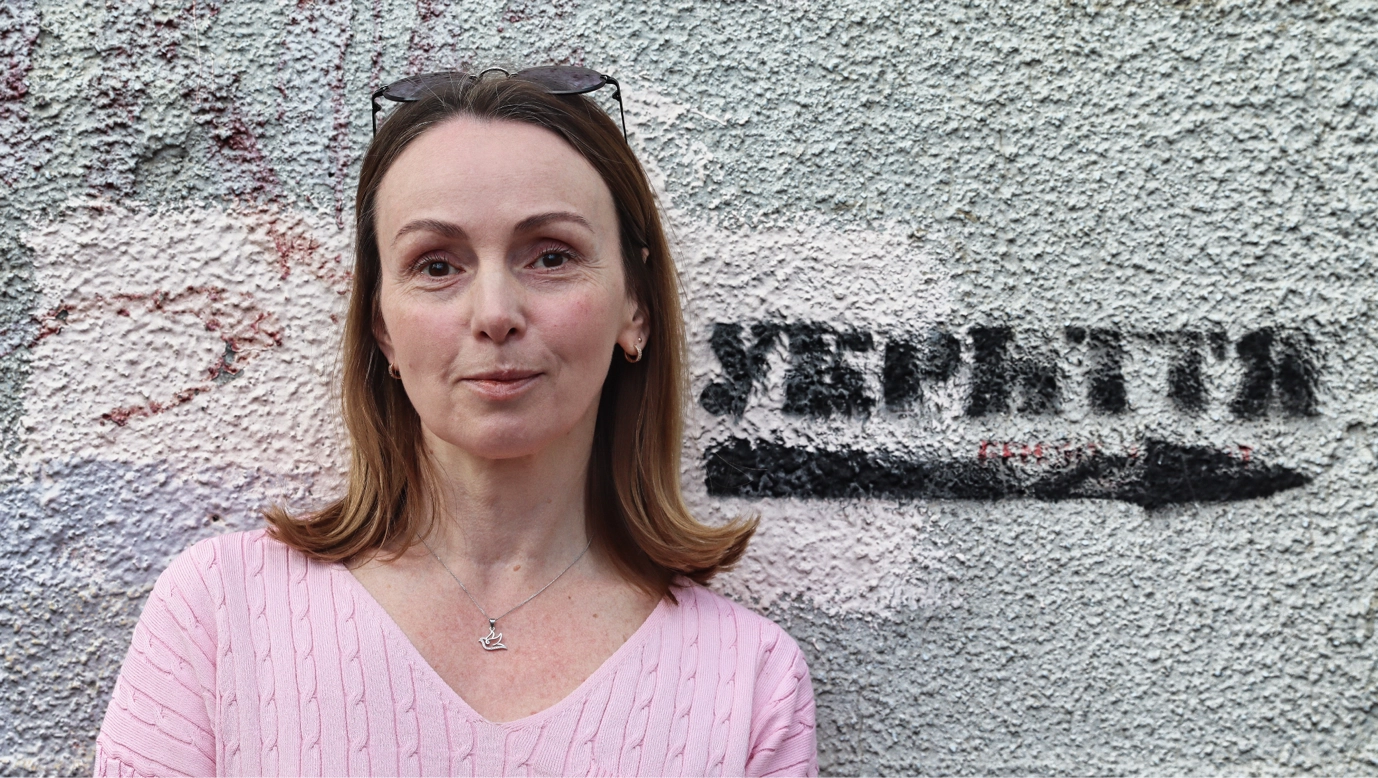
Nataliya Fesyuk in Kharkiv. The word “УКРИТТЯ” (“shelter”) is painted on the wall behind her, pointing toward a nearby bomb shelter. April 2026 (Photo by Korbinian Leo Kramer)
In that situation, she and other volunteers moved between both, delivering supplies where they were urgently needed, often just a short drive from their own neighborhoods. The distances were small, the risk immediate. “At one point, the frontline ran through the city itself,” Nataliya remembers. “The next road, there were Russians.”
To this day, the need for support has not diminished. Nataliya and her colleagues continue to assist military units, providing everyday basics, power stations, medical kits including life-saving tourniquets, and at times even vehicles.
“You just have to listen”
As Ukrainian forces began to regain territory in a series of counteroffensives in late 2022, she was increasingly drawn further. Together with other volunteers, she drove into recently liberated areas in the Kharkiv, Donetsk and Kherson regions. Sometimes, she says, they were among the first to arrive – the first car people saw after months of occupation.
What had started with food, medicine and household goods gradually became something else: people began to tell her what they had lived through. Each visit brought new fragments. “They had to unload it,” Nataliya says.
In Tsyrkuny, just a few miles north of Kharkiv, residents told her how drunk Russian soldiers burst into their homes, pointed weapons at them and asked why they were living “so well” – why they had lights in the streets, toilets and showers inside their apartments.
“They had kept all of this inside. You don’t have to say that everything will be fine. You just have to listen.”
What she heard was often brutal and difficult to process, and it stayed with her long after she had left. There were accounts of women who were raped and killed, of people taken from their homes, tortured, and never seen again, of towns where people died in large numbers while entire neighborhoods were cut off, with no internet and little sense of what was happening just a few streets away.
One story in particular has remained with her. In Vyshneva, a village southeast of Kharkiv, she says, Russian occupiers entered the house where a woman had just given birth to a boy. Pointing at the baby, they said he should be killed because he was “the son of a Ukrop,” a derogatory term used by Russian soldiers for Ukrainians, derived from the Russian word for dill. The child’s grandmother confronted them. Later, Natalia says, the old woman died under unclear circumstances.
“I let it all pass through me, through my heart,” Natalia says. “I came home and I cried.”
Some of the people she met in those early visits are still in touch with her now. What began as humanitarian work had, by then, become something harder to define: not only bringing aid, but remaining close enough to carry the weight of what others were finally able to say aloud.
Living with what returns from war
Over time, the work itself also became more structured – growing out of those early volunteer efforts into a wider network. In 2024, Natalia and her colleagues joined the Ukrainian Security and Cooperation Centre (USCC), an organization originally focused on countering Russian influence, which expanded its role after the full-scale invasion to coordinate support for both civilians and the military. A year later, in 2025, they established their own organization, the Free Ukraine Fund, through which much of their work continues today.
In a warehouse on the outskirts of the city, supplies are prepared for delivery, boxes stacked, equipment sorted, ready to be sent out to where they are needed.
Nataliya has come to see how deeply the war reaches into everyday life – into families, relationships, entire households. Almost no one is untouched.
When soldiers return, she says, they are not the same.
“They are all traumatized when they come back,” she says. Many of them do not know how to live in civilian life. Some become more closed, sometimes more aggressive. Others, she notices, want to go back to the front – because it is the place where everything is clear. For the families, it means learning how to live with someone who has changed. To rebuild trust. To accept silence. “You just have to hear them,” she repeats. “Understand them. Support them. Even just to be silent next to them.”
The weight of waiting
For Nataliya, the hardest part comes earlier: the uncertainty of whether someone will make it back at all. “It’s hard to be far away,” she says. “It’s a constant fear that something may happen.” She describes the hours after a message has been sent, when there is no reply – one hour, two hours, sometimes longer. At some point, she says, you begin to reach out to others, to fellow soldiers, asking if anyone has seen him, heard from him, knows anything.
She searches for the word, then continues.
“You wait. You don’t know if he is alive, if he is wounded or worse.” Her voice changes as she speaks. Tears run down her face.
Her partner was killed near Kharkiv about five months ago. He was an FPV drone operator. During a short break outside his position, a reconnaissance drone detected him. Artillery followed. But for now, she doesn’t want to dwell on it. The pained effort in her face as she resists getting pulled back is visible. Instead, she turns to the women she’s just met.
With many of them having partners, sons or brothers at the front – missing, captured or killed – they share a similar reality. They organize themselves in group chats, staying in touch with others who understand. It is easier, she says, when nothing has to be explained.
The backbone of society
“Women are peacekeepers,” Nataliya notes.
She speaks about the role women take on as the backbone of society, their commitment to soldiers, families, and one another, holding it all together, often quietly, in the background. “At the center of it is empathy,” she underscores. Women create circles of communication, spaces where people can speak, be heard, and hold each other up.
“It is very important to feel the pain of people,” she continues. “Maybe a person doesn’t need something specific. Just a kind word. Sometimes, that is support enough.”
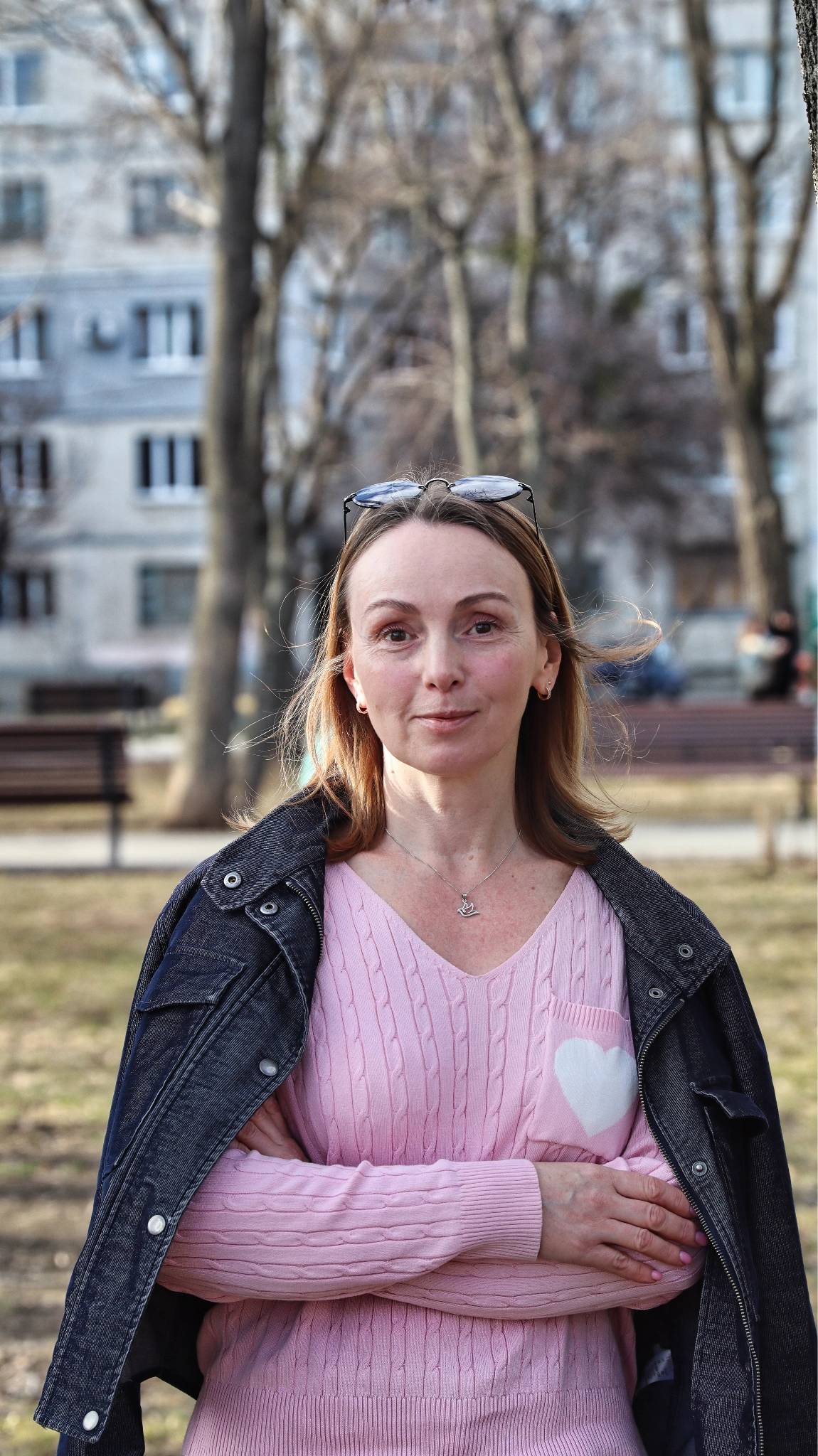
Nataliya Fesyuk in Kharkiv’s Kholodnohirskyi district, not far from the site of a Russian drone strike earlier that day. April 2026 (Photo by Korbinian Leo Kramer)
When Nataliya speaks about Kharkiv now, she does not describe a city that is collapsing under the weight of war. “People have become stronger,” she says. “I see more patience. A different awareness of life has taken hold.”
At the same time, she says, there is no illusion left about how long this will last. In the beginning, many thought the war would end in weeks, maybe months. “Now everyone understands it will not end quickly.”
The rhythm returns
What worries her more is that support from outside has faded. “The war is still going on, people should not forget that. When the military see that someone supports them, it inspires them. They understand they are not alone.”
When she looks beyond Ukraine, she says, it is sometimes difficult to understand the conflicts she sees in countries at peace – the arguments, the divisions, the way people turn against each other. “You have to value the people around you,” she reflects. “It is easy to destroy things, but much harder to rebuild them.”
The sun has come out. As she gets up to leave, the street has already been cleared.
The barriers are gone. People move through the high-rise apartment blocks again, carrying shopping bags and walking their dogs. The burned-out cars have been removed; only dark scorch marks remain on the asphalt. The wooden boards covering the windows are still fresh, but the rhythm has returned.
Kharkiv continues. And so does Nataliya, despite the constant threat from the sky.