China dials back on fuel price hikes to 'reduce burden' on drivers
3 hours ago
Gavin Butler
It comes as countries across the region are taking various measures to weather the soaring cost of fuel.

3 hours ago
Gavin Butler

 Getty Images
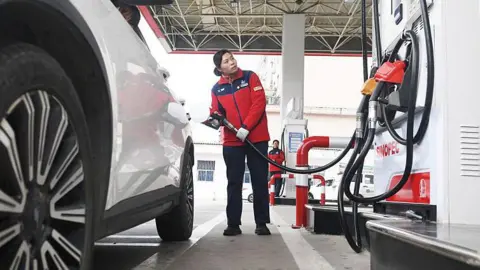
China has dialled back on planned fuel price hikes in a bid to "reduce the burden" on drivers, as energy costs surge amid the Iran war.
The local price of petrol has jumped by about 20% since the start of the conflict, which has seen Iran effectively close one of the world's busiest oil shipping channels, the Strait of Hormuz.
Gasoline and diesel prices were initially set to rise by 2,205 yuan (£239; $320) and 2,120 yuan per tonne respectively – but after government adjustments, the increases will be nearly halved to 1,160 yuan and 1,115 yuan, starting Tuesday.
More than 300 million people in China drive cars that run on petrol or diesel, with Gulf countries a major source of the country's oil.
Long queues of cars had formed outside petrol stations in multiple Chinese cities over the weekend, with some stations having to post notices that they had run out of fuel.
The latest price hike was the country's fifth and largest of the year so far - even with the reduction.
On Tuesday, the price of Brent crude oil jumped above $100 a barrel - a day after prices plunged, as conflicting accounts of potential talks between US and Iran emerged.
Beijing has over the years taken advantage of lower crude prices and the abundance of supply from Gulf states to build one of the world's biggest oil reserves, Ole Hansen, Saxo Bank's head of commodity strategy, told the BBC last week.
In January and February of this year, Beijing bought 16% more crude compared to the same time period a year earlier, according to its customs administration.
Iran, whose oil is sanctioned by the US, has been a key supplier of cheap crude for China, with reports suggesting that Beijing buys more than 80% of Iran's oil exports.
Hansen said that estimates show China has built up reserves of around 900 million barrels - just under three months' worth of imports. Figures from Columbia University, cited by Chinese state media, said China had petrol reserves of some 1.4 billion barrels.
Despite its reserves, Beijing has shown signs of caution to manage its supplies in the short-term.
Authorities in China reportedly ordered its oil refineries to temporarily cease fuel exports, in an attempt to keep domestic prices under control. China's government did not respond to BBC queries on the matter.
Barrels from Saudi Arabia and Iran account for more than 10% of its imports each, according to the US Energy Information Administration (EIA).
"To mitigate the impact of abnormal increases in international oil prices, ease the burden on downstream users and ensure stable economic operations and public welfare, temporary regulatory measures have been adopted," China's state planner said in a statement on Monday.
The price hikes were implemented by the National Development and Reform Commission (NDRC), which reviews petrol and diesel prices every 10 days and adjusts based on global prices of crude oil.
Other countries across Asia have also implemented a range of cost-cutting measures to help cushion the blow of soaring global energy prices.
Government employees in the Philippines have been ordered to work four days a week, Sri Lanka has declared every Wednesday a holiday for public institutions, and Thailand and Vietnam have encouraged citizens to work from home in an attempt to conserve fuel.
Thai civil servants have also been ordered to suspend overseas trips, wear short-sleeve shirts to work and use stairs instead of lifts.
Sri Lanka's private bus services ground to a near standstill on Monday after operators went on strike demanding a fare revision to pay for rising fuel costs.
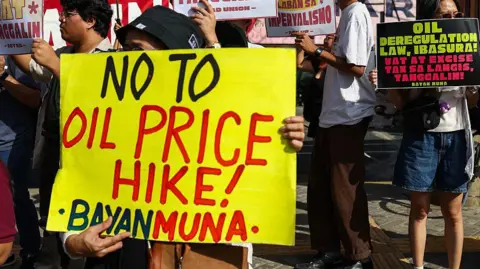
In the Philippines, more than 20 transport groups have similarly declared a strike from March 26 to 27 to demand government action on rising fuel prices.
 Getty Images
Japan and South Korea have been particularly affected by the Iran conflict, as they are heavily dependent on oil and gas that would normally pass through the Strait of Hormuz.
Gasoline prices in Japan reached a record high last week, with the average retail price of gasoline climbing to 191 yen (£0.90; $1.20) per litre on Monday, according to data from the country's economy ministry - an 18% increase from a week earlier.
South Korean President Lee Jae Myung on Tuesday said public institutions would cut back on their use of passenger cars.
On Monday, Lee's office announced that he had scrapped plans to attend an international forum in China so that he could stay in South Korea to "lead the emergency economic response directly and make swift decisions at this juncture".
Additional reporting by Osmond Chia

Australia and the EU sign sweeping trade and security deals after years of negotiations.

A Japanese person who claimed to be an active officer of Japan’s Self-Defence Forces illegally and forcibly entered the Chinese embassy in Tokyo, Beijing said. “China is deeply shocked by this incident and has lodged a strong protest with Japan,” Beijing’s Ministry of Foreign Affairs said on Tuesday

US biopharmaceutical company Gilead Sciences agreed to buy Ouro Medicines, which is developing an antibody-based medicine for autoimmune diseases licensed from China’s Keymed Biosciences, in a deal worth up to US$2.18 billion. Gilead Sciences is among a group of global drug makers facing patent expi

In a trip to Xiongan New Area, Chinese President Xi Jinping has called for the area to be transformed into an innovation hub to spark high-quality development in a project intended to take pressure off China’s capital, Beijing. It was the president’s first inspection tour to the “city of the future”