
The Italian Navy is preparing to acquire the Bayraktar TB3 unmanned combat aerial vehicle (UCAV), marking a new step in expanding its carrier-based unmanned aviation capabilities. The announcement was made by Chief of the Italian Navy, VAdm Berutti Bergotto, during his first parliamentary hearing since taking command on 6 November 2025.
Speaking before the Italian Senate’s Foreign Affairs and Defence Committee on 25 March, VAdm Berutti Bergotto confirmed that the service is moving forward with the Baykar-developed TB3 system, which is expected to operate from the aircraft carrier Cavour.
“You know that this company has signed a cooperation agreement with Leonardo; therefore, the acquisition will be through Leonardo. It can be integrated on board the Cavour (aircraft carrier). This allows both surveillance and the possibility of carrying armament,” he said.
While the admiral names it as Leonardo, the TB3 Bayraktar can be available via LBA Systems, a strategic joint venture established by Italian industry giant Leonardo, and Turkish drone manufacturer Baykar, which bears the title of the largest unmanned combat aerial vehicle (UCAV) exporter worldwide. The statement provides the clearest indication to date that Italy intends to integrate a fixed-wing UCAV into its naval aviation component, complementing existing manned aviation assets and rotary-wing platforms.
TB3 to Expand Italian Navy’s Unmanned Capabilities
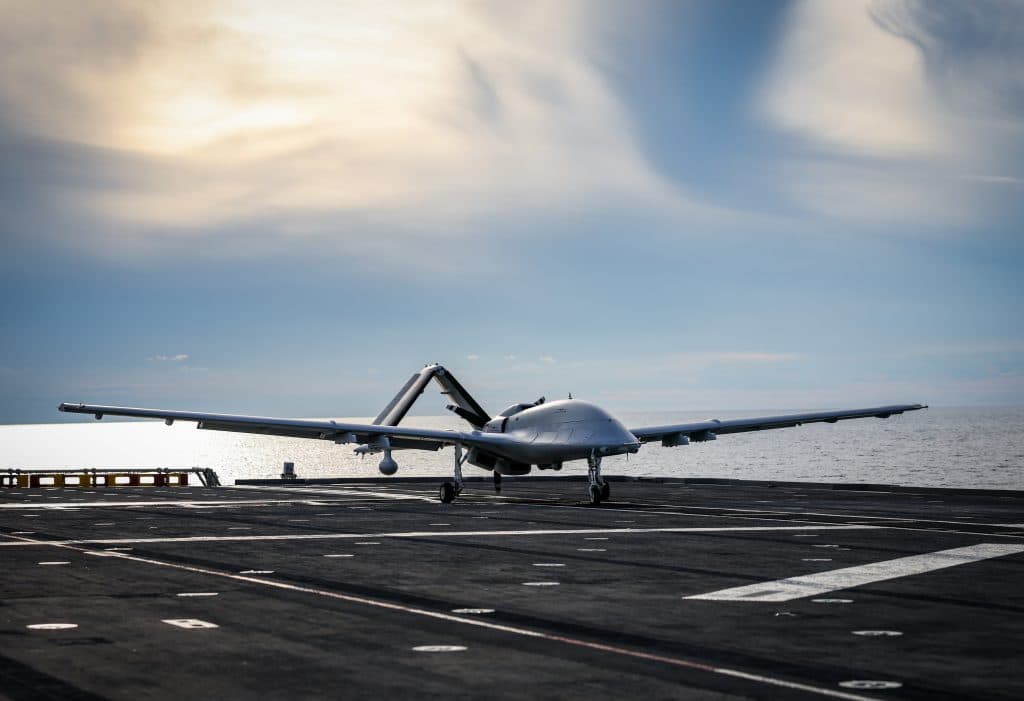
With this move, Italy is set to become the first European customer of the TB3, a navalised evolution of the widely exported Bayraktar TB2. The TB2 has seen extensive operational use and has been exported to more than 30 countries worldwide. The TB3 builds on that experience, incorporating features tailored for maritime and expeditionary operations, including the ability to operate from short-deck aircraft carriers.
Indonesia was previously announced as the first export customer of the TB3, with plans to procure both land-based and shipborne variants. Italy’s selection of the platform underscores growing European interest in operational UCAVs capable of carrier deployment.
The TB3 has been developed specifically for operations from short take-off carriers such as Türkiye’s TCG Anadolu. The platform features folding wings to optimize deck handling and storage, along with reinforced landing gear and systems adapted for maritime environments.
Recent demonstrations by the Turkish Navy have highlighted the TB3’s operational potential at sea. During NATO’s Steadfast Dart 2026 exercise, TB3 UCAVs were deployed from TCG Anadolu, showcasing capabilities including intelligence, surveillance, reconnaissance (ISR), and strike roles.

The integration of a similar capability aboard Cavour would represent a notable evolution for the Italian Navy, which already operates F-35B short take-off and vertical landing (STOVL) fighters from the carrier.
The TB3 announcement was made in the broader context of the Italian Navy’s expanding unmanned systems portfolio. VAdm Berutti Bergotto outlined ongoing and recent acquisitions aimed at enhancing maritime surveillance and strike capabilities. Among systems already in service, the Navy operates the ScanEagle UAV aboard FREMM-class frigates. In addition, the Navy Chief revealed the recent acquisition of a new vertical take-off and landing (VTOL) unmanned system capable of more than traditional ISR missions.
“We have acquired them recently. It is a system that extends the surveillance capability of naval units; it is quite small and easily integrable. The interesting thing is that it can release a drone that effectively becomes a munition and can go and strike the target,” he noted.
The VTOL platform, identified through accompanying material as the “Revolution” drone from Italian company General Defence, introduces a loitering munition capability deployable from a host UAV. This reflects a broader trend in naval warfare toward distributed and layered unmanned systems.
Turkish-Italian Partnership

The acquisition route through Leonardo highlights the growing industrial cooperation between Italy and Türkiye in the unmanned domain. Baykar and Leonardo signed a cooperation agreement aimed at integrating technologies and facilitating market access, particularly within Europe.
The introduction of the TB3 aboard Cavour would provide the Italian Navy with an organic fixed-wing unmanned strike and ISR capability at sea. This could enhance situational awareness, extend operational reach, and reduce reliance on manned sorties for certain mission profiles.
The TB3 is capable of carrying precision-guided munitions and conducting long-endurance missions, making it suitable for roles such as maritime surveillance, targeting, and small strike operations. According to previous reports, the platform has successfully conducted live-fire tests with indigenous munitions.
For the Italian Navy, integrating such a system alongside F-35Bs could enable a more flexible and layered approach to carrier air wing operations, combining high-end manned assets with cost-effective unmanned platforms.
Looking Ahead
While timelines and quantities have not yet been disclosed, the announcement signals a clear intent to incorporate advanced UCAV capabilities into Italy’s naval aviation. The TB3, if integrated successfully, would position the Italian Navy among a small but growing group of navies operating fixed-wing unmanned systems from aircraft carriers.
As naval forces continue to adapt to evolving operational requirements, the combination of carrier-based fighters, rotary-wing assets, and unmanned systems is likely to define the next phase of maritime air power. Italy’s planned acquisition of the TB3 represents a step in that direction.
