Latvia begins transfer of Scimitar light tanks, Spartan APCs to Ukraine
Latvia has already begun delivery of CVR(T) armoured combat vehicles to Ukraine, understood to be the Spartan or Scimitar variants.
Army Technology
75
4 min read
0 views
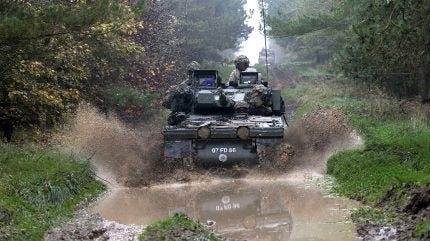
Latvia obtained its fleet of more than 200 Scimitar light tanks and Spartan APCs from the UK, beginning in the mid-2010s.
In 2022 170 Scimitars were in British Army service, but the fleet was axed in 2023. Credit: UK MoD/Crown copyright
Latvia has started transferring CVR(T) tracked armoured vehicles to Ukraine to equip a battalion-level unit
Ukraine stresses funding shortages; Latvia previously pledged 0.25% of GDP annually and the EU recently approved a €90bn support package
Latvia operates CVR(T) variants like Scimitar/Spartan; Ukraine’s existing CVR(T) fleet has seen combat losses
Ukraine has announced that Latvia has begun the transfer of a batch of Combat Vehicle Reconnaissance (Tracked) – also known as CVR(T) – armoured fighting vehicles as part of ongoing military assistance, with deliveries having “already started” according to Kyiv.
Detailed in a 25 March statement, the Ukrainian Ministry of Defence said that vehicles were intended for the equipping of a “battalion-level unit”, detailed as part of a visit by the Latvian Minister of Defence Andris Sprūds with his Ukrainian counterpart, Mykhailo Fedorov
Typically, a Ukrainian battalion comprises three companies led by a headquarters element, totalling around 500 personnel. However, due to the ongoing war, it is not known whether such formations still retain relative uniformity from one unit to the next, depending on combat losses and mission requirements.
During the meeting, Ukraine thanked Latvia for its “comprehensive support”, including a decision by the government in Riga to provide 0.25% of its GDP annually to Kyiv, with funding vitally important as Ukrainian forces continue to defend against Russian forces.
The visit was cut short following reports that Ukrainian drones had struck locations inside Latvia and Estonia, having travelled through Russian airspace. The cause is not known, however with the vast amounts of electronic warfare employed by Russian forces, the Ukrainian drones could have been spoofed or else malfunctioned and flew off course.
Ukraine needs funding: Zelenskyy
Meanwhile, the need for funding was made by Ukrainian President Volodymyr Zelenskyy, in a statement separate from the Latvian visit, where he stated that finances were “the scarcest resource today”, as the country’s defence industry operates at half capacity due to insufficient resources.
The United States has reached out to us regarding their bases in Middle Eastern countries. We’ve also been approached by Saudi Arabia, Qatar, the United Arab Emirates, Bahrain, Jordan, and Kuwait.
We’re already working with some of them, and our expert teams are already on the… pic.twitter.com/1y4HsvfU69
— Volodymyr Zelenskyy / Володимир Зеленський (@ZelenskyyUa) March 26, 2026
With the United States drawing down on its military support to Kyiv, and any financial packages now contingent on access to minerals and other resources inside Ukraine, the European Union has had to bear the brunt of providing fiscal aid.
In February 2026, the European Parliament approved a €90bn ($104bn) loan package for Ukraine to support its economy and defence through 2026–2027. The package is split into €60bn for military equipment/defence capabilities and €30bn for financial assistance.
However, pro-Russian EU member states such as Slovakia and Hungary have hampered the bloc from committing its full intended package of resources to Ukraine, leading to a shortfall in fiscal availability.
CVR(T): the last great British armoured programme
Although the Ukrainian announcement on the provision of CVR(T) platforms does not mention Scimitar light tank or Spartan armoured personnel carrier (APC) by name, Latvia is known to operate a fleet of around 200 of the CVR(T) variants, according to fleet inventory data gathered by defence intelligence firm GlobalData.
These platforms were obtained from 2015-2022 from the UK which was in the process of retiring its own fleet of CVR(T) vehicles. Early on in the Ukraine-Russia war, the UK donated much of what remained of its Scimitar light tanks and other CVR(T) vehicles held in storage.
Developed during the Cold War, the CVR(T) family comprised a fleet of lightly armoured vehicles fulfilling a range of duties on the battlefield, including: FV101 Scorpion (light tank), FV102 Striker (anti-tank), FV103 Spartan (APC), FV104 Samaritan (armoured ambulance), FV105 Sultan (command), FV106 Samson (armoured recovery), and FV107 Scimitar (reconnaissance light tank).
Although lightly armoured, the Scimitar was a successful platform, widely praised for its reconnaissance capabilities and manoeuvrability. Differentiated from the FV101 Scorpion through the intention of a high velocity 30mm main gun, instead of a low velocity 76mm, the Scimitar light tanks served in the British Army from 1973 -2023.
The UK retains a small number of the Stormer SHORAD sub-variant of the CVR(T), recently confirming their deployment to Cyprus in a belated defence of a British base in Cyprus.
According to open-source intelligence provider Oryx, Ukraine’s CVR(T) fleet has seen significant amounts of combat, if based on platform losses, which includes 39 FV103 Spartan; two FV104 Samaritan; three FV105 Sultan; and one FV107 Scimitar.