18 hours ago
Flora Drury
A statement says "significant progress" has been made into investigating the crash, in which 260 people died a year ago.

18 hours ago
Flora Drury

 EPA
EPA
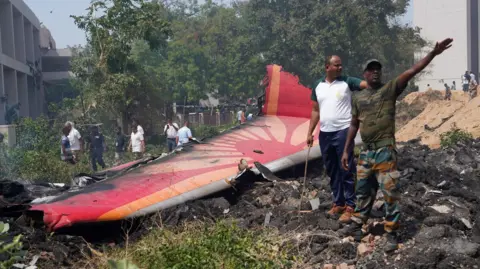
Investigators looking into the cause of the Air India crash that killed 250 people say they are not yet ready to release their final report.
India's Aircraft Accident Investigation Bureau (AAIB) released an update on Friday, the first anniversary of the disaster, saying "significant progress" had been made in the analysis of evidence relating to the crash but that this was ongoing.
It gave few other details, including when the final report might be released.
The exact cause of the Boeing 787 Dreamliner crash shortly after taking off from Ahmedabad en route to London on 12 June 2025 has been the subject of widespread speculation.
The plane came down about 6km (3.7 miles) from the airport, crashing into a building used as doctors' accommodation at the Byramjee Jeejeebhoy Medical College and Civil Hospital and causing an explosion.
It left 19 people dead on the ground, as well as killing 241 on board. Of the passengers and crew killed, 169 were Indian nationals and 53 were Britons.
One person survived - Viswashkumar Ramesh, from Leicester.
"Over the past year, the investigation team has undertaken an extensive and rigorous examination of all relevant technical, operational, organisational and human factors associated with the accident," the AIIB said in its latest statement.
"Significant progress has been made in the examination and analysis of aircraft systems, flight recorder data, engine-related components, maintenance and operational records, and other evidence relevant to the investigation.
"The evidence gathered and the results of various examinations are currently being analysed in a comprehensive and integrated manner."
It went on: "The Final Report will be released upon completion of all investigative activities and the requisite international review and consultation processes," adding: "Every aspect of the accident will be examined with the utmost care and diligence."
The statement, which extended the AIIB's condolences to the "families and loved ones" of the deceased, emphasised the fact that the "sole purpose of an accident investigation is to enhance aviation safety through the identification of lessons and safety recommendations, and not to apportion blame or liability".
The AIIB was required to provide an update on the anniversary of the crash in line with international aviation rules.
There had been widespread doubt that its latest report would be conclusive. In May, India's civil aviation minister muddied the waters when he told reporters the investigation into the crash was into its "last stage", and that the final report would "mostly... come after a month".
A preliminary report was published on 12 July last year, finding that just seconds after take-off, fuel-control switches abruptly moved to the "cut-off" position, starving the engines of fuel and triggering total power loss.
Audio recordings from the cockpit captured one pilot asking the other why he had done it, with the other replying that he had not. Investigators did not identify which pilot made either statement.
In the days following its release, attention turned to the pilots. The Wall Street Journal and news agency Reuters reported that new details in the investigation were shifting attention towards the senior pilot in the cockpit - Capt Sumeet Sabharwal.
"A cockpit recording of dialogue between the two pilots of the Air India flight" that crashed last year supported the view that the "captain cut the flow of fuel to the plane's engines", the Reuters report said, citing unnamed sources.
The media reports prompted a strong backlash from pilots' associations in India, which criticised the coverage and rejected suggestions that the senior pilot had caused the crash, as well as the AAIB.
"You see, every time an accident takes place, the pilot is blamed. Why? It's the simplest way to close the chapter. He is no more and cannot defend himself," Pushkar Raj, who is in his 90s, said.

Peace and stability in the Taiwan Strait needs a “joint answer” from people on both sides, Beijing’s top Taiwan affairs official said on Saturday. “As profound changes unseen in a century accelerate across the world, the international landscape is becoming increasingly turbulent and complex, the sit

China activated the world’s first three-band optical fibre communication system early this month, technology that its developers say could expand the carrying capacity of future AI networks. According to the project team, a single fibre can carry more than five times the traffic of conventional syst

In an era of naval warfare defined by air superiority, precision missiles and autonomous drones, China’s navy appears to be bringing back the “big guns”. A new naval gun system is said to be in development which takes 155mm, or 6.1-inch, artillery shells. That would make it the largest of its kind i

The Philippines’ confrontational approach to maritime territorial disputes, such as its championing of the 2016 South China Sea arbitration ruling, has not only failed to resolve regional tensions, it also risks undermining Asean centrality. In May, addressing Japan’s National Diet, Philippine Presi