Raytheon repackage Next Gen Jammer for land and sea
Raytheon will repackage the the Next Generation Jammer, used on Growler aircraft, to protect land and sea assets.
Army Technology
75
5 min read
0 views
The non-kinetic effector, typically found on US and Australian Growler aircraft, may begin to protect surface assets.
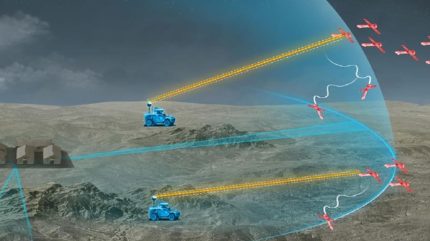
Pictured is a representation of the non-kinetic effects of the Raytheon Surface Electronic Attack system. Credit: Raytheon.
The RTX business will soon introduce the Raytheon Surface Electronic Attack System
This concept repackages the Next Generation Jammer (NGJ), used on Growler aircraft, to protect land and sea assets
Not yet in the field, Raytheon executive Chuck Angus said the company will likely demonstrate the weapon system in Q3 2026
Raytheon plans to adapt its airborne NGJ pods to protect land and sea based assets.
The saturation of uncrewed aerial systems (UAS) offer the launcher unprecedented reach of targets, often demonstrated with lethal effect in Ukraine and the Gulf. As the threat continues to grow, Raytheon’s electronic attack capability could be used to down them.
Discover B2B Marketing That Performs
Combine business intelligence and editorial excellence to reach engaged professionals across 36 leading media platforms.
Find out more
The Raytheon Surface Electronic Attack System (RSEAS), as the modified system is known, is already a “very mature system” insists Chuck Angus, a business development executive for Raytheon. The NGJ has already been in service for over a year on US Navy EA-18G Growler aircraft.
In fact, Growlers were deployed in the Middle East over the past two months during Operation Epic Fury. The Navy tasked the fleet to suppress Iranian air defence systems, which Army Technologyassessed in depth at the outset of the conflict.
Likewise, the Royal Australian Air Force – an NGJ production partner and Growler operator – has officially received its first pods today (20 April), according to the prime. The company will also provide on-site deployment and maintenance support in Australia.
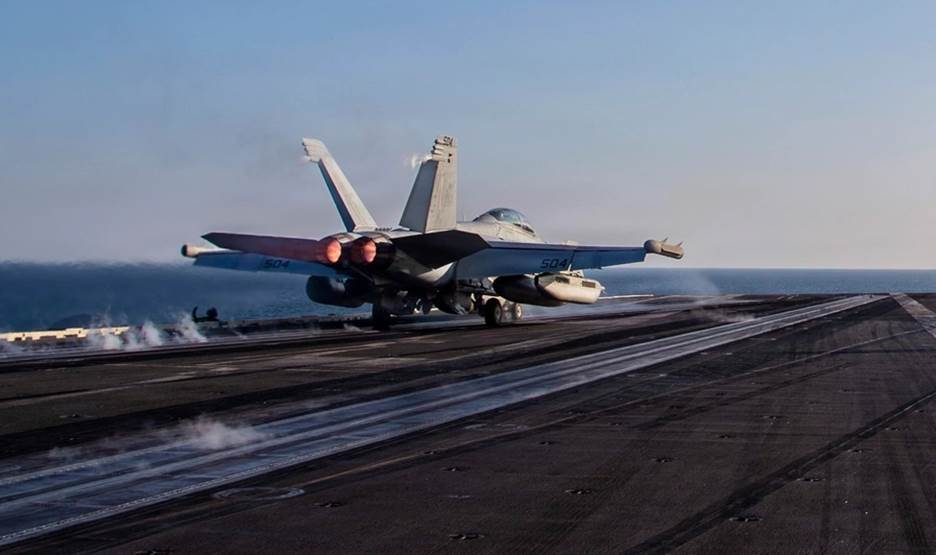
American Growler launches from the flight deck USS Abraham Lincoln (CVN 72) in support of Op. Epic Fury at an undisclosed location, 3 March 2026. Credit: DVIDS.
Raytheon Surface Electronic Attack System
But now, the 6×6 foot RSEAS unit may be used to protect surface assets such as outposts or ships at sea. It does not require a dedicated electronic warfare aircraft like a Growler; the system is a standalone electronic attack unit.
“Whether it’s against weapons, as in missiles or drones, it’s mobile, it’s transportable, and it uses very little [else] other than the high powered AESA radars and some [commercial off-the-shelf] equipment,” Angus envisaged.
“We currently have a demonstrator that is in our lab that sits on a cart with the right power and cooling,” he continued, and all this is controlled from a laptop.
Raytheon is in talks with unspecified potential customers who, Angus said, are particularly interested in the concept. He later noted that Raytheon has not explored international export opportunities at present.
When asked whether Raytheon is concerned about Europe’s newfound policy of strategic autonomy, largely due to political disrust with the capricious US administration, Angus explained that it is still easier and cheaper to adopt a proven system than developing a similar albeit sovereign system:
“I think that they would find themselves in a budget and schedule [that] does take a lot of investment to create a system like this, and it would take you a long time to get it.”
But this has not stopped European countries from developing their own systems. For example, the UK developed a radio frequency directed energy weapon with an effective range of up to one kilometre and a cost of ten pence per engagement.
US and allies require mobile C-UAS
In October 2025, this reporter found various industry players working together at the AUSA exhibition in Washington to deliver cohesive and mobile counter drone (C-UAS) systems – each comprising a range of sensors, deciders and effectors from different suppliers – all mounted on a light vehicle.
This industry trend has become fashionable as military tactics, techniques and procedures indicate a need to protect forward deployed assets with mobility and a desired effect determined by the nature of the threat in the moment.
In this sense, a ground-based electronic attack capability like RSEAS provides an effect that can pre-empt a threat “at its earliest stage,” Angus explained without specifiying the range of the weapon.
Adversarial tactics frequently take the form of hybrid salvos as Iran has demonstrated against US and UK military bases in the region. In this backdrop, allies are learning to protect their interests across a theatre of war.
The UK, whose cash-strapped Government were slow to respond, did eventually deploy C-UAS equipment like Rapid Sentry and ORCUS with notable success. Forces had scattered systems among its remaining bases in the Near East but also deployed to protect regional partners Bahrain, Iraq and Kuwait.
Soon American forces will need to deploy critical assets disaggregated across various island territories when the US eventually pivot to the Pacific theatre to contend with China’s military aggression. This includes crucial sources of power generation such as micro nuclear reactors which are currently in production.
American success in a prospective conflict with China will live and die with the security of its logistics and C-UAS capabilities will be a crucial means of protection.