
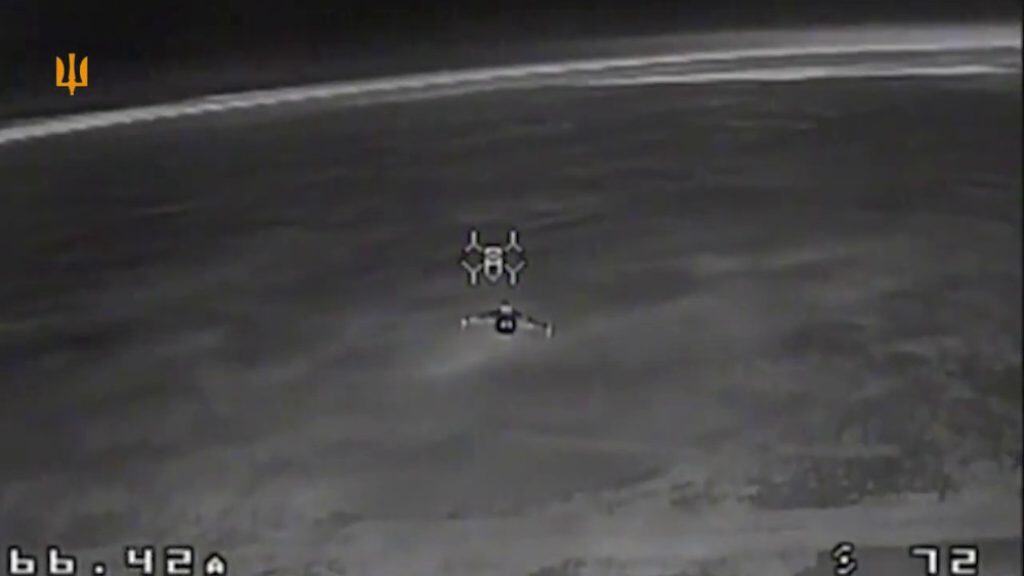
Years of Russian bombardment with Iranian drones have provided Ukraine with unparalleled experience in finding cost-effective ways to counter these weapons. Now, that hard-won expertise may be about to find a new purpose. Ukrainian President Volodymyr Zelenskyy says he plans to send Ukrainian technology and personnel to the Middle East to help America and its allies combat Iranian drones.
When the United States and Israel launched their attack on Iran on February 28, Tehran quickly began firing missiles and long-range one-way attack (OWA) drones at military and civilian targets across the region. By March 3, the Iranians had launched over 500 ballistic missiles and 2,000 unmanned aerial systems (UAS), according to US Central Command (CENTCOM). Iran’s ballistic missile launch rate has cratered since the war’s first day, thanks in large part to US and Israeli strikes on Iranian launchers. However, its drone launch rate has remained robust.
While the United States and its allies have intercepted the vast majority of these projectiles, the Pentagon reportedly acknowledges that OWA UAS have proven to be a greater challenge than anticipated. This has left the US military scrambling to bolster its counter-UAS capabilities in the region.
In many cases, US and allied forces seem to have lacked adequate point defenses to shoot down Iranian drones that slip past fighter jets and other air defenses. A strike in Kuwait killed six American servicemembers. OWA UAS have damaged valuable military assets, including satellite communications equipment at the US Fifth Fleet’s headquarters in Bahrain. Drones have also struck diplomatic, economic, and residential sites.
One of Iran’s workhorses is the Shahed-136, a propeller-driven delta-wing drone designed to attack fixed targets up to around 2,000 kilometers away. To Ukrainians, the Shahed-136 is all too familiar. The Islamic Republic began supplying those drones to Russia in the summer of 2022, offering Moscow a relatively inexpensive way to augment its long-range strike capabilities. With Iranian help, Russia later began producing modified variants itself—and in larger quantities. The Russians were churning out some 2,700 drones per month by mid-2025, according to Ukrainian intelligence.
Relying on expensive interceptor missiles to quickly shoot down Shaheds proved unsustainable. The Ukrainians needed more cost-effective solutions. Over time, they developed a layered system that includes aviation, electronic warfare, and mobile fire teams typically armed with pickup-mounted machine guns. Those teams, coordinated through a digital common operating picture that fuses data from radar and acoustic sensors, were eventually shooting down the lion’s share of Russia’s Shahed-type drones. With these adaptations, Ukraine put itself on the right side of the efficiency curve.
However, the Russians adapted, as well. They made technical and tactical changes that rendered Ukraine’s mobile fire teams and electronic warfare tactics less effective as Russian drone production soared. In response, the Ukrainians increasingly turned to interceptor drones — inexpensive UAS designed to take down other drones that are located by radar. These systems reportedly accounted for more than 70 percent of the Shahed-type drones destroyed over Kyiv and its environs last month. While the winter weather in Ukraine has been challenging for these systems, this factor will not be an issue in the Middle Eastern climate.
As Iranian missiles and drones began flying across the Middle East, Zelenskyy quickly offered to share Ukraine’s counter-UAS expertise. On March 1, UK Prime Minister Keir Starmer declared that London would “bring experts from Ukraine, along with our own experts, to help Gulf partners shoot down Iranian drones attacking them.”
Starmer may have jumped the gun, as the next day, Zelenskyy said Kyiv had not “received any direct requests from Britain” or other countries. However, he reiterated his willingness to share relevant information and technologies. In an interview with Bloomberg, the Ukrainian president suggested that Ukraine could send its “best operators of drone interceptors to Middle East countries” if those states could convince Moscow to accept a “month-long ceasefire.”
After discussing the Iranian drone threat with Middle Eastern counterparts on March 3, Zelenskyy said their teams would “determine how, together, we can provide stronger protection.” The next day, he asserted that both Middle East countries and the United States had requested Ukrainian “expertise” and “practical support” in countering Iranian drones.
Zelenskyy announced that he had directed Ukrainian officials “to present options for assisting the relevant countries” without undermining Ukraine’s own defenses. “Ukrainian experts will operate on-site, and teams are already coordinating these efforts,” he said. The Ukrainian leader later affirmed that in response to a US request, Kyiv would “provide the necessary means” and send “Ukrainian specialists” to the region to help combat OWA UAS.
Zelenskyy has also suggested that Ukraine could “exchange” interceptor drones for much-needed Patriot air defense missiles. While Washington and its Middle Eastern allies are unlikely to bite at that idea, the Financial Times reported that the “Pentagon and at least one Gulf government are in talks to buy Ukrainian-made interceptors.” Some NATO members, including the United States, have recently begun experimenting with interceptor UAS of various types. These include an AI-enabled system called “Merops,” which is backed by former Google CEO Eric Schmidt and has seen extensive action in Ukraine.
In all likelihood, the United States will face OWA UAS like the Shahed-136 not only in the Iran war, but in future conflicts, as well. Bringing battle-tested Ukrainian technologies and operators into the current fight could provide a unique opportunity for the US and its allies to learn from Ukraine’s unmatched experience in defeating these weapons.
John Hardie is the deputy director of FDD’s Russia Program and a contributor to FDD's Long War Journal.
Tags: Iran, Iranian drones, Operation Epic Fury, Operation Lion’s Roar, Russia vs Ukraine, ukraine, US-Iran


