
Contained within the Fiscal Year 2027 budget documentation, the U.S. Navy has laid out it’s plans for the new FF(X) program, seeking to rapidly field a new class of smaller surface vessels with the launch of the first Frigate taking place in the first Quarter of Fiscal Year 2029 (late calendar year 2028).
Following the first FF(X)’s launch due in Quarter 1 FY 2029, the vessel is planned to be delivered by the end of Quarter 3 of Fiscal Year 2030 (April-June of calendar year 2030). If the FF(X) program adheres to this timeline, it would make one of the shortest delivery timelines in recent U.S. Navy history, with the first vessel of the class delivered ~4 years after program start.
In order to accomplish such a tight timeline by U.S. shipbuilding standards, the Navy plans for the prime contractor in Huntington Ingalls Industries (HII) use components from the cancelled 11th ship of the Legend-class of coast guard cutters, from which FF(X) is derived. The usage of the Legend-class as a basis has likely truncated the timelines across the board due to the similarity of the vessels allowing for the the initial design process and construction to take as little time as possible.
Funding for the program in FY 2027 is listed at ~$1.429 billion U.S. dollars to go directly towards the procurement of the lead ship, alongside an addition $212 million earmarked for further research and development. Most of the Research and Development funding is slated to go towards validating ship systems (including combat systems), future test planning, integration work regarding modular payloads as well as USVs, and design studies in regards to the second flight of the frigates.
The FF(X) Flight 2 Question
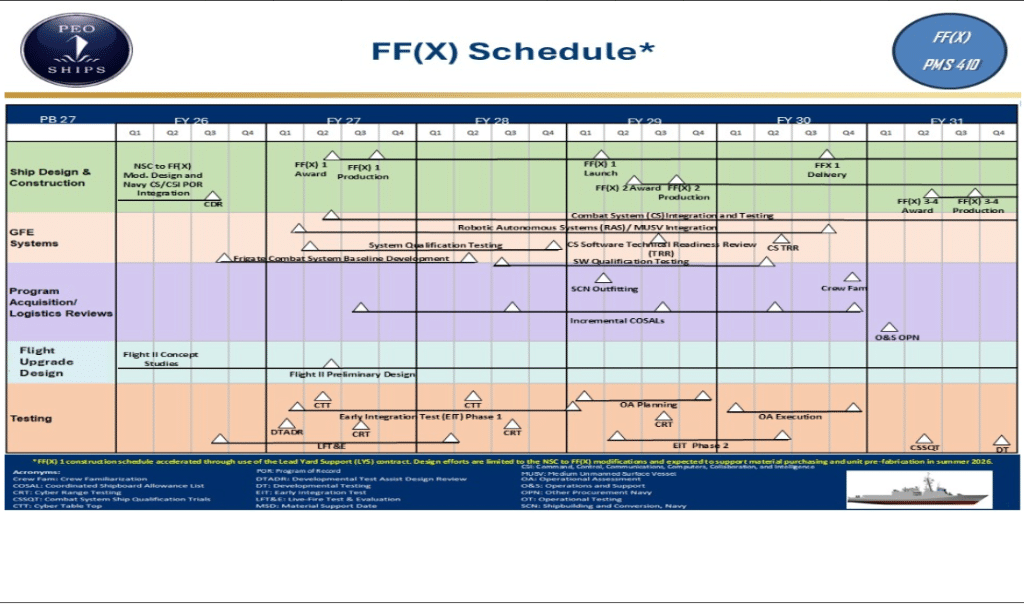
Design work in regards to flight 2 of FF(X) has already been initiated, with the flight 1 configuration to make up at least the first two vessels. These 2 (or more) ships will have as little modifications from the National Security Cutter baseline as possible to reduce production time, with the main differences being the installation of a Rolling Airframe Missile launcher for point defense, the addition of an SPS-77 variant air search radar, and the repurposing of the stern boat ramp to enable carriage of containerized payloads.
Inquiries into potential designs for Flight 2 are already listed by the Navy as being underway. The U.S. Navy stated in it’s research and development budget documents for FY 2027 it is already considering the addition of Vertical Launching Systems (VLS) into the design itself, rather then relying on the usage of containerized payloads for the ship’s main armament.
The addition of VLS cells would enable the Frigate to internally carry a large swathe of the Navy’s standard munitions such as the Evolved Sea Sparrow Missiles (RIM-162 ESSM), SM-2, and SM-6 series surface to air missiles, as well as the RUM-139 Vertical Launched Anti Submarine Rocket (VL-ASROC). The stated rationale is to better allow the Frigates to be flexible, enabling their usage beyond the stated low-end engagements the Flight 1 variant is targeted towards.
Anti-Submarine Warfare is also of particular concern, with the U.S. Navy also looking into the potential integration of innate Anti-Submarine warfare systems into FF(X)s architecture. 55-60 FF(X) frigates are planned, with a majority likely being of an upgraded standard with enhanced ASW and AAW capabilities.

