Why $20 durians are now being sold at half price - or given away for free
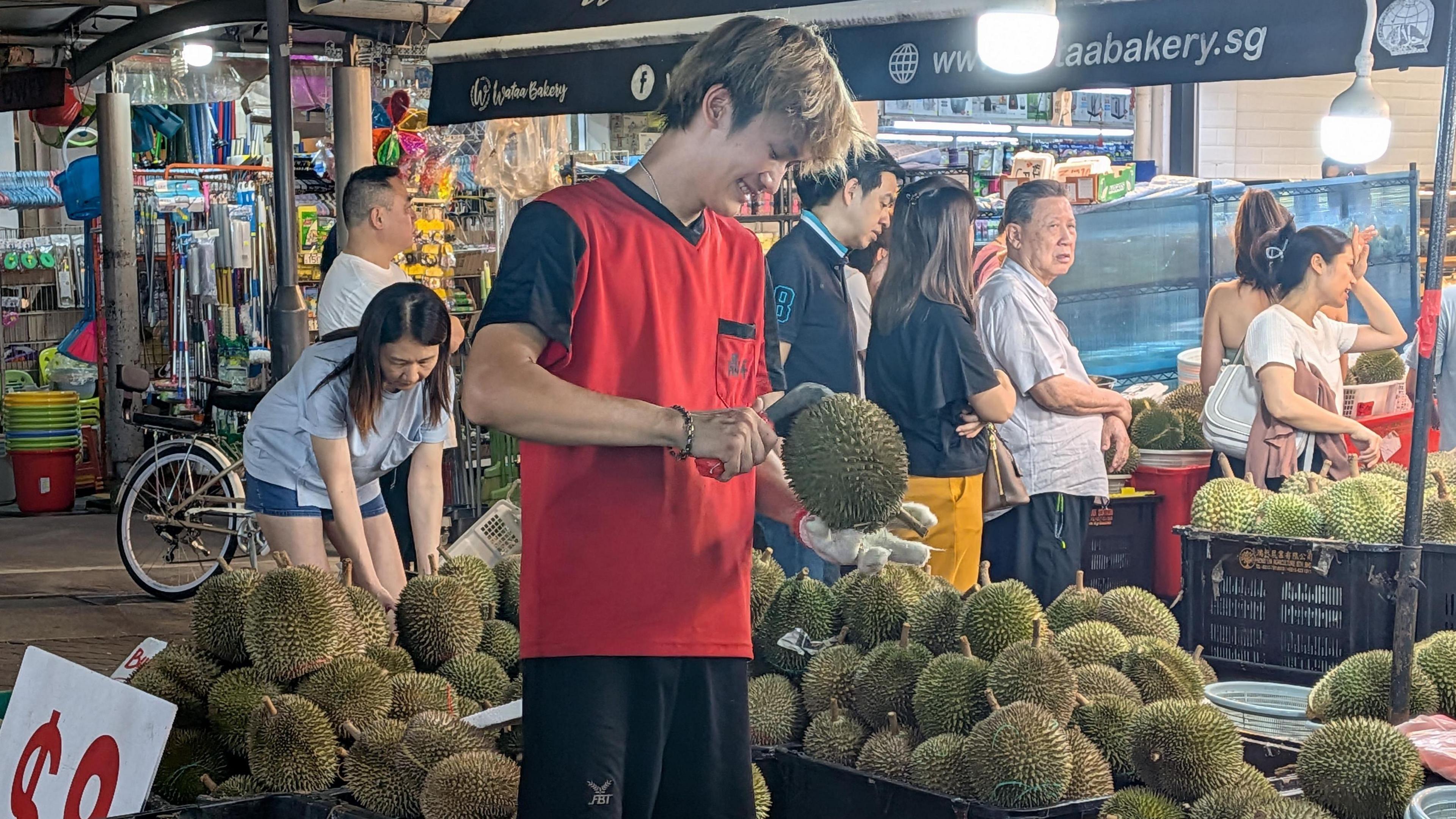
Durian prices have plunged because of oversupply
ByKoh Ewe and Kelly NgReporting fromSingapore
As Malaysian durians are being sold at throwaway prices, farmers worry about their livelihoods.

Durian prices have plunged because of oversupply
ByKoh Ewe and Kelly NgReporting fromSingapore
For days now, a long line has been snaking around the two blocks leading up to the Durian Ninja fruit stall in Tampines, a busy township in the east of Singapore.
They are waiting patiently for the free fruit the seller has been giving away daily since mid-June: two durians per customer, about 600kg a day.
This generosity is being fuelled by an oversupply of durian across the border in Malaysia, which typically produces about 550,000 tonnes a year.
But an unusually abundant 2026 has crashed the price of the prickly, pungent fruit beloved in large parts of Asia.
Sixty-nine year-old Cherng, who is in the line in Singapore, tells the BBC that he has been having durian "almost every day". For him and his family, this is a rare chance to devour durians "of good quality, and sometimes at nearly half the price of previous seasons".
Customers in Malaysia and neighbouring Singapore are swarming fruit stalls where durians are being sold at huge discounts or, if they are lucky, given away for free.
But while durian lovers feast, Malaysian farmers are chagrined.
They say this glut, or what many have dubbed a "durian tsunami", is the result of a decade-long boom, during which Malaysians flocked to durian farming to cash in on growing Chinese demand.
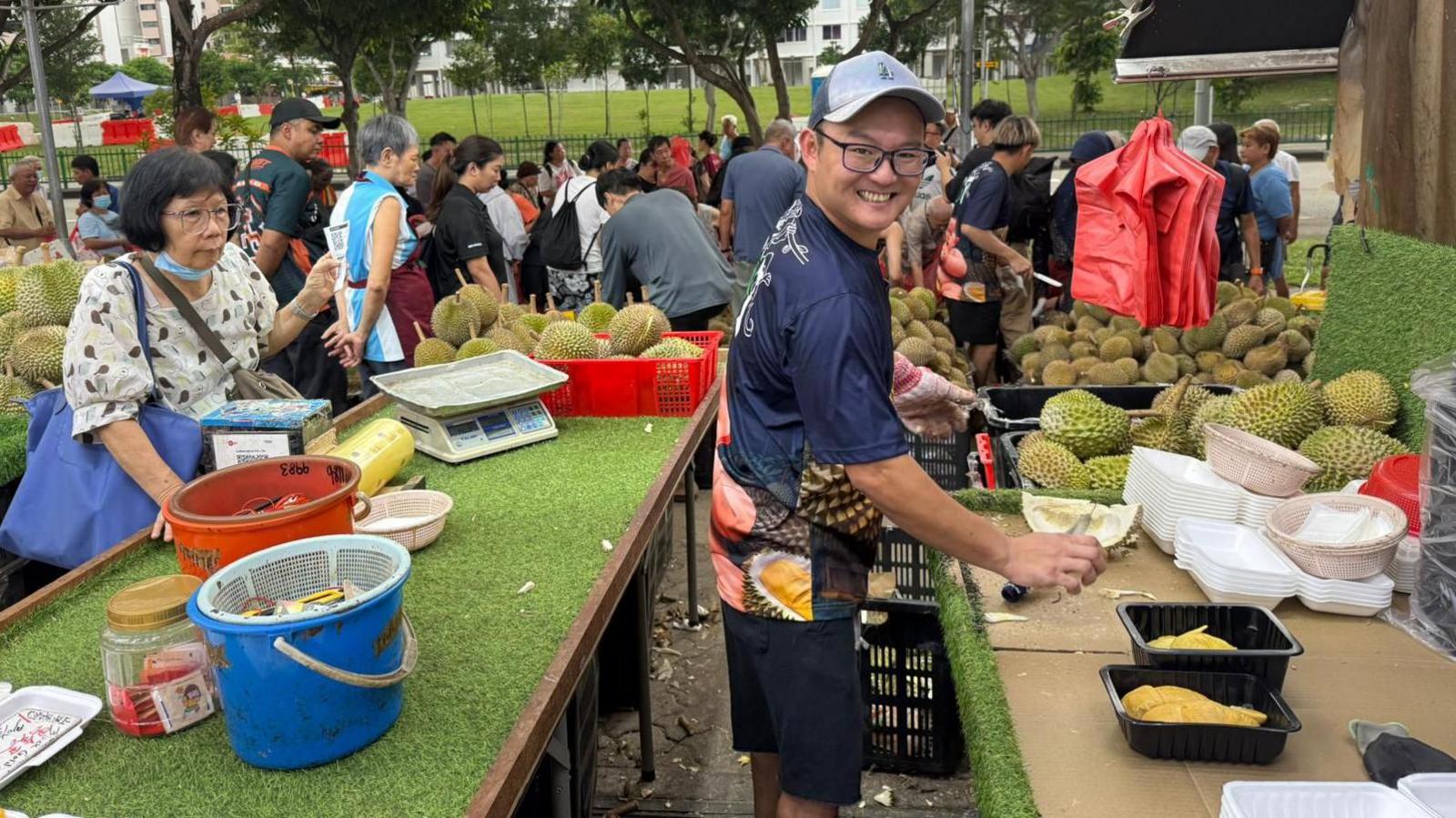
Customers line up for free fruit at Durian Ninja in Singapore
"Back then, a lot of people cut down their rubber trees or oil palms to grow durians. A lot of the trees [planted then] are now starting to bear fruit," says Lu Yuee Thing, the owner of several durian farms near the Malaysian town of Raub.
Over the last decade, Malaysia's durian exports, to China in particular, have soared, driven mainly by prized varieties like the Musang King - a buttery, bittersweet fruit largely grown in Raub that the Chinese have dubbed the "Hermès of durians".
As Musang King gained popularity, "a lot of people got into Musang King [farming]", says Lee Wah Chong, who runs a luxury resort and durian farm in Malacca.
The trees in the newer farms have reached maturity around the same time, resulting in a glut that has depressed prices across the Malaysian durian market and impacted exports.
Last December, Lu sold his Musang King durians to retailers at an average of 13.50 ringgit ($3.30). This month, Lu says he can only sell them for half the price.
Han says he has slashed prices for his Musang Kings by nearly a third, offering them to customers for 50 ringgit per kilogram.
"The market pressure is too high for me," he says, adding that he is now trying to make up for lost profits with other fruit he grows, such as bananas.
Some farmers also say they are competing against lower quality yields. Lee says that "although young trees are producing durian, the quality is not consistent".
This sentiment is shared by Han Sing Keng, a durian farmer and seller in Malaysia's Johor state, who says many of the durians flooding the market at throwaway prices are "not qualified for export".
"They don't have any other way to sell it," he says. "The name is still Musang King, but the quality is not up to standard."
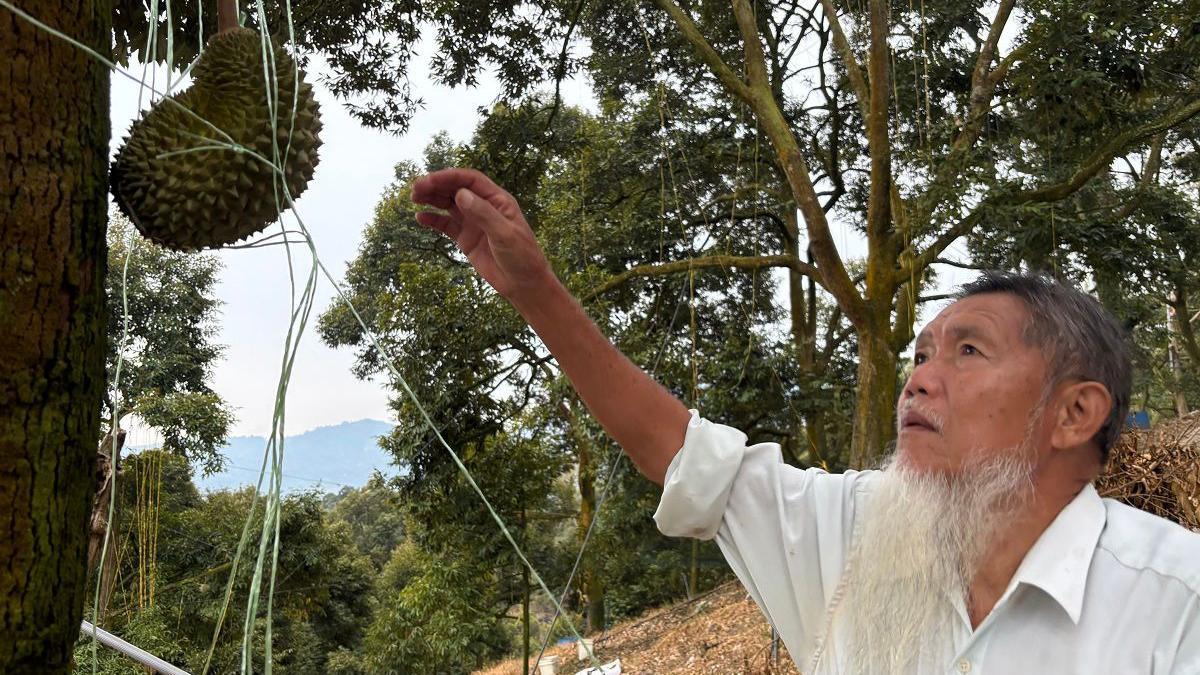
Lu Yuee Thing, the owner of several durian farms, is one of Raub's success stories
Also on the heavily discounted list are premium varieties like Black Thorn, but the cheapest are the "kampung durians", which are so low on the pecking order that they are yet to be named.
But for farmers like Lu and Han who have built their business around specialised varieties, this has been a difficult season.
They were already grappling with poor harvests because of unfavourable weather when the glut hit.
"Different periods of durian growth have different requirements of the weather," Han says.
Unseasonal or unusually heavy rain or winds can impact pollination, he explains, and then durian trees typically need about a month of hot weather to flower, but cooler temperatures for harvest.
Like most seasons, the weather has affected farmers unevenly across the country.
"Malaysia's diverse geography means each growing region experiences different weather conditions," says Edwyn Chiang Kyn Hoe, secretary general of the Malaysia International Durian Industry Development Association (MIDIDA).
While some orchards experienced irregular rainfall during flowering, other producers recorded "relatively normal harvests", he adds.
But the oversupply was a double whammy for those reeling from a poor harvest. So much so that it has alarmed authorities.
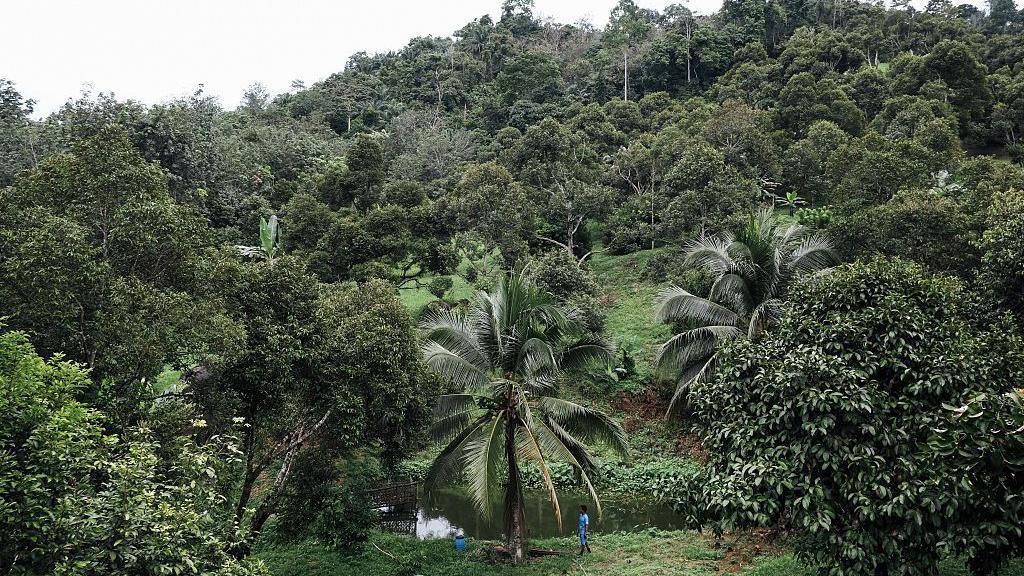
Durian trees and oil palms dominate Raub's landscape
Malaysia's Federal Agricultural Marketing Authority has deployed emergency interventions to protect the income of small farmers, such as purchasing durians from them at a base price.
"We hope prices can recover within the next few weeks, deputy director Faisal Iswardi Ismail told AFP news agency.
Chiang, from the durian industry body, says they want to "build a sustainable, premium Malaysian durian industry that competes on quality, authenticity and origin - not on low prices". He says they have been organising events in China to connect Malaysian exporters to Chinese importers to "strengthen the Malaysian durian industry for the future".
Shops meanwhile still have more durian than they can sell, and are resorting to creative promotions to deal with the overflowing crates.
One durian stall in Malaysia's Pahang state has drawn attention online for its all-you-can-fit promotion, where customers are leaving with sacks filled beyond the brim with durian for just 100 ringgit ($24).
In Singapore, where Durian Ninja continues to give away free fruit, stall owner Kee Eng Chai says he wants to "give back to society".
The free durians get snatched up within an hour or two, staff say. The rest are on sale for as little as S$1 ($0.80; £0.60) each for small, palm-sized portions.
Kee also hopes that the prices draw new customers because they have realised over the years that most of those buying from them are older Singaporeans.
"We hope to encourage younger people to try more varieties of durians."

India has stepped up engagement with Chinese media as Beijing presses New Delhi to issue visas to its journalists ahead of a possible visit by President Xi Jinping later this year, though any breakthrough on the issue is likely to take time, according to people familiar with the matter. The outreach

This article was first published on July 1, 2011 Plane beats train, but winning isn’t everything by Will Clem, Shi Jiangtao Two South China Morning Post reporters yesterday pitted the new high-speed Shanghai–to–Beijing train against an airliner and discovered that although taking to the skies had th
China and the European Union released a joint statement on Monday following talks between China’s Minister of Commerce, Wang Wentao, and the EU’s trade chief, Maros Sefcovic, in Brussels. During the meeting, the two sides agreed to establish a joint platform to monitor trade flows and to set up work

Flight schools across China said they had been told to suspend training and undergo safety inspections by authorities after a light sport aircraft crashed into Beijing’s tallest skyscraper on Friday. The pilot was killed when he flew the two-seater plane into the building near the East Third Ring Ro