
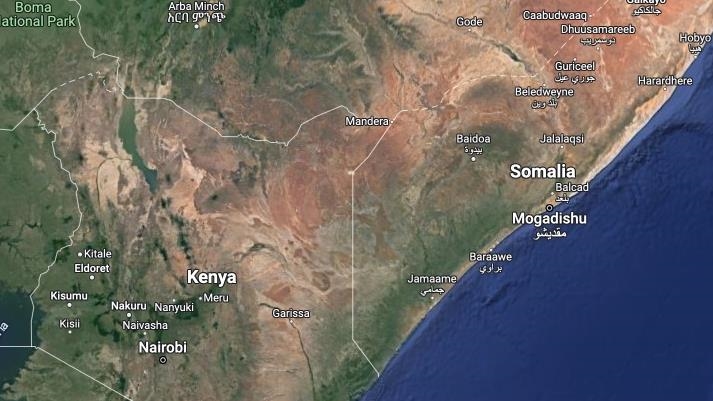
A disagreement between Kenya and Somalia continues over a 92,389-square-kilometer maritime zone that has long attracted international energy companies.
The United Nations’ International Court of Justice (ICJ) in 2021 awarded Somalia control of most of the area, but Kenya rejected the legally binding ruling over which the court has no enforcement powers. The countries differ over which direction the boundary follows into the Indian Ocean.
Experts such as Siyad Madey, a Kenyan lawyer and policy analyst, say the dispute centers on the question of how much potential energy wealth lies beneath the contested waters, which form part of the Lamu Basin that stretches across the coastlines of both countries. Surveys in Kenya’s part of the basin showed it could contain up to 3.7 billion barrels of oil and more than 10 trillion cubic feet of gas. Analysts say basins on the Somali side might contain tens of billions of barrels of oil.
“Even if only a portion of those resources proves commercially recoverable, the combined hydrocarbon potential of the Kenya-Somalia offshore corridor could plausibly translate into $200 billion to $500 billion in lifetime resource value, depending on recovery rates and long-term energy prices,” Madey wrote in the Middle East Forum Observer. “Such estimates help explain why what might otherwise have remained a technical maritime boundary disagreement evolved into geopolitical confrontation.”
Madey argued that the impasse has evolved into a test of sovereignty, investor confidence and regional strategic positioning. The outcome will help shape perceptions of rules-based order across the western Indian Ocean.
The ICJ ruling reduced the Kenyan Navy’s operational depth, forced the security corridor for international shipping lanes northward and undermined Kenya’s competitiveness as an Indian Ocean logistics hub, researcher Jie Sun wrote in a policy brief published by the academic journal Frontiers in Political Science.
“In terms of regional influence, Somalia launched new oil and gas bidding rounds following the ruling and partnered with external actors, such as Ethiopia and Qatar, to reshape maritime governance in the northwestern Indian Ocean,” Sun wrote.
Maritime security concerns complicate the situation. Due to the prevalence of sea crimes such as arms and human trafficking, illegal fishing, organized crime, piracy, and terrorism, the International Shipowners’ Association considers the disputed boundary a high-risk area.
“Kenya fears that the continuation of arms trafficking within the disputed area is enabled by the weak security architecture of the Somali regime,” Fred Jonyo, a professor at the University of Nairobi, and Philip Kaudo, a lecturer at the university, wrote last year in the journal Strategic Review for Southern Africa. “The proliferation of small arms and light weapons in the region presents a possibility of these weapons getting into the hands of local and international criminals and vigilante groups, both on land and at sea, thereby compromising the country’s national security.”
Although the ICJ’s 2021 ruling escalated longstanding diplomatic tension between Kenya and Somalia, there are signs of thawing relations. In February, Kenyan President William Ruto announced the reopening of the country’s land borders with Somalia by April. These borders have been closed for 15 years, and Ruto wants to stimulate trade between the two countries.
Continental border areas, often porous, poorly demarcated and neglected by the state, pose persistent security challenges. In North and West Africa, for example, 23% of all violent events occur within 20 kilometers of a border. Ruto has said an increased police presence and a multiagency security team will patrol the area. Plans to reopen the borders in May 2023 were paused after an al-Shabaab attack that killed five civilians and eight police officers in the area.
Somali economic analyst Ahmed Khadar said previous security cooperation between Kenya and Somalia was “very low, maybe because of weak government in Somalia, and maybe there was a time that Somalia, there were no government in Somalia.”
“The security concern is not that much compared to 10 years ago or 15 years ago,” Khadar told DW.


