Political turmoil in Indian border state as nine million lose voting rights
9 hours ago
Snigdhendu BhattacharyaKolkata
Nine million voters have been dropped from rolls in West Bengal, raising concerns over exclusion and fairness.

9 hours ago
Snigdhendu BhattacharyaKolkata

 Sudipta Das / NurPhoto via Getty Images
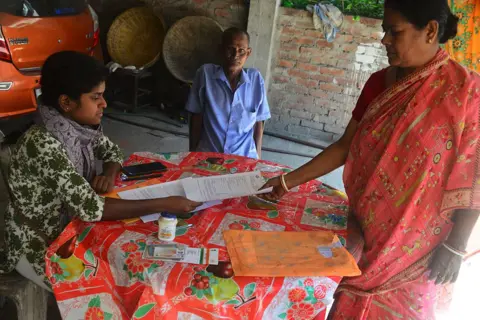
Muhammad Daud Ali, a former Indian army technician, recently discovered that he was no longer a voter in his home state of West Bengal.
His name - and those of his three children - had been struck off the electoral rolls despite valid documents, including his passport and service records. Only his wife remained on the list.
Ali, 65, and his children are among nine million voters - about 12% of West Bengal's 76 million electorate - who have been removed from the 2026 rolls as part of the Special Intensive Revision (SIR) exercise. Voting to elect a new state government will take place later this month in this eastern Indian state.
Of these nine million, more than six million names were struck off as absentee or deceased voters, while the fate of another 2.7 million - including families like Ali's - remains undecided and will be determined by tribunals.
Thirteen states and federally-administered territories have undergone the SIR process so far, but West Bengal is the only one where it was followed by an additional layer of special adjudication.
India's Election Commission says the revision is meant to weed out duplicate or outdated entries and add genuine voters. But the exercise has been mired in controversy and faced legal challenges ever since it was first held in the state of Bihar last year.
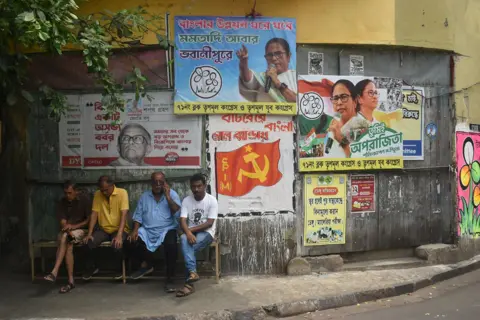
It has become particularly contentious in West Bengal, where the ruling Trinamool Congress party (TMC) is locked in a bitter standoff with the poll body.
Gyanesh Kumar, the chief election commissioner, has said the revision exercise's aim is to ensure a "pure electoral roll" with no eligible voters excluded and no ineligible persons included.
The tensions have been fuelled by remarks from political leaders, including from Prime Minister Narendra Modi, who have suggested in campaign speeches that the clean-up is aimed at identifying so-called "illegal Bangladeshi infiltrators" - a term the TMC says is being used to refer to Muslims. However, many Hindu voters have also been left out from the list.
India shares a 4,096km (2,545-mile) largely porous and partly riverine border with Bangladesh and a significant stretch of it runs through West Bengal. This has added a fraught political edge to debates over migration and voter rolls in the state.
West Bengal is also home to India's second-largest Muslim population, accounting for roughly 14% of the country's 172 million Muslims, according to the 2011 census.
 NurPhoto via Getty Images
Home to more than 70 million voters, the state has been governed by Chief Minister Mamata Banerjee's TMC since 2011, with Modi's Bharatiya Janata Party (BJP) as its main challenger.
With the fourth-highest number of India's parliamentary seats, West Bengal remains a key prize the BJP has yet to win. In the 2021 assembly polls, it secured about a quarter of the state's 294 seats.
Banerjee's party alleges the roll revision exercise has disenfranchised millions - particularly Muslims - to benefit the BJP, a charge both the party and the Election Commission deny.
After repeated legal challenges, the Supreme Court allowed the Election Commission to proceed with the April polls without settling all disputes over the deletions. As a result, the fate of 2.7 million voters remains undecided.
Their cases lie at the heart of the controversy.
These voters had submitted enumeration forms linking them to the 2002 electoral roll - widely regarded as the last "clean" list.
Yet the poll panel used a new, AI-driven process to flag what it called "logical discrepancies" in their records, treating them as doubtful voters.
Despite subsequent re-verification, people like Ali were excluded.
Constituency-wide data compiled by political parties suggests that around 65% of the 2.7 million in limbo are Muslims.
Overall, Muslims account for 3.11 million - about 34% - of the nine million removed, significantly higher than their 27% share in West Bengal's population, according to the 2011 census.
Ali and his children must now approach a tribunal set up on the Supreme Court's direction. But with the rolls frozen and elections due later this month - on 23 and 29 April - they see little chance of restoring their voting rights in time.
"I am dumbstruck. I feel deeply hurt and insulted. How can they conduct the elections without solving our disputes? I simply have no idea who to seek justice from," Ali told the BBC.
The deletion of such a large number of names has sharpened concerns over errors, exclusion risks and the criteria used to determine "valid" voters.
"There is no example of an election happening in India with voters' rights remaining suspended," said political scientist Sibaji Pratim Basu.
He says leaving out 2.7 million voters is such an "absurd proposition".
"This is a shame for democracy," he added.
But federal minister Sukanta Majumdar, a BJP leader from the state, says the revision exercise was necessary in the national interest.
"The constitution says only Indian citizens can choose prime ministers and chief ministers. Therefore, purging non-citizens was important," he told the BBC.
Asked about elections taking place while the status of 2.7 million voters remains unresolved, Majumdar blamed the state government, alleging it had "slowed the process" by taking the matter to the Supreme Court. He also dismissed allegations that the poll panel was favouring the BJP.
The impact of the overall revision has been uneven, with sharp cuts in some urban pockets in the state.
In the state capital, Kolkata city, nearly 29.6% of voters were struck off the rolls in the north and 27.5% in the south - among the highest rates in the state.
Paschim Bardhaman district saw the second-highest drop, with the electorate shrinking 16.9%. About 80% of those deleted are Hindus, many from Hindi-speaking communities with roots in northern India.
Border districts with Bangladesh - North 24-Parganas, Nadia, Murshidabad, Malda, Uttar Dinajpur and Cooch Behar - also saw heavy deletions.
North 24-Parganas alone lost 1.26 million voters (15%), with most deletions mirroring its Hindu-majority profile.
Murshidabad, India's most Muslim-populous district, saw 749,000 names (13%) struck off, broadly reflecting its demographics.
These border districts have become the epicentre of the controversy, where most exclusions occurred in the final phase - under the "logical discrepancy" category.
Muslims bore the brunt in districts like Murshidabad and Malda, while Dalit Hindus - especially from the Bangladeshi migrant Matua community - were hardest hit in North 24-Parganas and Nadia.
In the central Indian state of Madhya Pradesh, too, large numbers were flagged under "logical discrepancy". But with no elections due until 2028, voters there have more time to resolve their status.
The issue has since eclipsed almost every other campaign theme.
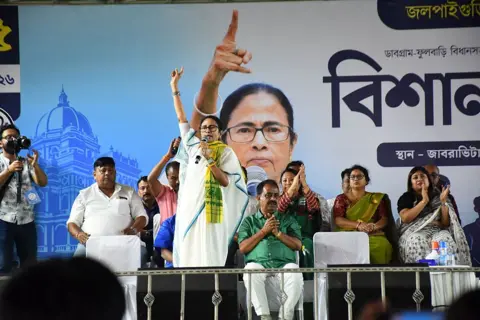
At her election rallies, Banerjee said she would move the Supreme Court of India again.
"How can the elections start without solving the cases of 2.7 million voters?" she asked.
On Friday, the court said they would hear the case on 13 April, offering a narrow and uncertain window for relief.
 NurPhoto via Getty Images
Mukulika Banerjee, an anthropologist at the London School of Economics, says the pattern of exclusion in West Bengal indicates that certain categories of the population may have been "selectively targeted".
Banerjee says voting is not just a procedural right but a deeply meaningful act - especially for marginalised communities.
"By denying them their right to vote, one takes away one of their fundamental rights, and one that is hugely meaningful to them and allows them to assert their voice."
She recalls a voter in West Bengal's Sundarbans telling her: "If we don't vote, no-one will even bother to remember that poor people exist."
In Harishchandrapur, a constituency in Malda district along the Bangladesh border, 35-year-old Hasnara Khatun is furious.
"I am very angry," she says, adding that her father, grandfather and great grandfather have been voters.
Now, five of the seven members of their family have their voting rights suspended.
"We have been effectively turned into non-citizens. Who knows what comes next?
"The system can't be trusted anymore. Therefore, the legal battle will go on, but we won't stop protests either," says Khatun.
Snigdhendu Bhattacharya is a Kolkata-based independent journalist

A mega-dam in Tibet must make ecological integrity and safety a priority, Chinese Vice-Premier Zhang Guoqing said during a visit to the project. The dam on the Yarlung Tsangpo will be the world’s largest hydropower facility and it is a key element of China’s plans to exploit the potential of the Tib

China’s reported decision to halt sulphuric acid exports, together with the failure of peace talks between the United States and Iran over the weekend, risks driving prices higher and disrupting global mining and fertiliser supply chains that have few readily available alternatives. Beijing had indi

Faltering confidence in the US dollar has handed China a “golden window of opportunity” to promote the global use of its currency, according to a former head of the Chinese central bank. “The core driving force behind the current changes in the international monetary system is the United States’ own

Chinese electric vehicle (EV) stocks rallied against a falling broader market in Hong Kong on Monday, as strong export data and rising oil prices bolstered the appeal of battery-powered and hybrid cars while a coming wave of model launches sparked hopes of a domestic demand recovery. Nio surged 7.5