
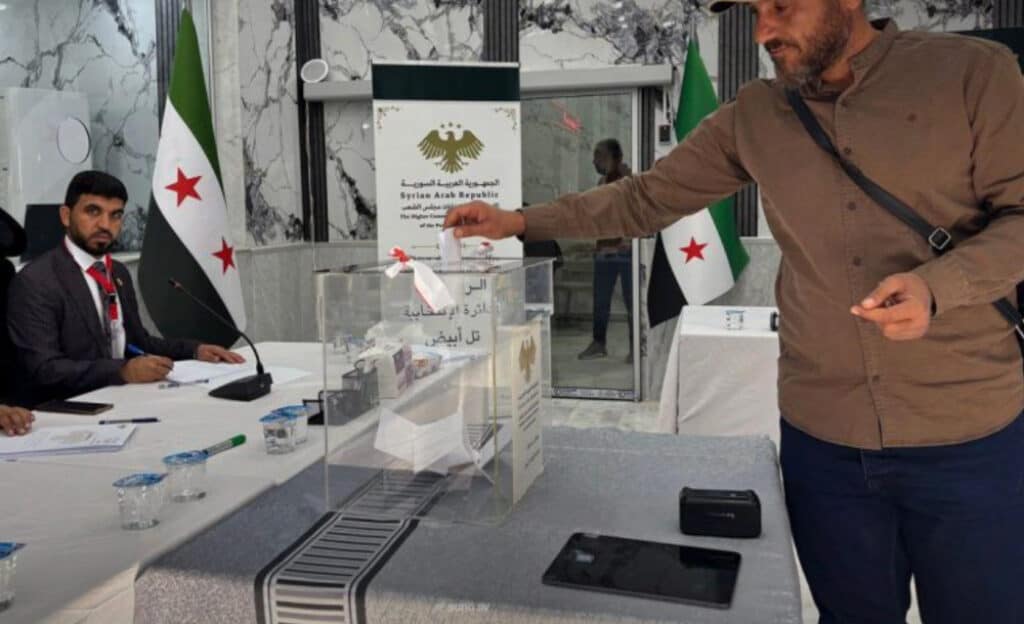
Syria held elections in Kurdish-majority areas of the country on May 24, with some politicians and commentators criticizing them for not being representative. Days after the local elections, Damascus said that it was working with Organisation for the Prohibition of Chemical Weapons (OPCW) to remove remnants of the Assad regime’s chemical weapons program. The two developments showcase the new government’s attempts to solidify control and establish legitimacy.
The elections are the latest round of an electoral process that began in October 2025 and is intended to choose 140 representatives for a new parliament. The procedure includes local committees that select a relatively small number of people to vote.
“In a process criticized as undemocratic, several thousand members of local committees cast their ballots Sunday to elect members of the assembly, which will have a renewable 30-month mandate,” France24 wrote in 2025. A total of 210 representatives are expected in the new assembly, with 140 elected by vote and 70 appointed by the president. The October vote chose 119 representatives, while several more were chosen in March elections in and around Raqqa. The May 24 vote selected at least nine more representatives.
The Syrian Arab News Agency (SANA), a state media outlet, noted on May 24 that elections had taken place in four regions. “Syria’s Higher Committee for People’s Assembly Elections said the completion of voting in the districts of Hasakah, Qamishli, al-Malikiyah and Ain al-Arab paves the way for the first session of the new parliament,” SANA noted. Ain al Arab is also called Kobane in Kurdish. These are all areas that were controlled by the Syrian Democratic Forces (SDF) over the last decade and had been administered by the Democratic Autonomous Administration of North and East Syria (DAANES), the civilian side of the SDF. In January 2026, following clashes between Damascus’s security forces and the SDF, a deal was reached to deploy Syrian Interior Ministry forces to these areas, setting the stage for the current vote. Voter turnout in each area was very high, estimated between 75 and 95 percent. However, as noted above, the turnout is counted only from among a small number of electors, not the entire population.
After the results of the vote were announced, the Syrian High Committee for the People’s Assembly Elections, which had organized the vote, said there had been no appeals in the wake of the balloting. It is expected that Syria will now convene a parliament based on the votes. The only area still outside government control and where no vote has taken place is the Druze-majority area of Suwayda.
Syria has acknowledged shortcomings in the October 2025 vote, where very few women were elected. In the May 2026 vote, there have been additional concerns about the number of Kurds elected to parliament.
“While initial media reports indicated that eight Kurdish candidates had won parliamentary seats, a Kurdistan24 review confirmed the number stands at nine,” Kurdistan24, a Kurdish media outlet based in Erbil in the Kurdistan Region of northern Iraq, noted on May 30. However, critics of the election were quoted by the Kurdish Hawar News Agency as claiming that Kurds make up 20 percent of Syria’s population. This would mean that out of around 140 seats, they should receive up to 28 rather than nine. Some Kurdish political groups, particularly those linked to the Democratic Union Party (PYD), which had been the powerful party in eastern Syria during the era of SDF rule, boycotted the recent poll.
In the wake of the vote in eastern Syria, Damascus also said it was working with the Organisation for the Prohibition of Chemical Weapons (OPCW) to turn over remnants of the previous Assad regime’s chemical weapons program. Most of this program was supposed to have been dismantled in 2013 during the Syrian civil war.
“The Organisation for the Prohibition of Chemical Weapons (OPCW) announced on Tuesday that dozens of munitions, chemical materials and related equipment linked to the deposed regime had been found at several sites in Syria, as part of ongoing verification efforts conducted in coordination with the Syrian authorities,” SANA noted on May 26. Syria received praise from US and Canadians officials for finding the chemical weapons and working with the OPCW. Syrian Foreign Minister Asaad Hassan al Shaibani said the development reflects a vision for a new Syria and its security and stability.
Reporting from Israel, Seth J. Frantzman is an adjunct fellow at FDD and a contributor to FDD’s Long War Journal. He is the senior Middle East correspondent and analyst at The Jerusalem Post, and author of The October 7 War: Israel's Battle for Security in Gaza (2024).
Tags: SDF, Syria, Syrian elections


