9 hours ago
Osmond ChiaBusiness reporter
With oil supply disrupted, Beijing's oil reserves and renewable energy push are being put to the test.

9 hours ago
Osmond ChiaBusiness reporter

 Getty Images
China has long braced for a Gulf oil supply shock - but the Iran war's disruption of a key global shipping route is now putting its resilience to the test.
Energy shipments from the Middle East have been at a standstill following Iran's threats to attack vessels that pass through a critical trade waterway as retaliation against US-Israeli strikes.
The blockade has led to a global oil shortage which has rocked Gulf-reliant Asian countries hard - with the Philippines mandating four-day work weeks to save fuel, and Indonesia seeking ways to avoid burning through reserves that will last just weeks.
China, the world's largest buyer of oil, is also feeling the strain.
But the country sits in a better position than its neighbours, after years of statecraft that have prepared it for a global energy crisis.
The world economy has been thrown into turbulence since the US and Israel launched strikes against Iran in late February.
Since then, oil prices have at points soared to close to $120 (£90) a barrel - pushed up by strikes on shipping and energy infrastructure and the effective closure of the Strait of Hormuz, the world's busiest oil shipping channel.
About a fifth of the world's oil passes through the strait - around 20 million barrels each day, according to estimates from the US Energy Information Administration (EIA).
The shortage has left countries scrambling for alternative crude suppliers outside of the Gulf, while others are tapping into their own oil reserves.
As the world's second-largest consumer of oil after the US, China uses an estimated 15 to 16 million barrels of oil daily, various market analysts told the BBC.
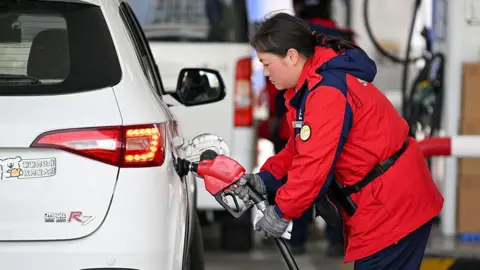
The oil is mainly used for China's massive transportation network of cars, trucks and jets. And much of it comes from abroad.
Gulf countries are a major source of the oil China ships in,with barrels from Saudi Arabia and Iran accounting for more than 10% of its imports each, according to the US Energy Information Administration (EIA).
 Getty Images
Most of the country's imported crude oil, which comes from Iran and the Middle East through the South China Sea, is used as fuel to support factories and transportation, mainly in the southern half of China.
The country's north, however, is mainly powered by oil produced domestically in major oilfields, along with pipeline imports from Russia - and these are not disrupted by the war in the Middle East.
While many Asian countries have relied heavily on oil from Gulf nations, Russian oil accounts for nearly a fifth of China's energy imports. That makes Moscow by far Beijing's biggest oil supplier, despite sanctions from the US and Europe.
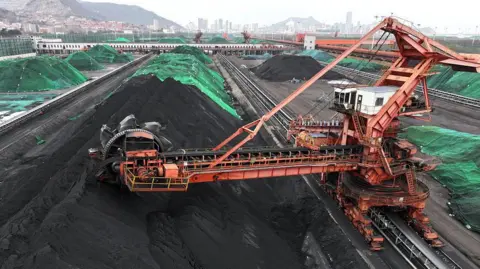
Coal is also the dominant source of power for most of China's electricity, and is available in abundance locally.
China is the world's largest coal producer, accounting for more than half of global production.
Oil and gas meanwhile account for just over a quarter of China's total energy mix, according to estimates published in state media - making the country less dependent on the resource than Europe and the US.
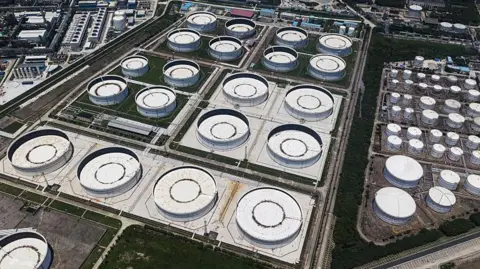
Beijing has over the years taken advantage of lower crude prices and the abundance of supply from Gulf states to build one of the world's biggest oil reserves, says Ole Hansen, Saxo Bank's head of commodity strategy.
In January and February of this year alone, Beijing bought 16% more crude compared to the same time period a year earlier, according to its customs administration.
Iran, whose oil is sanctioned by the US, has been a key supplier of cheap crude for China, with reports suggesting that Beijing buys more than 80% of Iran's oil exports.
Vessel-tracking data since the Iran war started indicates that some of this oil is still arriving in China - though analysts disagree on the exact size of China's oil stockpile.
According to trade analytics group Kpler, more than 46 million barrels of Iranian crude oil - several days' worth of energy - currently sit in tankers along the South China Sea.
 Getty Images
Hansen says that estimates show China has built up reserves of around 900 million barrels - just under three months' worth of imports. Figures from Columbia University, cited by Chinese state media, said China had petrol reserves of some 1.4 billion barrels.
It is also unclear how much daily imported energy China is using right away, and how much is being funnelled into its oil reserves, says Hansen. The sheer volume, he adds, still serves as a "substantial buffer" for times of disruption.
Despite its reserves, Beijing has shown signs of caution to manage its supplies in the near future.
Authorities in China reportedly ordered its oil refineries to stop exporting fuel for the time being, in an attempt to keep domestic prices under control. China's government did not respond to BBC queries on the matter.
China has become a world leader in green energy, rapidly rolling out wind and solar farms across the country.
Wind, nuclear, solar and hydropower generated more than a third of China's electricity in 2025, according to the National Bureau of Statistics. But the country has since expanded its renewables grid significantly, with estimates saying more than half the installed capacity is now from clean sources.
As a result of its renewable push, crude oil only made up around a fifth of China's total energy consumption in 2024.
Energy economics researcher Roger Fouquet said China's "ambitious" transition to renewables is not merely an environmental move, but has also helped to protect its economy from global risks like those we're seeing with the Iran conflict.
"To some extent, China is fortunate that 25 years ago it began its investment in renewable energy and it is now reaping the benefits," he said.
Electric vehicles (EVs), which account for at least a third of new cars sold in China, have also helped the country's economy become less reliant on oil, said Roc Shi from the University of Technology Sydney.
"It means an EV owner in Beijing simply doesn't feel the pain at the pump when the Middle East flares up," he said. "Their mobility costs are decoupled from international oil markets."
That is not to say the Chinese economy is immune to oil supply shocks.
For drivers of electric cars, charging prices can climb during an energy crisis if fuel prices rise.
Last week, petrol and diesel prices rose by 695 yuan ($100; £75) and 670 yuan per tonne respectively, according to state news outlet China Daily citing an official report.
For China's factories, rising oil prices can also drive costs in its massive petrochemical industry, which produces plastics, fertilisers and other chemicals.
As the world's largest energy importer, every barrel of oil will now come with a higher price tag due to the war, said Shi - but China will have no choice but to pay that premium.

Manufacturers stopped operations after supplies of propane and natural gas reduced sharply in recent days.

As the war in Iran rages and the consequences of the shock to commodity markets become clearer, the vulnerability of Asia’s economies tops the list of concerns in the research reports of investment banks. The region’s reliance on energy imports from the Gulf has come under scrutiny. The facts speak

China’s urban youth unemployment rate fell in February for the sixth consecutive month, though the marginal improvement provides little reprieve for jobseekers in a challenging post-holiday labour market. The jobless rate for the 16-to-24 age group, excluding students, edged down to 16.1 per cent in

Chinese authorities have renewed their push for stricter oversight of the electric vehicle (EV) market, urging carmakers to move away from aggressive discounting and focus instead on technological innovation. The directive comes as domestic manufacturers struggle with cooling demand and the phasing