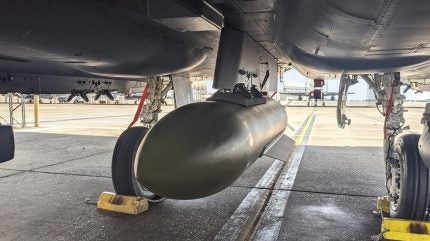
US employ 5,000lb ‘deep penetration’ munition in Iran War

US forces employ a 5,000-pound munition, seemingly for the first time, against Iranian capabilities near the Strait of Hormuz.

Air Force Technology
75
3 min read
0 views
US employ 5,000lb ‘deep penetration’ munition in Iran War

Central Command noted forces targeted “hardened” Iranian missile sites along the coastline near the Strait of Hormuz.

Eglin test squadron releases GBU-72 for first time, 7 October 2021. Credit: DVIDS.

The US Air Force (USAF) has employed a 5,000-pound bunker buster, seemingly for the first time in its air campaign against Iran.

It is the first time US Central Command (CENTCOM) confirmed the use of these air-to-ground “deep penetration” munitions against what it described as “hardened” Iranian missile sites along the coastline of the Strait of Hormuz.

Discover B2B Marketing That Performs

Combine business intelligence and editorial excellence to reach engaged professionals across 36 leading media platforms.

Find out more

CENTCOM specified that these sites utilised anti-ship cruise missiles, which could pose a risk to international maritime shipping in the contested space.

Hours ago, U.S. forces successfully employed multiple 5,000-pound deep penetrator munitions on hardened Iranian missile sites along Iran’s coastline near the Strait of Hormuz. The Iranian anti-ship cruise missiles in these sites posed a risk to international shipping in the… pic.twitter.com/hgCSFH0cqO

— U.S. Central Command (@CENTCOM) March 17, 2026

Bunker busters

Citing US military officials, CNN reporter Haley Britzkey said that the USAF employed the GBU-72 Advanced 5K Penetrator.

The GBU-72 was developed to overcome hardened deeply buried target challenges and designed for both fighter and bomber aircraft. 

The weapon design and its projected effectiveness were developed using advanced modeling and simulation techniques before the first warhead was forged, according to a USAF release from October 2021, when the munition was released by an F-15E Strike Eagle fighter jet over Eglin Air Force Base during its test phase.

Strategy by denial

Lacking the conventional means to defend against the overwhelming US and Israeli air campaign, the Islamic Republic is resorting to asymmetric activity through its cheap Shahed drone attacks in tandem with its efforts to deny global trade through the Strait of Hormuz.

By controlling the Strait, a vital trade artery with a distance of 29 nautical miles at its narrowest point, Iran creates limited space for tankers and warships, making their movements in the bottleneck predictable. This in turn allows fast employment of Iran’s anti-ship capabilities, reducing US Navy response time to as little as 30 to 40 seconds according to The New York Times.

While focusing on the ostensible success of the US air campaign in devastating Iran’s conventional military capabilities on 13 March, the US Defense Secretary Pete Hegseth dismissed Iranian efforts in the Strait of Hormuz as an act of “sheer desperation” that US forces are “dealing with”.

This is a telling statement: the air campaign is only successful insofar as it deprives Iran of its conventional military resources and leadership. However, it fails at the strategic level as the US Navy becomes bogged down in the Strait, forcing the US administration to demand help from unwilling allies, which only protracts the war well beyond the intended swift victory comparable to the Venezuela operation in January 2026.

Original Source

Air Force Technology

Share this article

Related Articles

🔬
🔬Weapons & Technology
USNI News

China Not Committed to 2027 Taiwan Invasion, U.S. Intel Report Says

Washington has determined that China does not plan to invade Taiwan in 2027, according to the U.S. intelligence community’s 2026 Annual Threat Assessment report published this week. “The [intelligence community] assesses that Chinese leaders do not currently plan to execute an invasion of Taiwan in

il y a environ 14 heures1 min
What is Rapid Sentry, the UK’s mysterious air defence system?
🔬Weapons & Technology
Army Technology

What is Rapid Sentry, the UK’s mysterious air defence system?

The UK has spoken publicly about a new air defence system, dubbed Rapid Sentry, designed to shoot down drone threats.

il y a environ 17 heures3 min
🔬
🔬Weapons & Technology
Defence Blog

NATO tests drone interception systems in Latvia

NATO has launched its first Testing, Evaluation, Verification and Validation (TEVV) campaign focused on Unmanned Aircraft Systems (UAS) and counter-UAS technologies at the Sēlija Military Training Area in Latvia. The testing activity took place from March 9 to 13, 2026, bringing together defense ind

il y a environ 17 heures1 min
🔬
🔬Weapons & Technology
USNI News

NATO Forces Wrap Arctic Warfare Cold Response 26 Drills

NATO forces wrapped up Exercise Cold Response 26 on Thursday following 10 days of arctic warfare drills across Norway and Finland. The exercise was the first NATO activity in the High North under Arctic Sentry, NATO’s new enhanced vigilance activity dedicated to the defense and security of the Arcti

il y a environ 18 heures1 min