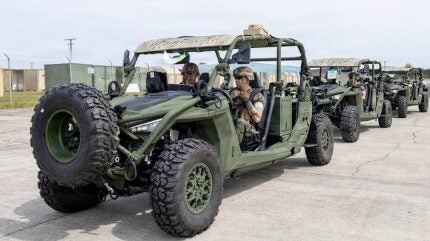
US Marine Corps awards new MRZR Alpha ULTVs contract to Polaris
The United States Marine Corps (USMC) has granted Polaris Government and Defense a sole-source contract valued at up to $98m to support production and delivery of the MRZR Alpha Ultra-Light Tactical Vehicle (ULTV).
The post US Marine Corps awards new MRZR Alpha ULTVs contract to Polaris appeared fi
Naval Technology
75
3 min read
0 views
The MRZR Alpha is Polaris’ latest light tactical vehicle, built for increased payload, tactical air transport, and off-road capability.
Polaris Government and Defense’s MRZR Alpha Ultra-Light Tactical Vehicles (ULTVs). Credit: Polaris Industries Inc.
The United States Marine Corps (USMC) has granted Polaris Government and Defense a sole-source contract valued at up to $98m to sustain production and delivery of the MRZR Alpha Ultra-Light Tactical Vehicle (ULTV).
The indefinite delivery, indefinite quantity (IDIQ) contract was awarded through the Program Acquisition Executive Marine Corps (PAE-MC) and covers an order period of five years.
Discover B2B Marketing That Performs
Combine business intelligence and editorial excellence to reach engaged professionals across 36 leading media platforms.
Find out more
According to Polaris, the contract includes, for the first time, acquisition of a 5kW exportable power variant of the MRZR Alpha as well as funding for ongoing engineering and logistics support from Polaris teams.
The MRZR Alpha is Polaris’ most advanced light tactical vehicle, designed to meet the evolving demands of expeditionary forces.
Intended for enhanced payload capacity, tactical air transport and off-road performance, the MRZR Alpha enables rapid unit deployment and manoeuvrability across difficult terrain while reducing logistical demand due to the vehicle’s superior durability.
The vehicle is designed for rapid transport and deployment, offering off-road mobility for infantry, reconnaissance, and logistics units. Its size allows it to be carried internally by MV-22 and CH-53 helicopters, enabling Marine Expeditionary Units to operate effectively in contested or denied environments.
The additional power capability has been introduced while preserving the vehicle’s original payload and medevac capacity. It eliminates the requirement for a separate generator and increases available cargo space.
Polaris’ contract also includes engineering and logistics support to maintain operational efficiency.
This contract aligns with Force Design 2030 priorities, supporting the integration and deployment of systems according to the fielding timelines for III Marine Expeditionary Force (MEF), II MEF, supporting establishments, and related programmes.
Currently, US Marines operate over 500 MRZR Alpha vehicles, employing them for various tasks including logistics, infantry manoeuvre, medical evacuation, counter-drone operations, communications, command and control, as well as aircraft ground refuelling.
Polaris Government and Defense Defence programme manager Erin Telander said: “This new contract enables us to continue leveraging our off-road engineering expertise to meet their evolving operational needs, whether that’s an increase in exportable power, towing capacity or payload. Polaris has been solving mobility challenges for its military customers worldwide for decades – with a significant number of those advancements made in partnership with the US Marine Corps over the last 10 years.”
Polaris’ partnership with the Marine Corps spans more than a decade.
The USMC initially acquired MRZR Alpha vehicles via a GSA contract managed by USSOCOM’s Program Manager for Family of Special Operations Vehicles (PM-FOSOV).
Amendments in July 2025 raised the value ceiling of that contract from $109m to $130m, further extending the relationship.