An inappropriate joke nearly ended his career. Now he's back with more humour
7 hours ago
Zoya Mateen
A misfired joke nearly derailed Samay Raina’s comedy career. Now he’s back, reclaiming his voice.

7 hours ago
Zoya Mateen

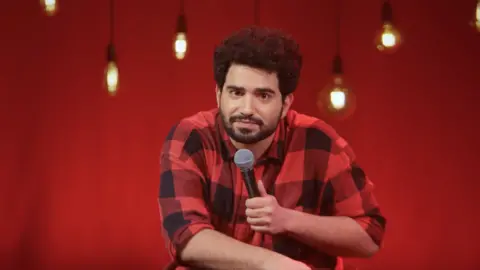 Samay Raina via YouTube
In an Indian city, an unassuming, slightly rumpled comedian walks into the spotlight for the first time in months.
Tousle-haired and clad in a checked shirt, Samay Raina half smiles on stage, as if a punchline is already poised at the edge of his lips. The audience laughs even before he begins speaking.
Until a year ago, Raina was at the top of India's burgeoning comedy scene, with millions of views online and sold-out shows across India and the world. His flagship YouTube show, India's Got Latent - a ragged, exuberant parody of talent competitions - had become an online phenomenon, blending absurd humour with sharp improvisation to capture the sensibilities of a generation raised on streaming culture.
Then, a joke uttered by someone else on the show brought everything crashing down.
Police complaints were filed alleging obscenity and a case was registered against the participants, including Raina. The fallout escalated when Raina's editor was arrested, prompting him to take down the entire series.
The controversy nearly ended his career. For months, he largely stayed off camera, avoiding public life.
Now, the 29-year-old comic is back, using the very thing that derailed him - humour - as his way of reclaiming the spotlight.
Earlier this week, he released Still Alive - a YouTube stand‑up special that reviewers have described as his boldest and most personal work yet.
The set blends humour and reflection, addressing his professional hiatus and the volatility of online fame: what it means to build a public identity in today's internet culture; the particular hell of losing it all, and how vulnerable he felt through it.
Once brash and unapologetic, his humour now carries a quiet melancholy - yet it lands with the precise timing of someone who has learned what it takes to survive.
"I always knew there'd be an FIR [police complaint] against me one day," he jokes ruefully. "I just never thought it would be for saying nothing."
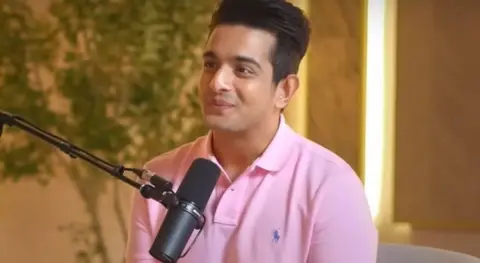 Beerbiceps via YouTube
Raina's route into comedy didn't follow the usual script.
Unlike the stand-up comedians who came of age in the small clubs of cities like Mumbai and Bangalore, Raina was a child of the internet.
A competitive chess player, he began streaming games online during the pandemic.
What followed was unexpected. Streams that began as focused chess sessions gradually loosened into something more freewheeling, with Raina interspersing gameplay with jokes and self-deprecating commentary, often engaging directly with the live chat.
His jokes - switching easily between Hindi and English and brimming with sarcasm and rooted in everyday observation - helped him build a large online following within a short span of time.
India's Got Latent was Raina's next leap, a sort of anti–talent show that mocked its own premise. Contestants performed for laughs and judges roasted them without mercy. The production was scrappy. The comedy style - expletive laden, raw and unhinged - upset some but was loved by millions of his fans.
The guest list was as eclectic as the format: fellow stand-ups, YouTubers, chess players and assorted internet personalities, each drawn into Raina's loose, improvisational orbit. For audiences long used to polished TV comedy, the impact felt electric: humour that was not defined by censors but was messy, daring and alive in real time.
That was both its charm and, eventually, its undoing.
When the episode featuring Allahbadia triggered backlash, the reaction was swift. Raina's YouTube channel fell quiet. Collaborators distanced themselves and even some loyal fans expressed disappointment.
In the months that followed, he largely stayed out of public view. Friends and fans speculated about his absence and within India's comedy circles, his name became shorthand for the risks of online fame.
In Still Alive, Raina addresses the hiatus with a mix of self-deprecation and defiance.
He jokes about the defamation suit, about the friends who stopped calling and the peculiar loneliness of being cancelled in the age of social media, where your worth is measured in real-time metrics.
In one of the episode's more poignant moments, Raina spoke about battling anxiety before performances, admitting that the pressure of returning to the stage often left him physically shaken. Moving clips of him describing feeling "broken" and how he struggled to answer his mother's calls have since gone viral.
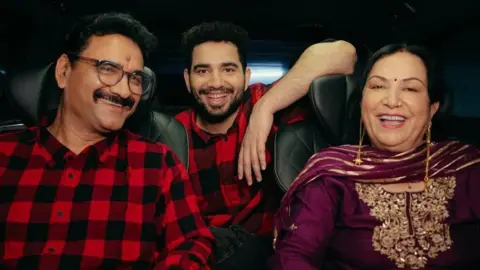 Samay Raina via Instagram
His experience mirrors a wider shift in Indian comedy. What was once a small, urban, English-speaking circuit has grown into a far bigger, more diverse scene, powered by YouTube and Instagram, where comics can reach millions directly. Live shows have surged too, drawing large audiences across cities and smaller towns alike, with regional-language comedy playing a big role in that expansion.
But with that expansion has come new pressures. Comics today operate with greater visibility and greater scrutiny. In recent years, several have faced police complaints, legal action and, in some cases, arrest over their material.
In Still Alive, Samay Raina gestures to that fragile balance: how jokes, once released into the online world, can travel far beyond their original context, taking on new meanings, and sometimes carry serious consequences.
At one point, he riffs on George Orwell's famous line that "every joke is a tiny revolution". With his trademark mix of irony and resignation, he twists it to fit his own experience. "If Orwell had lived in India," Raina adds, pausing just long enough for effect, "he'd probably have said - every revolution is a tiny joke". The line drew one of the night's loudest laughs.
Rather than reinventing himself, Raina seems to be adjusting his approach - testing how far his loose, spontaneous style can go without breaking.
It is a tightrope walk many young Indian comedians face: of staying authentic in a medium that rewards spontaneity, while performing for an audience that is vast, diverse and quick to judge.
There is no neat conclusion to this moment in his career. The controversy has not entirely faded and the risks of doing boundary-defying comedy remain.
But if Still Alive is any indication, Raina is less interested in resolution than in continuation. For fans, the special is not an apology, it's a reassertion - of his voice and his refusal to be flattened.
"I'm still here," he says towards the end, with a shrug that lands somewhere between defiance and a punchline, "and I am going to do whatever I want".

“I can’t wait to watch the game – it’s Lion’s Head Meatballs versus Hairy Crab!” Liu Jieling, a 42-year-old company executive from Suzhou, joked about a derby clash pitting a side inspired by her city’s signature crustacean cuisine against one by Yangzhou’s steamed meatballs. The 2026 season of the

China’s top intelligence agency has warned university students to be wary of lucrative job postings that may serve as covers for foreign espionage, as they begin searching for work ahead of a record graduation season. Offers such as earning 800 yuan (US$117) a day for remote data processing or resea

As the Strait of Hormuz reopened and closed again this week, manufacturers across China are navigating a roller coaster of concerns rooted in supply and pricing volatilities. Soaring oil prices have already filtered through to processed fuel and petroleum-based raw materials that help power China’s

A US delegation led by Vice-President J.D. Vance has arrived in Pakistan for peace talks aimed at reinforcing a fragile two-week ceasefire and ending hostilities with Iran after more than five weeks. The US negotiating team also includes Middle East special envoy Steve Witkoff and Trump’s son-in-law