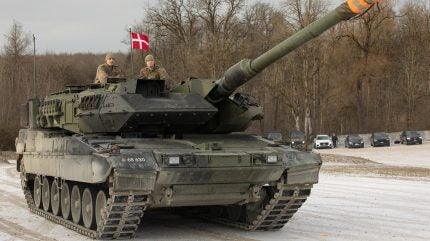
The Danish Ministry of Defence’s Materiel and Procurement Agency (FMI) has moved to increase the value of an ongoing 15-year framework agreement for the supply of tracks for its Leopard 2 tanks, first awarded in 2020.
According to a 20 March contract awarded notice, the FMI will increase the original framework agreement value by between DKK 355m-750m ($51.7m-115.9m) in a direct award to original equipment manufacturer KNDS Deutschland Tracks (formerly KMW).
Citing reasoning, the FMI said it had to increase the value of the original agreement “due to a greater need for the procurement of tracks for Leopard 2 family vehicles”.
In justifying the single-source award, the MFI stated the contract and the target value increase can be concluded and implemented without publication of a prior contract negotiation notice as it is “not possible to procure the tracks from anyone other than KNDS Deutschland Tracks”.
While a small country, Denmark maintains a capable military across the land, sea, and air domains. The Royal Danish Army operates a fleet of newly-modernised 44 Leopard 2A7 main battle tanks, having initially taken delivery of Leopard 2A5s in the late-1990s from German defence prime Rheinmetall.
Denmark had previously been part of a bilateral donation of 14 Leopard 2A4 tanks to Ukraine, announced in 2023.
Denmark: small but capable
By the end of 2023 and following Russia’s invasion of Ukraine, the European security paradigm had been upended and replaced with a growing realisation of the return of Great Power politics, a situation exacerbated with the returning US President Donald Trump.
Forecasts from GlobalData at the time said that security pressures would see Denmark’s defence budget rise from $5.1bn in 2023 to $6.3bn by 2028. Since this forecast, President Trump’s overtures to the acquisition of Greenland, a Danish overseas territory, forced additional defence spending from Copenhagen.