
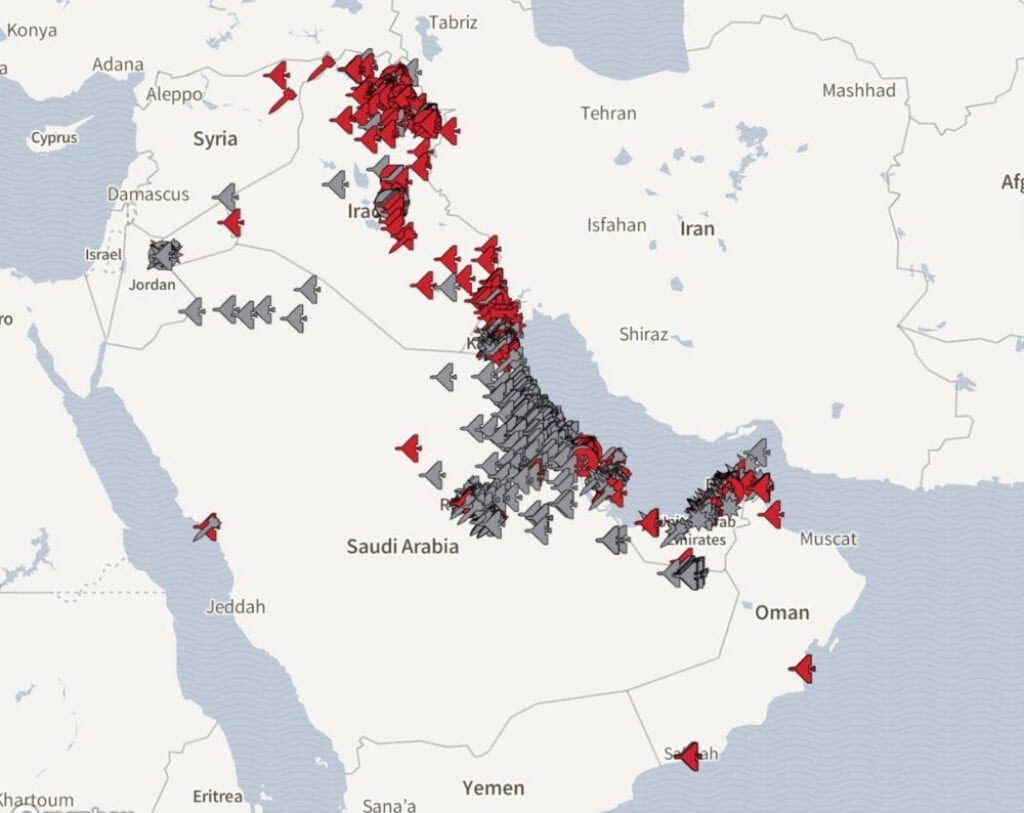
The ceasefire between the US and Iran has largely held since April 8, and large-scale Iranian barrages targeting Middle Eastern states have ended. However, some attacks, particularly against Iraqi Kurdistan, have continued.
Across nine primarily Arab states—Saudi Arabia, Bahrain, Kuwait, Qatar, the United Arab Emirates, Jordan, Syria, Iraq, and Oman—Iran and its allied proxy militias deployed thousands of aerial systems beginning on February 28. Reported and estimated attacks included:
The United Arab Emirates was the primary target by a wide margin, absorbing more than double the total attacks faced by Kuwait and nearly 10 times as many as Qatar. The 2,819 systems targeting the UAE are consistent with an Iranian campaign aimed at vital economic and logistical infrastructure.
In the case of Saudi Arabia, the campaign against the kingdom was overwhelmingly drone-heavy, with a nine-to-one ratio of drones to missiles. However, the missile component of Iran’s attacks, despite being smaller, repeatedly targeted high-value military and energy infrastructure, including Prince Sultan Air Base in Riyadh and key facilities across the Eastern Province. Drone waves repeatedly targeted the Shaybah oil field, the Ras Tanura refinery, pipeline infrastructure toward Yanbu, and more facilities in the Eastern Province.
In Kuwait, Iranian drones and missiles have struck Kuwait International Airport, damaging radar systems and fuel storage, as well as Ali al Salem Air Base, which hosts US personnel, where missile strikes caused significant runway damage. Additional attacks targeted Ahmed al Jaber Air Base, naval facilities such as the Mohammed al Ahmad Naval Base, and key energy infrastructure, including fuel depots and the Mina al Ahmadi and Mina Abdullah refineries. Civilian and government targets were also hit, including residential buildings, desalination plants, and the ministries complex in Kuwait City. Additionally, Kuwait’s geographic proximity to Iraq meant that some of these attacks originated from the neighboring state.
Qatar’s data gives the clearest insight into both targeting and defensive outcomes. With 69 drones, 196 missiles, and two aircraft directed toward its territory, Qatar faced a lower volume of attacks—267 total systems. However, it experienced a disproportionately high number of missile strikes compared to drone strikes. A notable repeated target was Al Udeid Air Base, which is the largest US military facility in the Middle East.
In Bahrain, Iranian drones and missiles struck the support office of the US Fifth Fleet. Energy infrastructure was also targeted, including the Bapco refinery, fuel storage sites, and industrial facilities, along with ports and maritime assets, including Salman Port and Khalifa Bin Salman Port. At the same time, Bahrain saw extensive strikes on civilian and commercial infrastructure. Drones hit residential buildings , as well as the Crowne Plaza hotel, wounding US personnel. Attacks extended to Bahrain International Airport, telecommunications infrastructure such as Batelco, and even cloud-linked infrastructure supporting Amazon services.
In Oman, Iranian drones struck or attempted to hit key maritime and energy infrastructure. These targets included the ports of Duqm and Salalah, as well as fuel storage facilities. Some attacks caused fires and casualties, resulting in deaths and injuries of foreign workers. Others were intercepted or caused limited damage. Oman, despite its close relationship with Iran, was not insulated from the campaign.
Jordan, which is significantly further from Iran than the Arab Gulf states, was targeted less than most other countries, with 125 drones and 166 missiles directed at it. The targeting profile was centered overwhelmingly on the Muwaffaq al Salti Air Base in Azraq, which hosts American and European forces. Multiple incidents involved ballistic missile strikes or attempted strikes on the base, including confirmed impacts and repeated explosions reported in and around the facility. German sources indicated that Iranian missiles hit sections of the base housing US and German personnel. Jordanian reporting shows a pattern of repeated missile-focused engagements, regularly involving fewer drones.
Attacks in Syria were limited in volume, focusing almost exclusively on US-linked military installations. Available reporting indicates that attacks were carried out primarily by Iran-backed militias, often operating from Iraq, and, in some cases, were claimed by front groups, such as the Syrian Popular Resistance and the Islamic Resistance in Syria. At least five rockets struck the Kharab al Jir base in northeastern Syria. Drone attacks targeted the Tanf garrison in the southeast, but Syrian authorities reported that all incoming drones were intercepted. Additional drone strikes hit the Qasrak base, which was the last remaining US military base in the country until April 15, when US forces withdrew to Jordan, ending a 12-year presence in Syria.
Iraq, particularly Iraqi Kurdistan, was among the conflict’s most active fronts. Iran-backed militias and, at times, the Islamic Republic itself, repeatedly targeted US diplomatic and military facilities, Iraqi and Kurdish security sites, energy infrastructure, and Iranian-Kurdish opposition camps. In federal Iraq, the Baghdad Diplomatic Support Center was attacked consistently with drones, rockets, and missiles. The US Embassy in Baghdad, Balad Air Base, Ain al Asad Air Base, K1 Air Base, Camp Taji, and Iraqi intelligence and military facilities also came under repeated fire. Oil infrastructure was also targeted, with strikes hitting the Rumaila, Majnoon, West Qurna, Buzurgan, and Artawi oil fields, as well as port facilities in Umm Qasr.
In Iraqi Kurdistan, attacks concentrated on Erbil International Airport, the US consulate, Harir Air Base, Peshmerga bases, foreign diplomatic facilities, energy sites, such as Sarsang, and Iranian-Kurdish opposition camps and headquarters. Some attacks were claimed by Iran-backed Iraqi militia fronts, including Saraya Awliya al Dam and Ashab al Kaf. Others were more directly attributed to the Islamic Republic of Iran, especially the missile and drone strikes against Kurdish opposition targets.
Most importantly, the US-Iran ceasefire did not end this front. Even after April 8, attacks have continued in Iraqi Kurdistan:
Ahmad Sharawi is a senior research analyst at the Foundation for Defense of Democracies focused on Iranian intervention in Arab affairs and the Levant.
Tags: bahrain, Iranian strikes on Arab states, Iraq, Iraqi Kurdistan, jordan, kuwait, Qatar, Saudi Arabia, Syria, uae, US-Iran, US-Iran ceasefire


