16 hours ago
Sebastian Usher,Jerusalemand
Paulin Kola
Thousands of displaced Lebanese residents will not be allowed to return home until northern Israel is safe, Israel's defence minister says.

16 hours ago
Sebastian Usher,Jerusalemand
Paulin Kola

 EPA
EPA
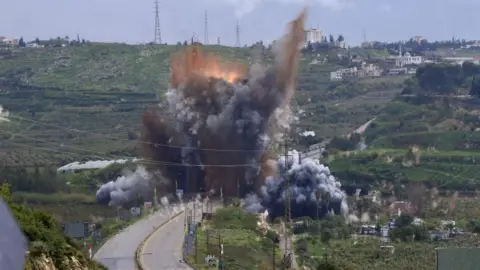
Israeli troops will control a large swathe of southern Lebanon as part of their campaign against Hezbollah, Defence Minister Israel Katz says.
Katz said troops had blown up bridges on the Litani River, about 30km (19 miles) from the Lebanon-Israel border, and a security zone would be established, with displaced residents not being allowed back until northern Israel was safe.
Five bridges "used by Hezbollah for the passage of terrorists and weapons" had been blown up, he said.
The latest escalation began after Iranian-backed Hezbollah fired rockets into northern Israel in retaliation for the killing of Iran's supreme leader and near-daily strikes on Hezbollah despite the November 2024 ceasefire.
Since then, 1,072 people have been killed in Lebanon, according to the Lebanese health ministry, including at least 121 children and 42 health workers.
More than a million people have been displaced, worsening an existing humanitarian crisis in Lebanon.
Israeli officials say the aim is to protect communities in northern Israel from Hezbollah attacks.
Israeli residents had returned to towns in the region after the ceasefire. For around a year and a half before that, they had been unable to go back to their homes because of rocket attacks by Hezbollah.
It would be a major blow to both the communities and the Israeli government if they were forced to evacuate again from Hezbollah, however weakened it now is.
Fighting escalated after the group fired at Israeli positions a day after the Hamas attack of 7 October 2023, drawing immediate Israeli retaliation.
In his briefing with defence chiefs on Tuesday, Israel Katz added that the aim would be "to create a defensive space and keep the threat away". The strategy is based on the model followed in Rafah and Beit Hanoun - major population centres in the Gaza Strip that have been largely destroyed by air strikes and remain under Israeli military control.
Katz said the Israel Defense Forces (IDF) was now "manoeuvring into Lebanese territory to seize a front line of defence, eliminating Hezbollah terrorists and destroying the terrorist infrastructures that were established there", as well as houses which he said were used by Hezbollah near the border.
He said that the many thousands of Lebanese people in the south who have been displaced "will not return south of the Litani River until security is guaranteed for the residents of the north" of Israel.
Southern Lebanon is the heartland of Lebanon's Shia Muslim community, Hezbollah's main support base. But it is also home to other communities, including Christians.
Under the ceasefire agreement that ended the war in 2024, Hezbollah was meant to disarm and leave its positions in the south. This was to be supervised by the Lebanese government and army.
Progress was made, but it was partial. Israel also maintained several military posts in the south and continued to carry out regular attacks on what it said were Hezbollah targets.
The will may have been there for the Lebanese government to disarm Hezbollah, but it has always lacked the ability to do so. The prospect of a major confrontation between the Lebanese state and Hezbollah has also long been a major concern, reawakening fears of a descent back into civil war.
Israel Katz has said that Israel is now acting because the Lebanese government had done "nothing".
Lebanon's President Joseph Aoun has described the Israeli plans as a "collective punishment against civilians".
The creation of a what Katz described as a "defensive buffer" inevitably raises echoes of the buffer zone that Israel set up in southern Lebanon in 1985 and maintained up until 2000.
A big part of the motivation for its withdrawal was the attrition that Hezbollah was able to inflict on Israel. Footage of dead and wounded Israeli soldiers being regularly helicoptered out of the zone turned the Israeli public against the policy.
Now, Hezbollah is saying it's prepared to fight again to prevent Israel from taking hold of the south. A top Hezbollah official, Hassan Fadlallah, said it was an "existential threat".
He went on: "We have no choice but to confront this aggression and cling to this land."
Images online show banners quoting Hitler in Persian as Tehran continues arrests and executions of those accused of aiding Israel.
According to the report, Hezbollah is searching for “creative vulnerabilities” that could enable it to seize Israeli troops in an area where the chances of success are higher.
Smoke rose from the location following the attack, the sources added.
Asia is at the frontline of the fuel crisis, buying more than 80% of the crude that transits the Strait of Hormuz, which has been almost totally blocked by Iran since the war broke out in February.