
RIGA, Latvia — Latvia will deploy mobile drone-interceptor units to its eastern border within a matter of days in response to a string of drone incursions from the direction of Russia, according to the head of the Baltic country’s Autonomous Systems Competence Center.
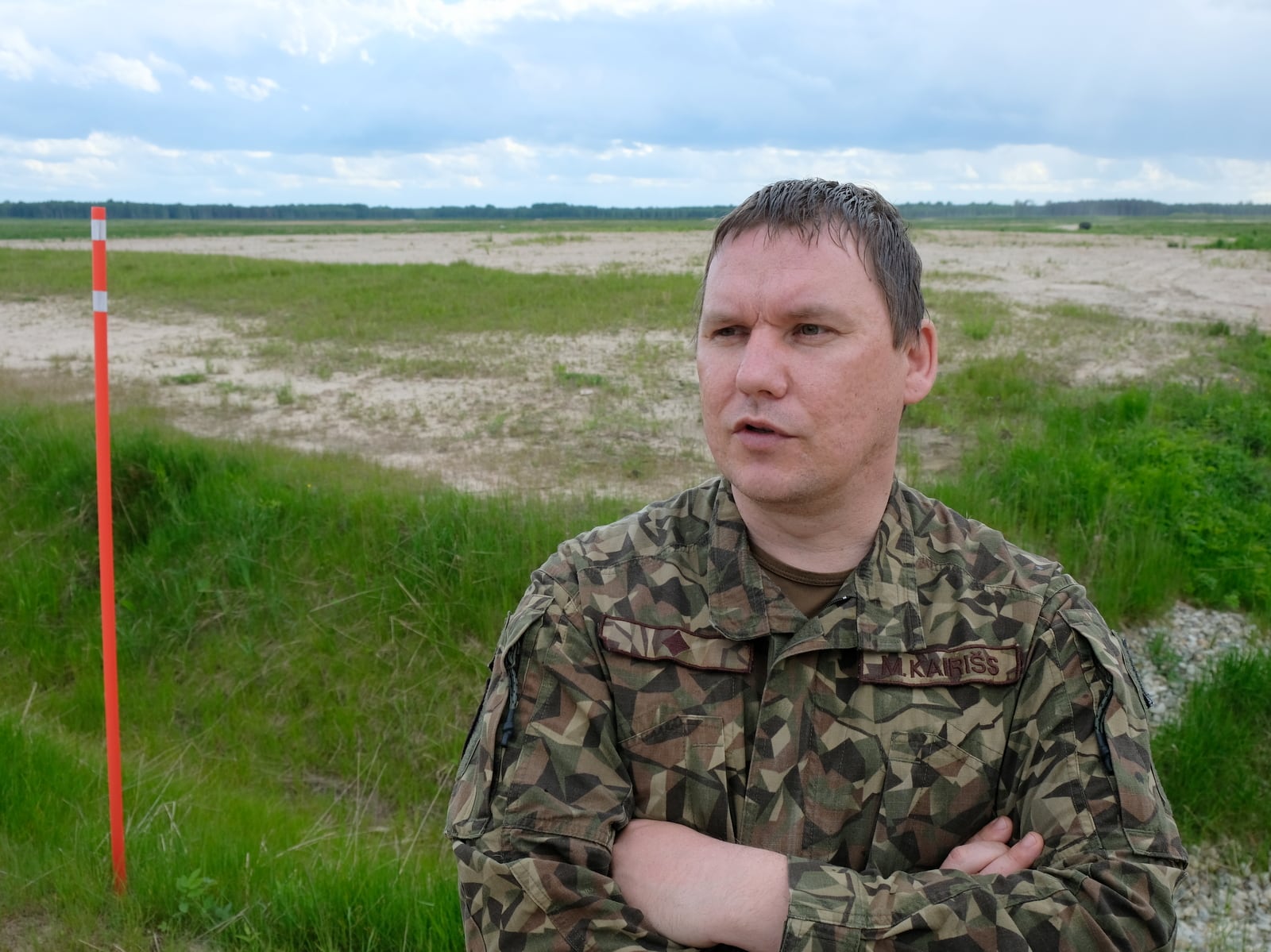
The Latvian armed forces will deploy teams up to four soldiers in 4x4 vehicles, equipped with interceptor drones from Latvian manufacturers Origin Robotics and Eraser, to the eastern border with Russia, said Maj. Modris Kairišs, head of the center, in a briefing with reporters here on May 26. The goal is to have the units operational by early next month, he said.
Low-altitude drone defense has become one of the most critical security gaps for Latvia and neighboring Lithuania and Estonia amid a growing number of drone incursions from the direction of Russia. Independent Russian media outlet Novaya Gazeta Europe counted at least 24 drone incidents in the three Baltic countries since early 2025.
“The force teams we plan to deploy to the border in the coming days will be equipped with local interceptor drones,” Kairišs said, adding that the number of teams to be deployed is confidential.
Latvia’s government collapsed this month in the wake of a renewed incursion of Ukrainian drones into the country’s airspace, with two drones crashing in Latvian territory on May 7, including one that hit an empty fuel depot, and a third drone entering the country’s airspace before leaving again. Kairišs said Russia is using “very powerful” jamming to disrupt navigation of Ukrainian drones.
“At least if we will send these initial teams, it will solve the society requirements, politicians’ requirements, and we are moving forward,” Kairišs told Defense News. “Let’s say it is initial capability. We need a lot of teams to fully cover the border.”
Ukraine has been using mobile fire teams to defeat Russian drone threats since 2022, though the country has increasingly shifted to interceptor drones.
Interceptor teams are not a long-term answer, according to Kairišs, who instead envisages a future solution of fully automatic interceptor drones stationed along the border in launch canisters, “where you can, from the command and control center, just give the command to intercept.” He said Latvia is testing what he called “launch-box technologies.”
“This is where Western countries need to move, because our human resource is very expensive,” Kairišs said.
With Latvia’s eastern border with Russia and Belarus nearly 400 kilometers long, achieving Ukrainian-style levels of drone protection would require “a huge number” of personnel and put significant stress on the armed forces, Kairišs said in the briefing. He said Latvia needs to “find a balance between peacetime and war.”
The country is counting on assistance from Ukrainian experts for tactical advice and practical operator experience on intercepting drones, according to Kairišs. He said Latvia is seeking Ukrainian expertise rather than hardware, for example, on tactical procedures related to the kill chain and sensors.
One of the biggest challenges NATO faces in dealing with drone threats is what Kairišs called “a legacy way of thinking” around command and control, in which all sensor data is fused and information classified. Delivering that classified information to a mobile group operating near the border then stumbles over procedures that disrupt effective C2 at the tactical level, the Latvian major said.
Kairišs said countries need a cross-border solution for drone interception that allows for command and control at a “very low classification level.” With multiple NATO countries working on their own C2 systems for drone defense, there will need to be an effort to let them work together, he said.
Shahed-type drones, once detected, are “not a hard target” due to their relatively low speeds, according to Kairišs, who compared them to World War I-era biplanes. However, detection is the hardest part, with the drones flying at low altitudes and usually built from cheap composite materials that are radar-transparent, the major said.
Latvia has deployed a network of acoustic sensors for several months already, which when combined with radar and optical sensors is “quite effective,” Kairišs said. With drones flying at altitudes of 50-100 meters, detecting them requires tactical radars every 10 to 20 kilometers, with associated infrastructure, he said.
Latvia hosts the NATO innovation range for counter-unmanned aerial systems at the Sēlija training area in the center of the country, and is taking a leading role in the alliance’s C-UAS efforts. European countries and more broadly NATO lack the opportunity to test systems against real front-line drones, which is something the Sēlija range allows, Kairišs said.
Testing of drones, counter-UAS and electronic warfare is “almost impossible” in some European countries due to bureaucracy, population density and air-traffic density, “and here in Latvia we have this opportunity, and we want to share it,” the Latvian major said.
He said that due to the urgency of the security situation, the government has exempted the Sēlija range from some restrictions regarding use of electronic warfare and high-altitude flights, and Latvian forces are “more or less” capable of simulating current battlefield conditions as they exist on parts of the front line in Ukraine.
In addition to interceptor drones, Latvia is field-testing an automated .50 caliber turret that Kairišs said may be demonstrated within several weeks, as well as working on electronic warfare and cheap missile systems. The Autonomous Systems Competence Center has special governmental permission to fast-track procurement, Kairišs said.
Rudy Ruitenberg is a Europe correspondent for Defense News. He started his career at Bloomberg News and has experience reporting on technology, commodity markets and politics.

