
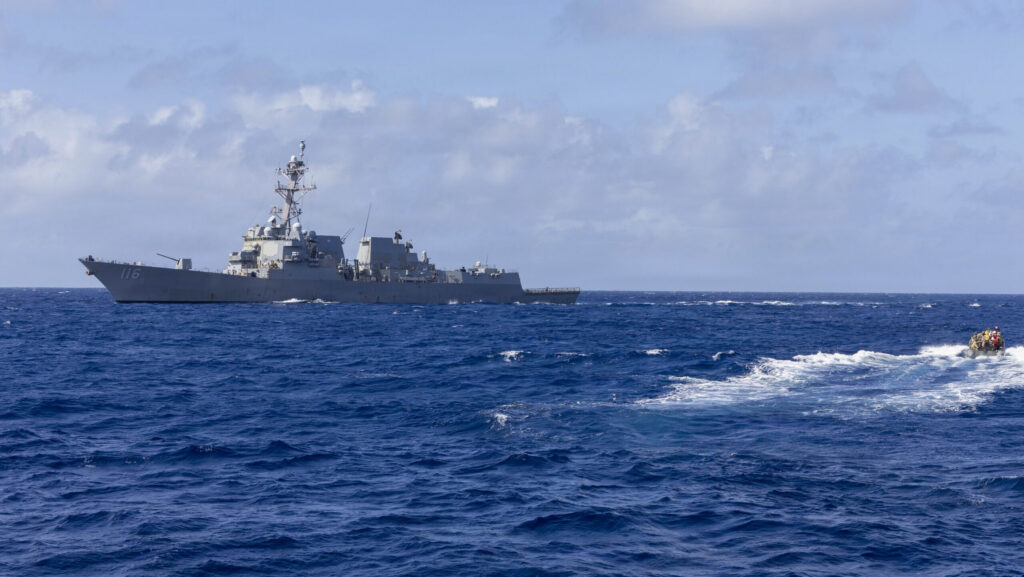
WASHINGTON — The Defense Innovation Unit (DIU) has awarded defense manufacturing company Mach Industries a contract award for the Runway Independent Maritime Expeditionary Strike (RIMES) program, in pursuit of a drone to execute long-range strikes with minimal infrastructure.
The Navy is looking for an unmanned aerial system (UAS) that can operate from ships without a large flight deck — like Arleigh Burke-class destroyers — to conduct long-range strikes amid heightened threats from anti-ship weapons, according to the RIMES program solicitation published in February.
Mach Industries will work with propulsion provider Whisper Aero to spearhead development and program execution to design and deliver a next-generation aircraft called Atlas for the RIMES program, the company said today.
“Atlas can use unimproved rotary-wing landing zones, while maintaining the control simplicity of a fixed-wing aircraft and a thrust-to-weight ratio that is less than half of what is required for vertical flight,” Mach Industries said in a news release today. “This, along with highly efficient propulsors, result in significantly increased range, as well as radical reductions in acoustic signature.”
The initiative will utilize Whisper Aero’s JetFoil propulsion system, in alignment with DIU requirements to launch without a runway.
“We developed JetFoil to propel the next generation of conventional, short, and vertical takeoff and landing aircraft silently and efficiently,” Mark Moore, CEO of Whisper Aero, said in a statement today. “With JetFoil, Atlas can effectively meet the needs of the RIMES mission to operate even from Destroyer class vessels.”
The RIMES program solicitation said the DIU is seeking a drone with a one-way range of at least 1,400 nautical miles that can be outfitted with 1,000-pound munitions that currently arm aircraft like the F/A-18 Super Hornet. Likewise, the drone must have the capability to launch from “expeditionary locations with minimal infrastructure, or from ships without large flight decks,” the notice said.
Currently, naval surface combatants are “constrained in their ability to support long-range strikes over extended combat operations due to reliance on single-use missile systems, with limited magazine depth and limited at-sea munition replenishment capability,” the notice said.
DIU’s solicitation notice said that it was seeking “cost-effective” solutions that were ready for “significant physical prototyping within 12 months of agreement award.”
A spokesperson for Mach Industries confirmed it is not the only one receiving a contract for the program. DIU did not respond to a request for comment from Breaking Defense by publishing time regarding details of the contract value, or which other firms were awarded contracts for the program.

