
On Tuesday, May 26, South Korea’s Ministry of National Defense announced the “Basic Plan for the Development of the Republic of Korea Nuclear-Powered Submarine.”
Republic of Korea Ministry of National Defense Press Release Translated by Naval News
The “Basic Plan for the Development of the Republic of Korea Nuclear-Powered Submarine” is the first document to present, both domestically and internationally, the direction for the Republic of Korea to systematically develop a nuclear-powered submarine. Its main contents are as follows.
Nuclear-powered submarines possess dramatically enhanced operational capabilities compared to existing diesel-powered submarines, including long-duration submerged endurance and high mobility. They will therefore play a key role in responding to North Korea’s submarine-based nuclear and missile threats.
The development of nuclear-powered submarines is not merely a warship construction project, but a national strategic project that requires the concentration of national capabilities based on the Republic of Korea’s technologies in the nuclear and shipbuilding sectors. The project will be developed systematically and in phases while observing the following five principles.
In addition, based on the trust of the international community, the Republic of Korea will transparently and firmly fulfill its non-proliferation obligations, and makes the following three commitments.
Furthermore, the Republic of Korea will firmly maintain nuclear safety and security throughout the implementation of the nuclear-powered submarine project, and will safely and systematically manage all radioactive waste generated from nuclear-powered submarines in accordance with relevant laws and regulations.
The development of nuclear-powered submarines is a national industrial development project spanning more than 40 years, including 10 years of construction and more than 30 years of operation, that connects the shipbuilding, nuclear, and defense industries, and will contribute to the development of industry.
Going forward, the government will name the nuclear-powered submarine project the “Jangbogo-N Project” and promote it as a core national-level force acquisition project.
This name carries the meaning of inheriting the spirit of the Republic of Korea’s first submarine, ROKS Jangbogo(SS-061), while building a next-generation model, applying nuclear-powered propulsion, and integrating advanced new technologies.
The Ministry of National Defense will continue to concentrate all national capabilities of the Republic of Korea so that the nuclear-powered submarine project can become a historic milestone that opens a new horizon for the Republic of Korea’s maritime security.
-End-
Naval News Comment
By adopting low-enriched uranium, generally understood as uranium enriched to less than 20%, South Korea appears to be signaling its commitment to international non-proliferation obligations, while reducing some of the political and non-proliferation sensitivities surrounding nuclear fuel supply.
Another notable point is the plan’s emphasis on domestic development and construction, as well as the use of South Korea’s accumulated civilian nuclear and shipbuilding technologies. This appears to alleviate concerns that the program could rely heavily on foreign technology, instead pointing to Seoul’s intention to establish a more self-reliant framework for development, production, sustainment, nuclear fuel management, decommissioning and radioactive waste management.
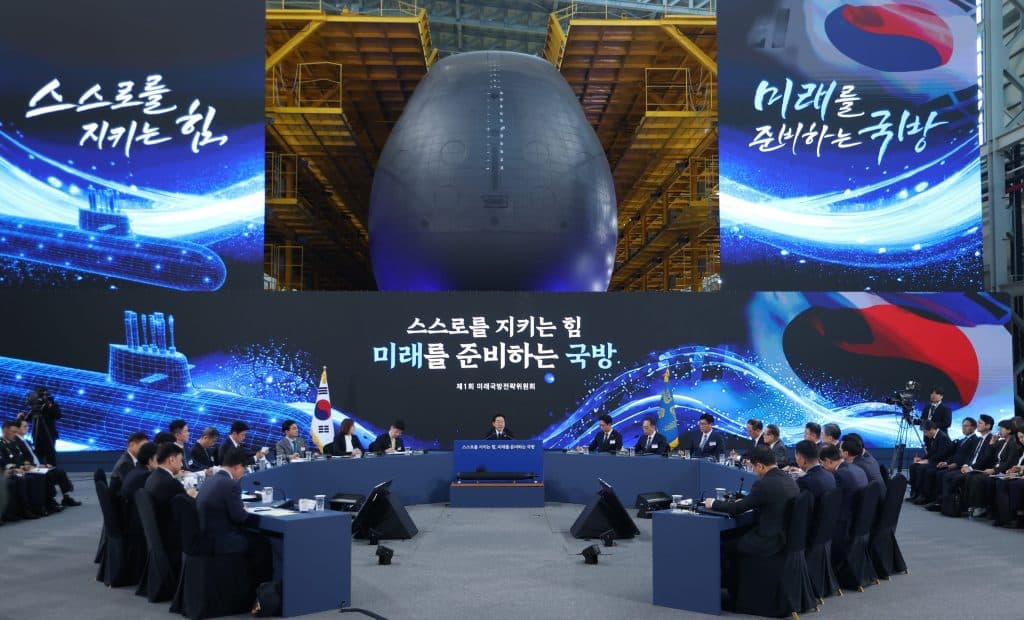
Coming on the same day as President Lee Jae-myung’s call to accelerate the introduction of nuclear-powered submarines and swiftly pursue the transition of wartime operational control, the announcement appears to fit within Seoul’s broader push for greater defense autonomy. It also reflects South Korea’s ambition to become a stronger maritime power based on its own industrial and technological capabilities.