While President Trump claims to have a "very good relationship with President Xi," with a bit of friendly competition, divisions between Washington and Beijing are growing deeper.
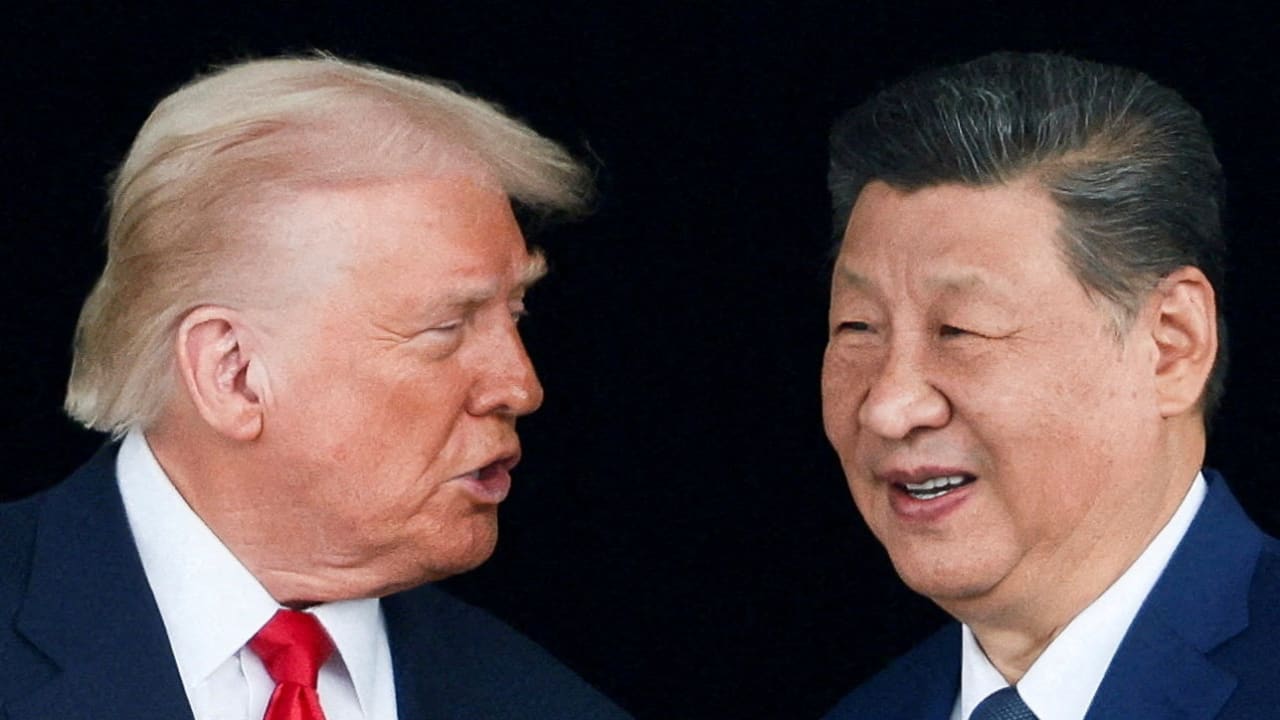
Ahead of the US-China summit, the world’s two largest economies are preparing for a high-stakes meeting in Beijing, where US President Donald Trump and Chinese President Xi Jinping are set to meet at a critical moment as personal chemistry and national rivalry collide on the global stage.
“I have a very good relationship with President Xi,” Trump told reporters ahead of the trip. “I find him to be a tremendous guy. We have a friendly competition — a very friendly competition.”
Yet beneath the phrase “friendly competition” lies a deepening geopolitical and strategic divide.
Take, for example, the Strait of Malacca — the narrow waterway linking the Indian Ocean and the South China Sea, through which roughly 40% of global trade and a quarter of the world’s oil supply passes.
“The Strait of Malacca is a critical trade route for the world, but for China, it is a lifeline,” said Noam Urbach, an analyst of Chinese affairs.

Beijing summit to test US-China relations
Urbach said Beijing is increasingly concerned about expanding US-Indonesian defense cooperation. The Major Defense Cooperation Partnership grants the US military broader operational access to Indonesian airspace, along with enhanced radar and surveillance capabilities over the Strait of Malacca. That would allow Washington to closely monitor one of the world’s most important economic chokepoints.
“When Beijing sees the closure of the Strait of Hormuz alongside new agreements between Washington and Indonesia, fears grow that the US could block Malacca in the event of a confrontation.”
The summit also comes as the Trump administration continues pressuring China to increase purchases of American goods, including agricultural products and Boeing aircraft.
In recent years, Trump’s primary response to the growing economic rivalry with China has been tariffs. Yet despite the administration’s latest measures, recent data showed Chinese exports surged by more than 14% in April, complicating Washington’s narrative of economic leverage.
Dr. Doron Ella, a China researcher at the School of Political Science at the University of Haifa, said both sides appear interested in reaching an economic agreement even as they recognize the broader struggle is only beginning.
“The Chinese desire — and perhaps Trump’s as well — is to reach a deal that benefits all sides in terms of trade and investment,” Ella said. “But both sides understand they are in a race. Each side essentially wants to buy time and resources in order to become as strong as possible.”
The race for technological dominance has emerged as a new front line, particularly in the fields of artificial intelligence and semiconductor independence.
While Trump has asserted that “we are leading China in AI,” Beijing is working aggressively to bypass American export restrictions on advanced semiconductor chips.
“China is not yet at the stage where it can independently develop and manufacture advanced chips, though it is moving in that direction,” Ella said. “For now, it still relies on chips coming from the rest of the world, including the United States.”
Perhaps the most explosive issue on the agenda is the status of Taiwan.
With the Chinese Communist Party approaching its 100th anniversary next year, many analysts fear Beijing could adopt a more assertive approach toward the island, which China considers part of its territory.
President Xi Jinping has been unequivocal in his rhetoric.
“The Chinese people will never allow any foreign force to bully, oppress, or enslave us,” Xi said in a recent address. “Resolving the Taiwan issue is the Chinese people’s own business. Those who dare to interfere will find themselves facing a steel wall of 1.4 billion Chinese people.”
Urbach noted that Taiwan will likely be central to the diplomatic bargaining during the closed-door meetings.
“China wants a declaration from Trump that the United States does not support — and will not defend — Taiwan in the event of a declaration of independence,” Urbach said, adding that Beijing is also seeking a reduction in US arms sales to the island.
