14 minutes ago
Yang Tianand
Helen Sullivan

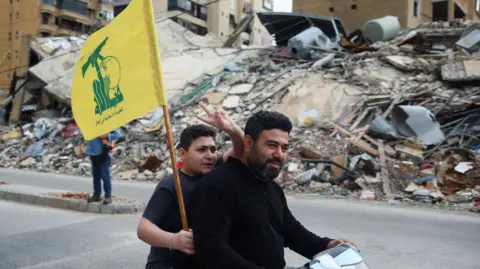 Reuters
A 10-day truce between the two countries is now in effect, with Iran-backed Hezbollah voicing support, as negotiations continue between the US and Iran.

14 minutes ago
Yang Tianand
Helen Sullivan
Reuters
US President Donald Trump has announced that the leaders of Israel and Lebanon have agreed to a 10-day ceasefire, which took effect from 17:00 EST (21:00 GMT; midnight local time) on 16 April.
There was no mention in Trump's statement of Hezbollah, the Iran-backed militant group in Lebanon, with which Israel has been exchanging fire for the past six weeks. But in a later post on Truth Social, Trump urged the group to abide by the ceasefire, saying, "I hope Hezbollah acts nicely and well during this important period of time."
Following the announcement, the US president also invited Israeli Prime Minister Benjamin Netanyahu and Lebanese President Joseph Aoun to the White House for further talks.
Here is what we know about the truce.
The terms of the deal specify that the ceasefire is set to last 10 days, with the possibility it being "extended by mutual agreement" if negotiations show signs of progress.
According to further details provided by the US State Department:
The statement added that the truce was a "gesture of goodwill" by Israel intended to enable "good-faith negotiations towards a permanent security and peace agreement" between the two parties.
Israel and Lebanon's leaders have both welcomed the truce, with Netanyahu calling it an "opportunity to make a historic peace agreement".
Lebanese Prime Minister Nawaf Salam said he hopes the agreement will allow those have been displaced by the conflict to return to their homes.
Hezbollah have also signalled a willingness to participate in the ceasefire, but said it must include "a comprehensive halt to attacks" across Lebanon and "no freedom of movement for Israeli forces".
The Iran-backed group, while deeply embedded in Lebanon, is not part of the Lebanese government's security apparatus.
Iran's foreign ministry welcomed the ceasefire, with spokesperson Esmail Baghaei expressing his "solidarity" with Lebanon. Tehran had insisted that its own two-week ceasefire with the US should include Lebanon while the US and Israel said it did not.
UN Secretary General António Guterres commended the role of the US in facilitating the ceasefire, and urged all parties to "fully respect" and "comply with international law at all times".
President of the European Commission Ursula von der Leyen called the deal a "relief", saying Europe will continue to "call for the full respect of Lebanon's sovereignty and territorial integrity".
EU foreign policy chief Kaja Kallas added that the ceasefire must be used to "step back from the violence" and create space for talks for "a more lasting peace".
Despite the agreement, Netanyahu said Israeli troops would remain stationed 10km-deep (6.2 mile) into southern Lebanon.
UN figures show that across Lebanon, more than 1.2 million people have been displaced, the majority of these from the south.
Israel re-entered southern Lebanon after strikes by Hezbollah in early March, and has described the area occupied as a "security zone", with Netanyahu saying this week: "We are there, and we are not leaving."
Israeli Defence Minister Israel Katz previously said the area to be occupied would go up to the Litani River in southern Lebanon - about 30km (18.6 miles) from the border with Israel.
He also said all houses in Lebanese villages near the Israeli border would be demolished.
Lebanon's Defence Minister Maj Gen Michel Menassa said Katz's remarks reflected "a clear intention to impose a new occupation of Lebanese territory". European nations, Canada and the UN also criticised Israel's announcement.
A previous ceasefire deal between Israel and Hezbollah - ending 13 months of conflict - still saw near-daily cross-border strikes.
Israel and Lebanon held rare direct talks in Washington earlier this week week aimed at easing the war, which has seen deadly air strikes on part of the Lebanese capital of Beirut and fighting in the country's south.
Trump's announcement said the deal came about after "excellent conversations" with Aoun and Netanyahu, but did not mention whether Hezbollah was directly involved in the talks.
He later urged Hezbollah to "act nicely and well during this important period of time" on social media.
Netanyahu, while welcoming the truce, also made clear that he was making few concessions on the ground.
He said Hezbollah had insisted on two conditions: the withdrawal of Israeli forces from Lebanon, and a principle of "quiet for quiet".
A widely respected Israeli news outlet tonight described Netanyahu convening a security cabinet meeting with just five minutes notice, shortly before the ceasefire announcement was made.
Leaks from that meeting say ministers were not given a vote on the ceasefire.
When the ceasefire with Iran was announced, there were mixed messages on whether Lebanon was involved. Pakistani officials, who helped negotiate the deal, and Iranian officials, said it was, but Israel said it was not. US President Donald Trump's press secretary Karoline Leavitt also later said Lebanon was not part of the deal.
Israel launched strikes on Lebanon on 2 March in response to strikes launched by Hezbollah. This was after the US and Israel launched strikes on Iran – prompting retaliation from Tehran against US allies in the Gulf, and from Iran's proxies, which includes the Lebanese militant group.
Israel and Hezbollah have continued to exchange fire since then, despite pleas from Lebanon's Prime Minister for both sides to stop doing so.
Hezbollah attacks have killed two civilians in Israel over the same period, while 13 Israeli soldiers have been killed in combat in Lebanon, Israeli authorities say.
On Thursday, the Israeli military destroyed the last bridge linking the south to the rest of the country, further isolating the region and renewing fears among many Lebanese that this could lead to a long-term occupation of some areas.
Student delegations to Poland, ceremonies, museums, and educational programs – all of these are essential. But memory is not an end in itself; it is a means.
Another five tankers, loaded with approximately 9 million barrels of oil, were spotted in the Gulf of Oman earlier this week and are no longer visible in the images.
Amid a fragile ceasefire, Iranians face mounting concerns about their future, with an economy in tatters and fears of growing government control.

Iran command says Hormuz closed again over US blockade Iran's central military command announced on Saturday it would resume "strict management" of the Strait of Hormuz, reversing a decision to unblock the strategic channel as part of nego