
Effective Anti-Drone Warfare demands a complete kill chain – detection, identification, tracking, and hard-kill engagement – with every link matched to the physics and economics of the Tier 2 OWA drone threat. This article examines the technology choices for each link: why only AESA radar meets the detection requirement, what the electro-optic director must deliver, and how the principal effector classes compare against the demands of the ADW mission.
This article on anti-drone warfare is written by Mr Hasan Özyurt, (R) Rear Admiral, currently working at ULAQ Global as Naval Systems Coordinator.
The first article in this series established Anti-Drone Warfare as a distinct operational domain, with its own threat physics, engagement economics, and platform requirements. Two principles govern the analysis that follows. Forward deployment is essential: when the threat axis is from the sea, defence cannot begin at the shoreline, and effective maritime ADW requires meeting the threat earlier, along the threat axis itself. And tiered overlap provides depth: the three-tier framework – Tier 1 Counter-UAS, Tier 2 ADW, Tier 3 Anti-Air Warfare – reflects the reality that no single system covers the full threat spectrum, so a system optimised for Tier 2 that can also reach into Tier 1 and the lower end of Tier 3 provides defence in depth.
The Kill Chain Problem
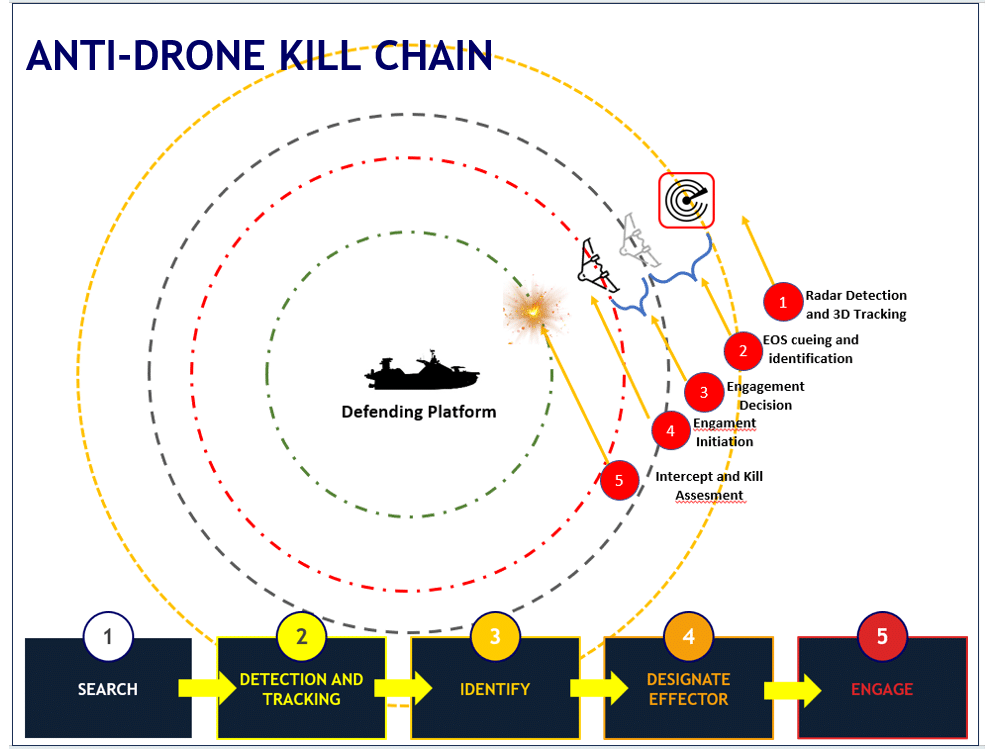
Defence against DoD Group 3 / NATO Class II OWA drones requires a complete kill chain executed within a highly compressed time window. Detection must occur at a range that allows sufficient reaction time, identification must confirm the contact as hostile, tracking must maintain fire-control-quality data, and hard-kill engagement must destroy the drone before it reaches its target.
The failure of any single link renders the entire chain ineffective. A sensor that detects but cannot track, an electro-optic system that identifies but cannot designate, or an effector with insufficient kill probability or slow reaction time all yield the same outcome: a leaker. Against a port, an energy installation, or a ship at anchor, a single leaker can be fatal. Technology selection is therefore not about the best individual component – it is about assembling a coherent chain matched to the platform’s constraints, cost boundaries, and engagement timelines.
Detection and Tracking: The First and Hardest Problem
The detection challenge is defined by two compounding parameters: radar cross-section (RCS) and platform constraints. Tier 2 OWA drones present an RCS as low as 0.1 m², making them virtually invisible to legacy air search radars. Large naval AESA systems can detect targets down to 0.01 m², but they are designed for large warships and are too heavy, power-intensive, and expensive to serve as scalable, forward-deployed screening solutions. Establishing a detection barrier across a maritime threat axis demands sensors that can be fielded in numbers on small, unmanned platforms within tight size, weight, and power (SWaP) constraints.
Passive systems – RF direction-finding and acoustic sensors – face a fundamental limitation: they generally cannot provide the three-dimensional data required for engagement-quality tracking, and the operational trend toward autonomous OWA variants that transmit nothing in their terminal phase leaves them with no signal to find. Passive detection is consequently relegated to Tier 1 C-UAS or secondary cueing roles.
Compact Active Electronically Scanned Array (AESA) radar, purpose-designed for the counter-UAS mission, solves these issues. Modern compact AESA designs achieve detection and tracking of targets with an RCS as low as 0.01 m² within the SWaP envelope of a small-to-medium Unmanned Surface Vessel (USV). They provide 360° coverage with simultaneous multi-target track-while-scan, maintain performance in adverse weather, and cover the full speed envelope from slow piston-engine types to jet-powered variants. Compact AESA radar forms the foundation of Tier 2 ADW detection.
| System | Detection range vs OWA drone | USV compatible | ADW employment |
| Compact AESA radar | 8–12 km | Yes | Primary sensor |
| Mechanical rotating radar (legacy) | <5 km | Marginal | Not suitable |
| EO/IR (radar-cued) | 8–12 km | Yes | Primary sensor for tracking and identification |
Identification and Fire Control: The Electro-Optic Director
While AESA radar manages search and tracking, the Electro-Optic System (EOS) delivers identification and fire control after receiving a radar cue. It performs three sequential functions: slewing automatically to acquire the target visually, providing high-resolution data to confirm hostile intent, and delivering continuous fire control – coded laser designation or seeker handoff – followed by post-impact kill assessment.
Positive identification of a target 2.5–3.5 metres in length must be achievable at 5–10 km under maritime conditions, requiring a stabilised gimbal capable of sub-pixel tracking accuracy despite sea-state-induced motion, and automatic radar-to-EOS handoff to match tight engagement timelines. Reliability across this envelope depends on multi-spectral capability: daylight cameras for highest resolution in favourable conditions, thermal MWIR channels to see through darkness, haze, and smoke, and SWIR channels to penetrate maritime aerosol and humidity.
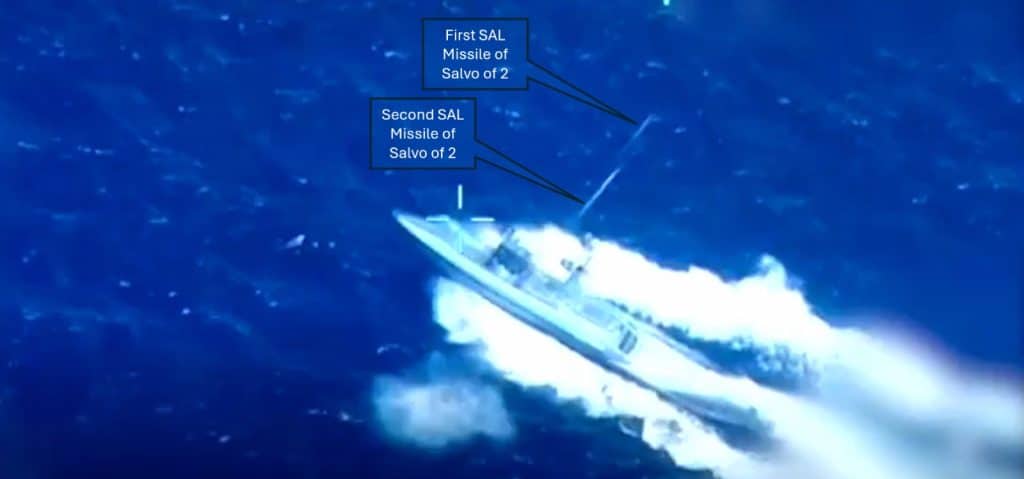
The choice between a high-end integrated suite and a mid-tier compact director depends on the effector carried. A platform using Semi-Active Laser (SAL) guided missiles needs a coded laser designator and precise stabilisation to maintain illumination through missile flight, while IR/IIR fire-and-forget effectors can use a mid-tier EOS focused mainly on cueing and lock-on confirmation.
| Function | Component | Requirement |
| Acquisition and tracking | Gyro-stabilised gimbal | Sub-pixel stability through sea state 4; auto-slew from radar cue |
| Identification | Daylight, MWIR, and SWIR channels | Positive ID at 5–10 km in clear and degraded conditions |
| Fire control | Coded laser designator or LOS data output | Continuous SAL designation, or lock confirmation for IR/IIR handoff |
| Kill assessment | Real-time post-engagement imaging | Visual/thermal confirmation, radar cross-check |
The Effector Landscape
Selecting an effector means balancing kill probability against a cost-exchange ratio that can withstand a high-volume drone campaign. Cost-per-engagement varies by over eight orders of magnitude across system categories – from roughly $0.01 for electronic warfare to $4.75 million for advanced missile interceptors. That divergence represents entirely different economic regimes, and each effector class must be judged against the one the Tier 2 mission actually sits in.
Advanced surface-to-air missiles – Patriot PAC-3, NASAMS, IRIS-T SLM – offer superb kill probabilities but impose a cost-exchange ratio greater than 100:1 in the attacker’s favour against a $20,000–50,000 drone, and their weight and power requirements disqualify them from small unmanned platforms. These belong to Tier 3, not Tier 2.
Gun-based systems using programmable airburst ammunition are highly cost-effective per engagement, but small-calibre guns are short-ranged, while large-calibre rapid-fire systems are too heavy and power-hungry to be employed on a USV. Their limited effective envelope of 3–5 km leaves minimal margin for re-engagement if the first burst misses – workable for warships and fixed shore installations, incompatible with forward-deployed USV screens.
Electronic warfare is highly effective against Tier 1 drones dependent on operator links and GNSS, but largely ineffective against autonomous Tier 2 OWA drones navigating on pre-programmed INS, hardened GNSS, terrain-matching, or AI-based vision. The trend toward terminal autonomy renders EW unreliable as a primary Tier 2 tool.
Directed energy weapons offer near-zero cost per engagement and an effectively unlimited magazine, but sustained engagement demands hundreds of kilowatts – currently incompatible with small-to-medium USVs – and maritime atmospheric effects attenuate and diffract beam effectiveness. DEW is a compelling long-term solution, but remains an emerging capability. Interceptor drones offer attractive per-engagement cost, but propeller-driven variants are aerodynamically bounded below 300 km/h, making an engagement against jet-powered OWA variants (500–650 km/h) geometrically impossible. The category’s own evolution – toward rocket propulsion and higher closing speeds – confirms the problem rather than solving it: as an interceptor drone gains the speed to compete, it converges toward the precision-guided missile it was meant to replace. At sea, the problem compounds further: there is no terrain to anchor sequential intercept lines as on land, and FPV-guided interceptors are operator-bound, with no autonomous handoff between targets – a hard ceiling on engagement rate against a saturating salvo.
| Effector | Cost-exchange ratio | USV compatible | Counter-swarm capability | Tech readiness |
| Tier 3 SAM missiles | Unfavourable | No | N/A | Mature |
| Gun-based systems | Very favourable | Limited (weight/range) | Limited by range | Mature |
| Electronic warfare | Very favourable | Yes | N/A | Mature, wrong threat |
| Directed energy | Very favourable | No (power demand) | Limited (single-target dwell) | Maturing |
| Interceptor drones | Very favourable | Feasible | Poor (operator-bound) | Maturing |
| SAL/IR/IIR light missiles | Sustainable | Proven | Good | Mature |
The Optimal Effector Choice: Precision-Guided Light Missiles
Analysing the options reveals a clear pattern: Tier 3 SAMs are economically unsustainable against mass campaigns; guns and DEW face physical or maturity constraints on small unmanned craft; interceptor drones and EW are defeated by basic OWA speed physics and terminal autonomy. What scores consistently well is precision-guided light missiles in the SAL and IR/IIR categories – high kill probability, fast reaction, sustainable cost-exchange, and proven USV compatibility. Their roles are complementary: SAL missiles provide precision hit-to-kill engagement out to 5 km, sequentially servicing several targets per transit; IR/IIR missiles offer true fire-and-forget autonomy out to 8 km, freeing the EOS immediately after launch for near-continuous engagement cycling against saturation salvos. Combined on a common launcher, the pairing addresses the tactical gaps of either system alone.
The kill chain analysis points to three firm conclusions. Detection requires compact AESA radar – legacy mechanically-scanned systems cannot match the low-RCS tracking and multi-target capability that modern ADW demands within a USV’s size, weight, and power envelope. Identification and fire control require a multi-spectral EOS architecture combining daylight, thermal, and SWIR channels together; single-channel systems will fail operationally across changing sea states, darkness, and maritime humidity. And the hard-kill answer, for now, is the combined SAL and IR/IIR light missile pair on a common launcher – the only effector pairing that is simultaneously economically sustainable, operationally mature, and proven on an unmanned hull.
For the threat as it exists today, the conclusion is unambiguous: matching sensors and effectors to the physical and economic realities of the Tier 2 OWA drone threat is what determines whether a maritime ADW kill chain actually closes – or produces a leaker.