
The UK’s ability to tackle ‘real-world’ threats at sea would be significantly enhanced by expanding maritime uncrewed system (MUS) numbers as a substantial proportion of what could grow to be a ‘1,000-ship navy’, a UK defence minister has said. The impact of such MUS capacity in countering such ‘real-world’ threats is already evident, including in operations to secure UK and NATO critical undersea infrastructure (CUI), and in plans to secure shipping in the Strait of Hormuz.
“The Strategic Defence Review[SDR] gave an instruction to the UK to go faster, to go further” in introducing uncrewed systems into the UK military’s force structure and operations, Luke Pollard, Minister for Defence Readiness and Industry, told the Combined Naval Event 2026 (CNE26) conference in Farnborough, UK in May.
“We know that the threats in the naval domain are increasing,” the Minister added.
Here, he highlighted Russian naval activity around UK waters – which the government said, earlier this year, had increased by 30 percent since 2024. Russian covert activity in particular, Pollard noted, included operations by its submarines, surface vessels, and surveillance ships like Yantar, with these vessels loitering around UK CUI nodes. “They’re doing it because they know our economy relies on the energy and the information that’s passed through those undersea cables; they know that if they can disrupt or hold at risk those cables, they can use that as part of their ‘grey zone’ tactics against the West,” Pollard explained. “That is why we’re increasing our work in terms of protecting our undersea cables.”
Uncrewed operations
In national terms, the UK has procured and deployed RFA Proteus, a commercial offshore support vessel acquired and re-roled as a specialist CUI security platform, carrying MUS capabilities designed to deliver underwater surveillance presence. Proteus has already been engaged in dealing with Yantar, for example deploying with other UK naval assets to its southwestern approaches in November 2024 to deter the Russian ship’s activities.
In multinational terms, NATO’s ‘Baltic Sentry’ enhanced vigilance activity has seen MUS employed across the air, surface, and sub-surface maritime domains to provide surveillance presence and gather data for building, and understanding, a shared operational picture. Uncrewed surface vessels (USVs) in particular, with their speed of deployment to incident sites, have made a significant contribution to shortening response times. The UK, as framework lead for the 10-country Joint Expeditionary Force (JEF), is engaging with JEF members on building CUI deterrence and response capacity: in recent years, JEF’s maritime task force has focused on North Atlantic CUI security.
Working with allies, Pollard said, “[the UK will] look at how we increase our ability to monitor, [and] how we increase our ability to protect and understand the threats facing our undersea environment.”
“If we do that correctly, not only do we get more secure cables … but we have a more secure economy and we have greater deterrence against Russia,” the Minister added.
“Marine autonomy also is a huge opportunity for the work we are doing [around] the Strait of Hormuz,” Pollard continued.
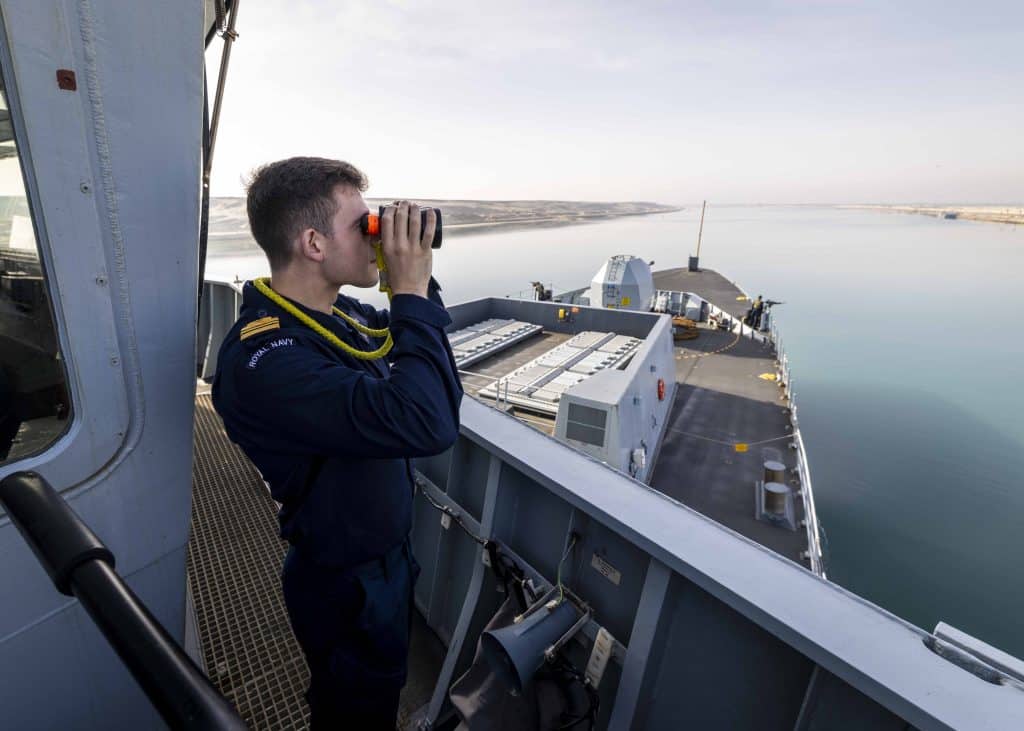
Although not involved in the latest Gulf war, the UK has teamed up with France to lead a multinational force developed to support an international mission to maintain freedom of navigation for commercial shipping using the Strait as and when operational conditions permit. During the US/Israel versus Iran war, which occurred between late February and early April, Iran closed the Strait with the threat of mine presence and the use of missiles and drones against commercial shipping. The Strait remains closed, despite the US and Iran trying to extend the current ceasefire into a longer-term peace agreement.
In early May, the RN and French Navy began deploying forces from the Eastern Mediterranean to the Red Sea and further east, pre-positioning assets to support such a mission in Hormuz. Such assets include the RN’s Type 45 air-defence destroyer and the French Navy’s FS Charles de Gaulle carrier strike group.
The UK has also been readying the RN auxiliary vessel RFA Lyme Bay, currently operating in the Mediterranean, to support this mission by deploying as a mine-countermeasures (MCM) ‘mothership’. For this role, it is carrying uncrewed surface vessels (USVs) and uncrewed underwater vehicles (UUVs) to deal with the mine threat, along with command-and-control capacity to act as a mission command node.
In this context, Lyme Bay is embarking on significant MUS capability.
The UK has prepared a MUS-focused funding package for the potential Hormuz mission. “Last week, we announced a GBP115 million package of new uncrewed vessels to support [the] multinational mission,” Pollard said.
1,000 hybrid ships
The Minister explained how this investment illustrated the RN’s integration of crewed and uncrewed platforms within an emerging ‘hybrid navy’ force structure. He noted that, only a few years previously, the expectation would have been for crewed platforms to take on such a mission. “That is a pace of change which is really quite exciting,” he added.
Underlining the key role that uncrewed capabilities would play in a mission to secure shipping in the Strait, the package included funding for mine-hunting uncrewed systems and technologies to counter uncrewed aerial vehicles.
Pollard explained that the RN’s direction of travel was steering directly towards the ‘hybrid’ force structure, and that this structure could be the base for building a ‘1,000-ship navy’. “I want us to expand our navy, but I want most of those platforms to be uncrewed,” he said. While the transition will take time, the ‘hybrid navy’ headmark has been set out in SDR, the Defence Industrial Strategy, and the forthcoming Defence Investment Plan, Pollard added.
“We’ve been locked in to a narrative around how many crewed platforms we have as a country for far too long,” said Pollard. “I want us to expand our thinking – but I want us to expand our lethality and our deterrence at the same time.”
“[The ‘hybrid navy’] is an opportunity to have more naval presence in more parts of our ocean than ever before; it is an opportunity to increase our lethality, with more effectors able to take down air, surface, and sub-surface threats; and it is about more deterrence, but more warfighting ability if required,” Pollard continued.
“That is what a ‘hybrid navy’ can deliver for the UK and, importantly, can deliver for our … allies,” he added.
Comment
The US Navy (USN) has in the past set headmarks for building force structures at a significant scale.
In the 1980s, a 600-ship navy was the USN’s ambition under the Reagan administration, to meet the strategic and operational requirements of the first ‘US Maritime Strategy’.
In the early 2000s, then-USN Chief of Naval Operations Admiral Michael Mullen launched the ‘1,000-ship navy’ concept, not as a national target for crewed USN platforms but as a multinational collective, intended to build global maritime security presence.
The RN’s current crewed force structure is very lean, even if the UK does have long-term plans to rebuild submarine and surface ship force levels. So, aiming for a ‘1,000-ship navy’ very much includes uncrewed platforms as the bulk of this ‘hybrid’ force structure. The RN is already developing operational concepts that mandate the deployment of uncrewed systems at a scale that reflects these numbers. For example, in its ‘Atlantic Bastion’ underwater warfare concept, the first phase ‘Atlantic Net’ – which is currently going through procurement and capability development – is aiming to scale sensing capability through integrating hundreds of UUVs.
