How China is working to turn Saishiteng Mountain into the world’s largest astronomy base

Construction on the Tibetan plateau of some of the Earth’s most powerful optical telescopes is putting China on track to house the world’s biggest astronomy base by the mid-2030s, according to project scientists. Deng Licai, lead scientist for site planning at the National Astronomical Observatories

South China Morning Post
75
2 min read
0 views
How China is working to turn Saishiteng Mountain into the world’s largest astronomy base

Construction on the Tibetan plateau of some of the Earth’s most powerful optical telescopes is putting China on track to house the world’s biggest astronomy base by the mid-2030s, according to project scientists.

Deng Licai, lead scientist for site planning at the National Astronomical Observatories of China (NAOC) in Beijing, said the telescopes at Saishiteng Mountain in northwestern Qinghai province would stretch between 6.5 metres (21.3 feet) and 14.5 metres across, and partner with dozens of smaller instruments.

“Their collective light-gathering power is expected to surpass [that of the telescopes] on Hawaii’s Mauna Kea peak,” he said on Wednesday.

Mauna Kea has long been regarded as the crown jewel of ground-based astronomical observation, home to the twin 10-metre Keck telescopes, the 8.2-metre Subaru and the 8.1-metre Gemini North.

Groundwork, mirror polishing and instrument development were already under way for the 2.5 billion yuan (US$369.03 million), 14.5-metre Large Optical Telescope (LOT) and the 1.5 billion yuan, 6.5-metre MUltiplexed Survey Telescope (MUST), Deng said.
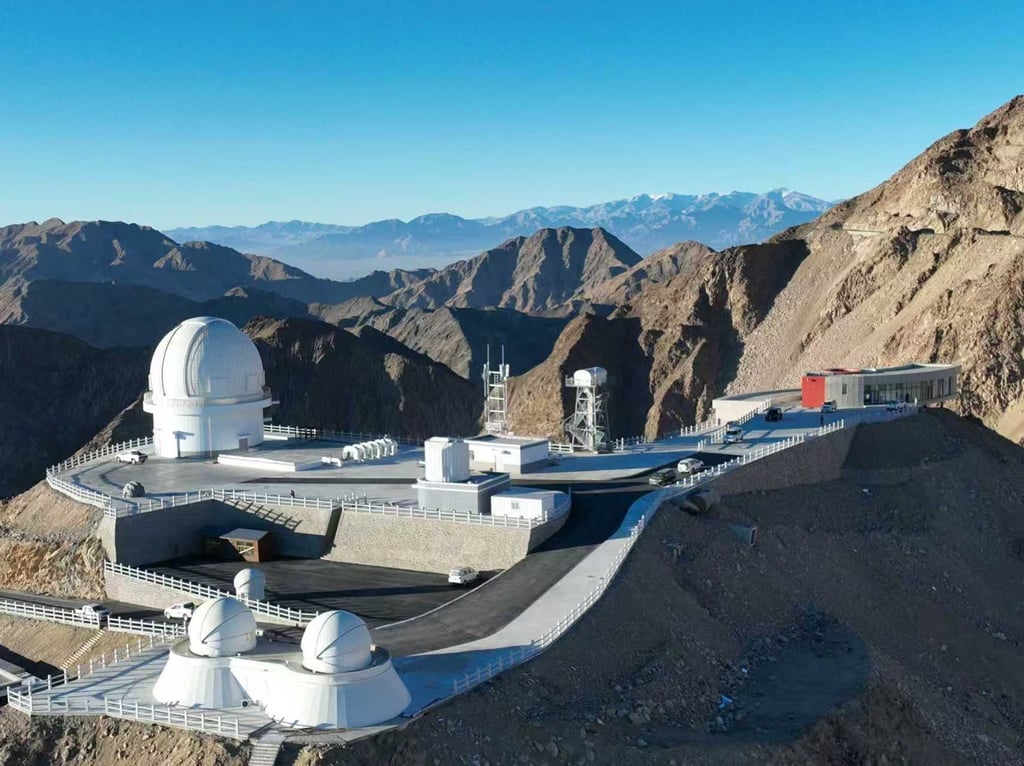
Telescope domes dot the summit of Saishiteng Mountain in Qinghai province, a site that China aims to develop into the world’s largest astronomy base by the mid-2030s. Photo: Handout

Telescope domes dot the summit of Saishiteng Mountain in Qinghai province, a site that China aims to develop into the world’s largest astronomy base by the mid-2030s. Photo: Handout

The LOT is government-funded and led by the NAOC, while MUST is backed mainly by private capital and led by a team from Tsinghua University. Both aim to achieve “first light” – or practical use – by 2030.

Share this article

Related Articles

Hong Kong should adopt the ‘Hefei model’ in the Northern Metropolis
🇨🇳🇹🇼China vs Taiwan
South China Morning Post

Hong Kong should adopt the ‘Hefei model’ in the Northern Metropolis

The arrival of Yuan Gujie, the new deputy director of Beijing’s liaison office in Hong Kong, has sparked widespread speculation. Her legal background and experience in Guangdong province suggest that her posting carries a clear agenda: to promote deeper integration between Hong Kong and other Greate

circa 2 ore fa2 min
Beijing sends largest patrol ship east of Taiwan after Japan-Philippine boundary talks
🇨🇳🇹🇼China vs Taiwan
South China Morning Post

Beijing sends largest patrol ship east of Taiwan after Japan-Philippine boundary talks

Beijing has sent a flotilla that includes mainland China’s largest patrol vessel to waters east of Taiwan in response to Japanese-Philippine maritime boundary negotiations. The Ministry of Transport ships are expected to conduct joint patrols with a coastguard formation dispatched to the same waters

circa 3 ore fa1 min
Chinese medical team arrives in DR Congo to help fight Ebola, ‘filling US void’
🇨🇳🇹🇼China vs Taiwan
South China Morning Post

Chinese medical team arrives in DR Congo to help fight Ebola, ‘filling US void’

A Chinese team of medical experts has arrived in the Democratic Republic of Congo for a three-month frontline mission to contain an expanding Ebola outbreak across a mining region with extensive Beijing-backed mineral investments. The five-member team of specialists in epidemiology, clinical medicin

circa 4 ore fa1 min
China’s nuclear weapons scientist Du Xiangwan clarifies role in nation’s war on waste
🇨🇳🇹🇼China vs Taiwan
South China Morning Post

China’s nuclear weapons scientist Du Xiangwan clarifies role in nation’s war on waste

One of China’s most prominent nuclear scientists has publicly clarified his role in the country’s rapidly expanding waste-to-energy sector, following years of speculation linking nuclear weapon technologies to municipal waste incineration. In a June 2 press release from the Chinese Academy of Engine

circa 6 ore fa1 min