9 hours ago
Nikhil Inamdar
Cash transfers are a major welfare tool but they come at a huge cost, raising concerns about their long-term efficacy.

9 hours ago
Nikhil Inamdar

 Hindustan Times via Getty Images
The world's fastest growing major economy is increasingly dependent on dole to keep its poorest people out of desperate poverty.
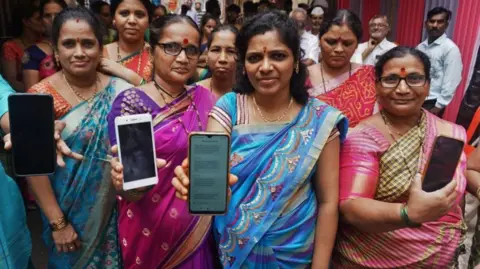
Over the past decade, government cash transfers, particularly directed at women and farmers, have emerged as a major welfare tool for poverty eradication in India.
Federal and state allocations for such schemes grew more than 20 times from under $2bn (£1.51bn) in 2015 to nearly $30bn, according to data from ProjectDEEP, an organisation that works on cash-based policies across the country.
They now constitute just under 1% of India's GDP and over 10% of its social sector spending, and this growth outpaces spending increases on flagship social schemes that guarantee food security and employment.
The trend is widespread.
Seventeen out of 28 Indian states and one federally-administered territory - Delhi - now provide monthly cash transfers compared with a mere four in 2019, according to Crisil Intelligence.
Often derided as wasteful or a ploy to influence elections, direct transfers of cash could be emerging as a key tool to address two immediate economic challenges - weak household consumption and chronic unemployment, reports show.
The transfers range from 1,000 rupees ($10.5; £7.7) to 2,500 rupees per month, depending on the state. But a median cash transfer of 1,500 rupees per month could be covering 74% of monthly expenditure in rural areas and 51% in urban areas for the bottom 20% of households, making them a "new buffer for India's household consumption", Crisil Intelligence said in a recent report.
The money could particularly be a cushion at a time when "the economy sees inflation risks from high energy prices and the El Niño [weather phenomenon]", according to Crisil.
 Anadolu via Getty Images
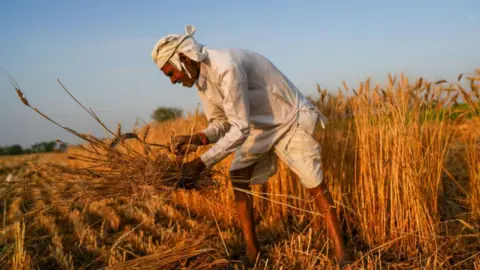
While such transfers have so far mostly been directed towards women and farmers, a growing number of programmes are also focusing on unemployed youth.
According to ProjectDEEP, nearly 10 state governments, including India's poorest state Bihar, have begun to offer money to young jobless men and women seeking work.
And most of these were launched in just the past three years.
"Unemployment is a particularly big question in India, with the rise of AI and climate shocks making income streams more uncertain. These schemes are typically designed to create bridge income," Pankhuri Shah, co-founder of ProjectDEEP, told the BBC.
Despite being critical short-term buffers, there are growing anxieties about their growing fiscal cost.
India's economic survey, an annual document presented by the government ahead of the budget, called them a "key driver" of fiscal stress for the states, saying half of those implementing such programmes have a revenue deficit.
According to Crisil, in fiscal 2026, gross market borrowing by states jumped 15.2% year on year - faster than that of the federal government. And of the states giving cash, 12 recorded double-digit growth in market borrowing.
This not only raises concerns about fiscal sustainability, but also comes with hidden costs.
"Much of the financing for these schemes comes from expenditure switching, and some from higher deficits," Axis Research found in a 2025 study. Which means higher expenditure on cash transfers comes at the cost of lower spending by states in other areas.
As a result, "the scope for expanding productive capital expenditure [or income-generating assets] becomes increasingly constrained, especially in an environment of limited revenues and elevated deficits", the Economic Survey pointed out, calling for their regular reassessment.
Shah admits that this is a big missing piece.
Most schemes come without an end date and have been found to largely improve short-term stability rather than enable a sustained exit from poverty.
"Impact assessment is virtually non-existent and that leads to big gaps in design," she said.
"For instance, if consumption support for the elderly is your goal and the pension transfer amount is only 200 rupees, that does not cut it from an impact perspective, something that needs to be re-looked at,"she added.
The government also needs to assess whether cash can replace in-kind transfers, like poultry or baby kits and other subsidies on things such as energy or tractors, said Shah.
This will reduce "both administrative costs and overlapping benefits to the same person" and make the system much more sustainable.
There is already good precedent.
Liquified petroleum gas (LPG), which was earlier being physically given, was transitioned from a subsidy to a direct cash transfer. And that saved the country $7-8bn, according to ProjectDEEP analysis.
 ProjectDEEP
Experiments by organisations like ProjectDEEP could offer some clues on how state transfers can become more productive.
In June 2022, Shah and her partner Muzamil Baig distributed 65,000 rupees to some 50 households in drought-prone Krishanpur in western India's Maharashtra state through the organisation.
It was the start of a unique study to see the impact of lump-sum rather than monthly unconditional transfers to some of the poorest communities in the country.
Over the last three years, they expanded the experiment to six other villages, putting over half a million dollars - raised from various corporate donors - directly into the accounts of some 3,500 families across the country.
The results have been striking.
Nearly 90% of the funds they deployed was spent by households to improve livelihoods, pay off bad debts and create income-earning assets.
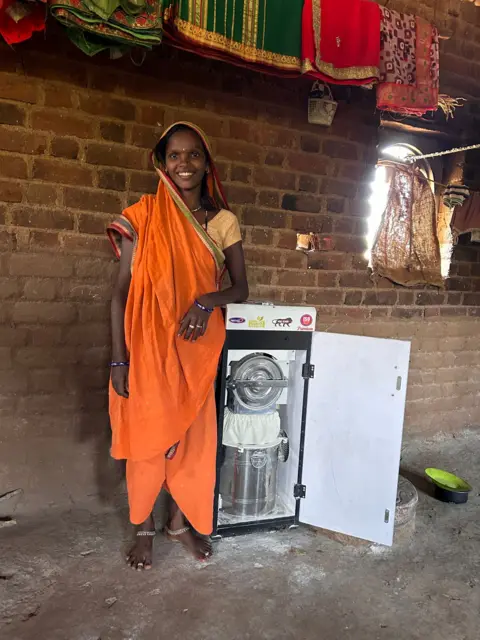
Shobha, a woman from an isolated village called Shelkui in Maharashtra, invested in a small flour mill with the money she got from ProjectDEEP.
It has saved her time and money spent on getting grain milled into flour from a nearby town and also helped generate an additional source of income.
The lump sum acted like "seed capital", setting off an investment cycle rather than merely covering basic consumption expenditure.
Comparative studies in Kenya also reflect a higher rate of return on every dollar spent for a lump-sum transfer rather than piecemeal monthly credits.
As cash transfers become more politically entrenched and their costs rise, policymakers need to think more creatively about how such schemes are designed, said Shah. The goal should be to encourage investment and self-employment, rather than simply boost consumption.
But implementing such an approach at scale could be challenging.
"A lump sum is irreversible, so targeting must be near-perfect. A large amount concentrates the risk of capture and misuse. Also, the cost must be borne by the government within a single budget year," Dr Vidya Mahambare, professor of economics at the Great Lakes Institute in Chennai, told the BBC.
Ultimately, she argues, the state's focus must remain on generating growth that creates enough jobs.
"Cash can cushion consumption, but it cannot substitute for employment. And once families become dependent on transfers, they are very difficult to withdraw," Mahambare added.
It's a challenge that Indian states - many of whom have found themselves locked into expensive welfare promises - know all too well.

We have selected seven stories from this week’s news across Hong Kong, mainland China, the wider Asia region and beyond that resonated with our readers and shed light on topical issues. If you would like to see more of our reporting, please consider subscribing. 1. Iran and US sign peace deal, Strai

Some see a double standard: Japanese men who clean in public while their wives do all the housework.

European Union national leaders have asked Brussels to come up with new trade instruments to deal with the economic threat posed by China, following a rare summit debate about Beijing late on Thursday night. After a two-hour discussion, the EU’s executive branch was told to engage with China to try

Plans for US Vice-President J.D. Vance to travel to Switzerland for a new round of talks with Iran have been delayed, according to the White House. In a statement on Thursday, the White House said the arrangements for the “technical talks” had not yet been finalised and that the US delegation remain