
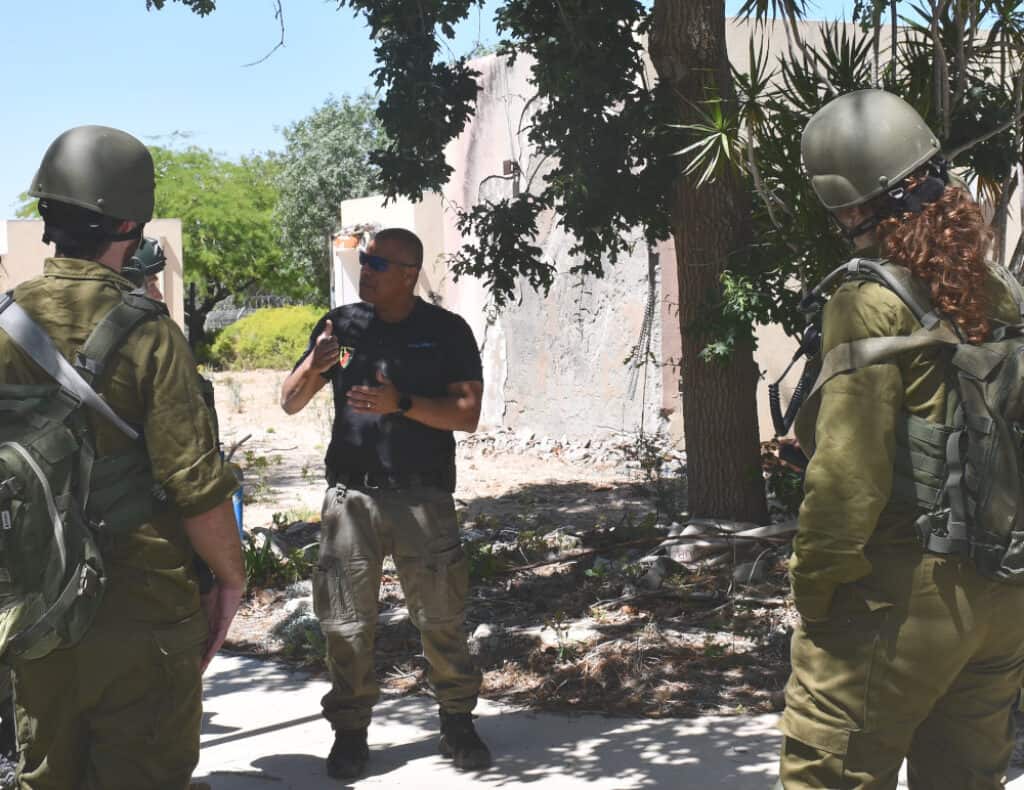
In early May, in the Nir Oz community on the Gaza border, members of a new civilian volunteer security team completed their second of eight training sessions conducted as part of a new program. Magen 48, an initiative operated by the Israeli NGO Magen Yehuda with a stated mission to equip “civilian defenders with the knowledge and tools of experts,” has partnered with the Israeli Defense Forces (IDF) to train local civilian volunteer security response teams.
On October 7, 2023, thousands of Hamas terrorists, backed by other terror groups and civilian looters, attacked Israeli border communities near the Gaza Strip. Today, many Israeli communities on the border are still rebuilding, with residents returning to their homes. The new initiative is part of this process and aims to proactively enhance security in the event of another attack. The local security response teams being trained, called “Kitat Konenut” in Hebrew (Rapid Response Squads), are an integral part of life for Israelis living in small border communities near Gaza, Lebanon, and the West Bank. They consist of former soldiers who are equipped to respond quickly to attacks and serve as the first line of defense while a community waits for other security forces to arrive.
Magen 48 was named for the 48 security team members killed on October 7. The organization is working with the IDF’s Home Front Command and Gaza Division, as well as local councils. The initiative modeled its training on communities that successfully held off the October 7 attack, particularly Kibbutz Erez.
Magen 48’s website notes that it aims to complete a “broader effort to ensure that every community surrounding the Gaza envelope is trained, equipped, and operationally prepared to defend itself against future threats.” The preparation is part of broader challenges Israel faces in making residents near the border feel safe while also investing in reconstruction.
The security initiative comes at a key time for the Gaza border area as Israel continues to press for Hamas to be disarmed. Israeli Prime Minister Benjamin Netanyahu met with Gaza Board of Peace Director Nickolay Mladenov on May 13, where they discussed the status of the ceasefire and Hamas’s disarmament. The IDF said on the same day that it eliminated a Hamas Nukhba member in Gaza.
Ari Briggs, one of the Magen 48’s co-founders, detailed Israel’s new training protocol for these communities to FDD’s Long War Journal. Briggs said the new training protocol, approved by the IDF, has trained 67 communities near the Gaza border, and he wants to help instruct up to 600 communities in the coming years. According to Briggs, over 550 training sessions have taken place with more than 1,500 people trained, equivalent to several infantry battalions.
“That’s just the proof of concept. There are 900,000 vulnerable people. We’ve covered around 85,000-100,000,” Briggs said. The 100,000 figure refers to the population of the communities around the Gaza Strip. After October 7, more than 74,000 people were evacuated from these border communities for more than a year, and a similar evacuation took place in northern Israel. Many residents have returned, but the ongoing war means many do not feel safe, according to a recent survey. Briggs said that a total of 900,000 Israelis live near various borders, and these communities are therefore assessed to be at a larger risk of attacks.
“On a tactical level, we were given the opportunity [to do the training] because of the capability of the team to look at how to defend each and every community. We built the plan for each community,” Briggs said. This effort includes examining where cameras should be placed, how to defend the fence around a community, and where strongpoint positions can be erected. Magen 48 also changed some of the doctrine on how the teams respond, encouraging confrontation with an enemy before it reaches a community’s front gate, essentially taking the fight to the enemy rather than waiting.
Briggs emphasizes that the major lesson they learned from October 7 wasn’t about the individual skill of the responders, but about organizing the team. Some basic tactics, such as rapidly assembling two-person teams and then linking up with more team members, are part of the training. During a training that Long War Journal observed in early May, the team at Nir Oz practiced this method of linking up and then clearing a specific area of the community from mock terrorists.
“The key is, this is not gun training but doctrine, command and control, emergency response,” said Briggs, noting that the training also involves medical support for the wounded.
The current training consists of eight sessions per year, during which volunteers receive time off from work as IDF reservists for the day. Magen 48 has expanded access to ammunition for training, with Briggs noting that prior to October 7, each person was issued only 70 rounds a year to practice at the range. Trainees are expected to be proficient shots out to 150 meters. The initiative also expanded team sizes from around 12 per community to up to 28 in most places. The teams are coed, as was clear at Nir Oz, where some of the volunteers were female.
Reporting from Israel, Seth J. Frantzman is an adjunct fellow at FDD and a contributor to FDD’s Long War Journal. He is the senior Middle East correspondent and analyst at The Jerusalem Post, and author of The October 7 War: Israel's Battle for Security in Gaza (2024).
Tags: Gaza, IDF, Israel, Magen 48, October 7 Attack


