The US Army wants thousands of air defense missiles to replace the Stinger
A new Army Request for Information seeks to identify companies that can deliver 11,000 next-gen, short range interceptors beginning in Fiscal Year 2028.
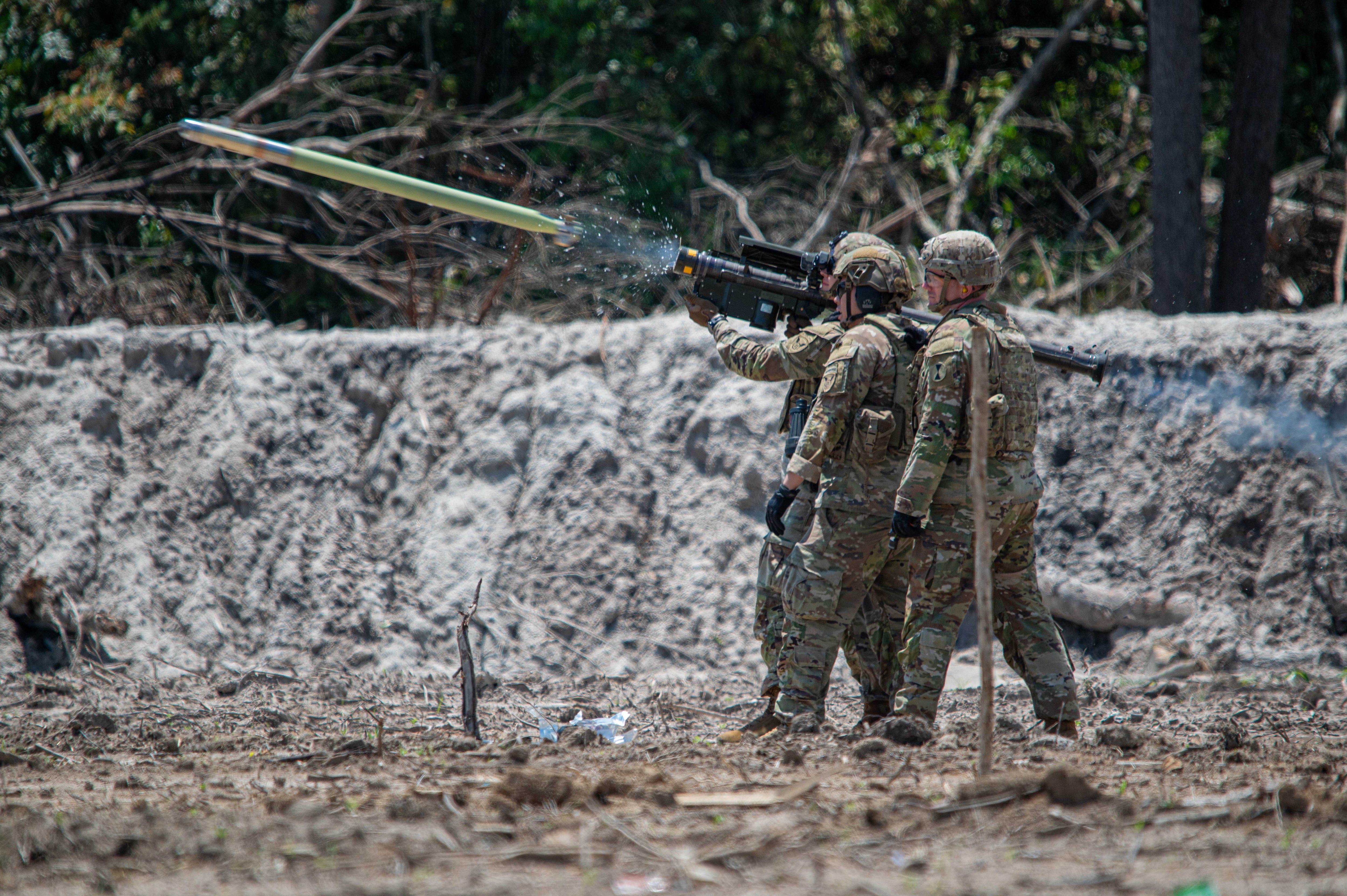
U.S. Army Pfc. Jackson Muse fires an FIM-92 Stinger during Super Garuda Shield 25, Baturaja, Indonesia, August 2025. (Pfc. Seu Chan/U.S. Army)
The U.S. Army plans to order thousands of next-generation, short-range air defense missiles to replace the aging FIM-92 Stinger.
A new Army Request for Information seeks to identify companies that can deliver 11,000 Next Generation Short Range Interceptor, or NGSRI, missiles beginning in Fiscal Year 2028. The response deadline is July 6.
The RFI asks companies to “provide projected unit cost estimates given a planning factor of 11,000 NGSRI missiles and 2,200 Control Launch Assemblies over a ten-year production period,” the document states. “As a planning factor, assume procurement of 200 missiles and 20 CLAs in year one (FY28) and 500 missiles and 20 CLAs in year 2 (FY29). As an additional planning factor excursion, assume doubling the [low-rate initial production] quantities in year one and year two.”
The Army describes NGSRI as a “high performance, soldier portable, fire and forget, surface to air missile system capable of defeating rotary wing, fixed wing, and Group 2/3 unmanned aircraft system threats.”
The NGSRI initiative is part of the Maneuver Short Range Air Defense, or M-SHORAD, program, which aims to revamp the Army’s mobile air defenses amid a growing threat from drones, hypersonic missiles and other guided munitions.
Trials for M-SHORAD Increment 1 — renamed Sgt. Stout — mounted Stingers, a 30mm cannon and a 7.62mm machine gun on a radar-equipped Stryker. Increment 2 tested a 50 kW laser mounted on a Stryker.
Increment 3 calls for replacing the Stinger with the faster and longer-range NGSRI short-range interceptor. The Stinger only has a speed of Mach 2, in part because it is “powered by a traditional solid fuel rocket motor,” explained the Army’s Combat Capabilities Development Command Aviation and Missile Center.
The NGSRI will reportedly have a speed of Mach 3. RTX and Northrop Grumman tested these missiles with a more powerful Highly Loaded Grain solid rocket motor last year.
In February 2026, RTX demonstrated NGSRI’s “to track drone targets and be fired from a man-portable launcher,” the company said.
NGSRI is designed to be fired from vehicles and shoulder-mounted launchers. It will be compatible with existing Stinger missile launchers, such as Sgt. Stout and the Marine Corps Air-To-Air Launcher.
The new Army RFI calls for contractors to explain how they will mount NGSRI on the Sgt. Stout.
“The company shall describe the approach and cost per kit for retrofitting the SGT STOUT to fire the missile from the Stinger Vehicle Universal Launcher,” the RFI states. “As a planning factor there will be 248 SGT STOUTs with up to two Stinger Vehicle Universal Launcher launchers per platform.”
The Stinger was first deployed in the early 1980s to replace the FIM-43 Redeye. It has been used in numerous conflicts, including the Soviet-Afghan War, where Afghan militants used U.S.-supplied Stingers to down Soviet Mi-24 helicopter gunships.
About Michael Peck
Michael Peck is a correspondent for Defense News and a columnist for the Center for European Policy Analysis. He holds an M.A. in political science from Rutgers University. Find him on X at @Mipeck1. His email is mikedefense1@gmail.com.