Ukraine's drone commander has Russian oil, troops and morale in his sights
4 hours ago
Sarah RainsfordSouthern and Eastern Europe correspondent , Eastern Ukraine
In a rare interview, Commander Robert Brovdi shared how his unit accounts for a third of all targets destroyed on the battlefield.

4 hours ago
Sarah RainsfordSouthern and Eastern Europe correspondent , Eastern Ukraine

 BBC/Moose Campbell
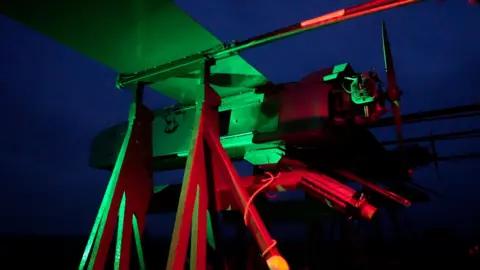
"We're like a red rag to the enemy. Because we're taking the war to their territory so that they feel it too," the Ukrainian soldier says, as his unit scramble to assemble long-range drones for launch at Russia.
Ukraine has been intensifying its deep strikes like this for several weeks, targeting oil export facilities, in particular, like never before.
Now, in a rare interview, the commander of all Ukraine's unmanned systems has told the BBC such attacks will escalate and claimed his drone forces are also holding back Russia's advance along the frontline by killing a record number of soldiers.
"1,500 to 2,000km (930-1,240 miles) inside Russian territory is no longer the 'peaceful rear'," Robert Brovdi warns. "The freedom-loving Ukrainian 'bird' flies there whenever and wherever it wants."
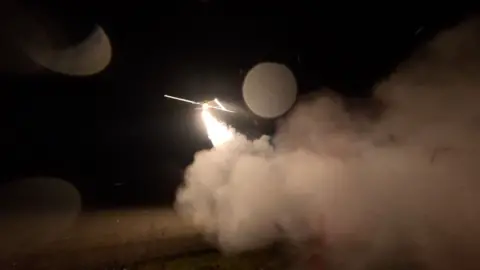
At the secret launch site, a drizzly field in eastern Ukraine, the long-range drones are primed and we're ordered back to a safe distance. The team work quickly before Russian forces can detect them and send ballistic missiles hurtling towards us. There's a shouted command, loud revs of an engine and a flash of white as the first device tears into the sky towards Russia like a mini jet plane.
President Volodymyr Zelensky calls such deep strikes "very painful" to Moscow, causing "critical" losses running to tens of billions of dollars in its energy sector despite the recent surge in global oil prices.
The increase in such attacks is partly down to technology. Locally produced drones are becoming cheaper and flying further: the model we see launch can now travel more than 1,000km and others already go twice as far.
But it's also about focus. In addition to military personnel and production, Russia's energy exports have been identified as a priority target.
 BBC/Moose Campbell
"Putin extracts natural resources and converts them into blood dollars that they then direct against us in the form of Shahed drones and ballistic missiles," says Commander Brovdi, justifying the strikes.
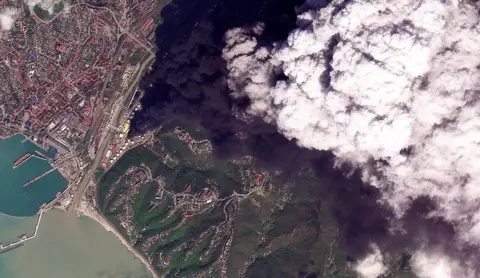
Residents in Tuapse on Russia's Black Sea coast complain of toxic rain after a second wave of major strikes on the local refinery in several days. But Brovdi is dry-eyed.
"If oil refineries are a tool to make money that's used for war, then they are a legitimate military target, subject to destruction."
The commander wages war in the skies from a secret location deep underground. We're taken to meet him in a van with blacked out windows, then led down stairs and along corridors lined with sleeping pods to emerge into a high-tech cavern covered in screens from floor to ceiling.
The soundtrack is a series of bleeps and pings as fresh data is fed to dozens of men in T-shirts and hoodies hunched over joysticks and keyboards. They're monitoring images streamed directly from the battlefield from drone pilots with names like KitKat and Antalya.
Brovdi's Unmanned Systems Forces make up just 2% of Ukraine's military but these days he says they account for a third of all targets destroyed. Their own casualty rate, he tells me, is no secret: less than 1% per year.
Each strike – of any kind – is filmed for verification and logged, and monitors on one wall display a detailed scorecard, updated in real time.
In the past week, Brovdi has reported hitting a dozen Russian FSB security service officers in occupied territory as well as multiple energy facilities in Russia itself. He argues that his forces are critical to denying Putin any headline victories, especially his aim of seizing the rest of the eastern Donbas region within months.
"What is he smoking?" Brovdi is curt. "That's not realistic. It's absurd."
 BBC/Moose Campbell
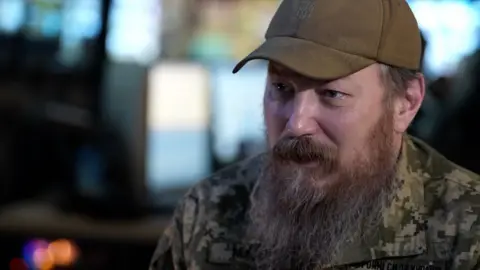
Four years ago, Robert Brovdi was more comfortable in auction houses like Christie's than filthy trenches. A well-off grain dealer in those days, with a sideline as an art collector, fragments of his pre-war life survive in the paintings and sculptures by Ukrainian artists dotted around the bunker. They're displayed beside missile casings and captured drones. He's an ethnic Hungarian, from Uzhhorod in western Ukraine, and best known by his military call sign, Magyar. Clean-shaven before the war, he now wears a long ginger and grey-speckled beard.
The businessman signed up to fight just before Russia's full-scale invasion – "we all knew war was inevitable" – initially joining the Territorial Defence, then passing through some of the fiercest battles, including for Bakhmut.
But it was before that, pinned down by Russian fire in Kherson, that he first saw the potential of drones. Brovdi recalled a device he'd bought for his own children and began to introduce similar ones to his unit. Suddenly they could climb above Russian positions and stream live images to a nearby artillery team, enabling them to strike. "The idea first developed as self-preservation," he explains, but it transformed the battlefield.
Within months the soldiers were building their own drones and attaching munitions, and soon became renowned as 414th Brigade, the Birds of Magyar.
 BBC/Moose Campbell
Brovdi's strategy is not only built on long-range strikes.
He talks, at length, about another priority: reducing Russia's advantage in terms of manpower.
The issue has become even more acute for Ukraine as it struggles to mobilise men for the front: "Those who wanted to fight are already fighting," the commander accepts.
So his crews are under direct orders to kill more enemy soldiers each month than Russia can recruit. That's over 30,000 men a month.
"30% of all drone strikes have to be against military personnel," Brovdi is clear. "You can call it a kill plan, yes, and right now we are exceeding it."
He says they've met their target for four months in a row.
I can't confirm that data, but Brovdi tells me his men do exactly that: the death of each soldier has to be proved by video, or it doesn't count.
Some of those clips play on a grim loop on screens in the command centre and Brovdi also posts them on Telegram, where he styles his drone forces as the "birds" and their Russian prey as "worms" to hunt and destroy.
"The greatest mass killing of an enemy in the history of mankind is taking place in this room," he says at one point, gesturing at the screens around us.
It is brutal talk, from a softly spoken man, but Brovdi refuses to be "gnawed by pity".
Russian troops are far beyond their own borders, he says, sent by Putin "who wants to destroy our nation".
"If we don't kill them, they kill us. That is clear."
 Reuters
The commander insists he has no "rose-tinted spectacles": his goal is containment, not mounting new counter-offensives or taking back huge swathes of land.
"We have an effective weapon: not to conduct an offensive war, but to prevent the enemy advancing effectively on our territory," he tells me.
He also believes Vladimir Putin cannot afford to end his invasion, because the risks of failure are too great.
So Brovdi has one more target: Russian morale.
He hopes a high casualty rate, combined with giant fires burning at facilities deep beyond the border, can create "a certain ferment" within Russia. He's aiming for the shock factor.
One recent video widely shared in Ukraine shows a Russian woman in Tuapse in floods of tears. "I just wanted to live by the sea with my child, but everything's ruined…those drones fly, destroying everything," she sobs, between expletives.
For Brovdi, it's a sign that the fallout from Russia's invasion – and Ukraine's strong pushback – could be spreading beyond its so-far limited circles.
His aim, with every drone, is to make more Russians question the war their country is fighting and the president who started it.
Additional reporting by Sophie Williams, Moose Campbell, Volodymyr Lozhko and Anastasia Levchenko.

Iran has presented the U.S. with a new proposal to restore shipping in the Strait of Hormuz and end the war, while suggesting that negotiations on its nuclear program be postponed to a later stage.
U.S. President Donald Trump is holding "good conversations" with both Ukrainian President Volodymyr Zelenskyy and Russian leader Vladimir Putin in an effort to settle the ongoing war, the American leader said during a Fox News broadcast on April 26.

Russian forces struck Odesa with a massive drone attack overnight on April 27, the head of the city’s military administration, Serhiy Lysak, said.