
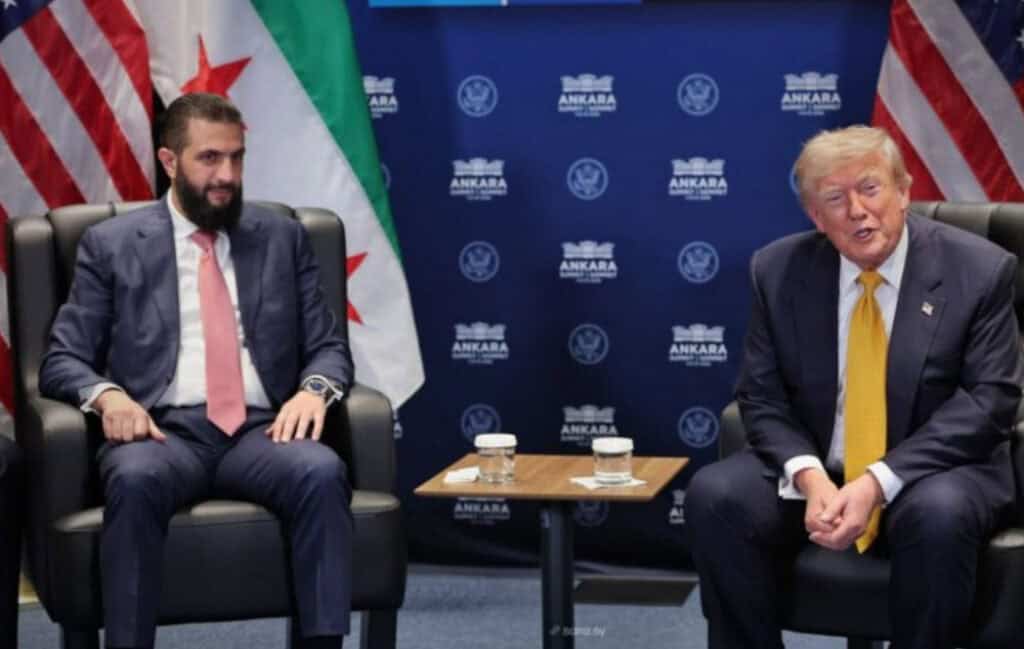
US President Donald Trump “informed Congress of his administration’s intent to rescind Syria’s designation as a State Sponsor of Terrorism (SST),” the US State Department announced on July 8. The decision followed a meeting between Trump and Syrian President Ahmad al Sharaa on the sidelines of a NATO summit in Ankara, Turkey. The American move also came in the wake of meetings between Sharaa and French President Emmanuel Macron in Damascus on July 6 and 7. Macron became the first major Western leader to make a state visit to Syria since the fall of the Bashar al Assad regime in December 2024.
Syria was designated as a State Sponsor of Terrorism in 1979, when former President of Syria Hafez al Assad was in power. The move to end the designation is one of a number of significant efforts the White House has made to end sanctions on Syria and also end a $10 million bounty that was once offered for Sharaa. The bounty was placed on Sharaa in 2017, when he was a key leader of Hayat Tahrir al Sham (HTS), which evolved from Al Nusrah Front — Al Qaeda’s former official branch in Syria.
Trump has shown support for Sharaa and Syria over the last year. In May 2025, the two leaders met for the first time in Riyadh, Saudi Arabia. In November, Sharaa visited the White House and met with Trump again. “President Ahmad al-Sharaa said the historic decision by US President Donald Trump to lift sanctions on Syria, together with the support of regional partners, particularly Türkiye and the Gulf states, is deeply appreciated by the Syrian people,” the Syrian Arab News Agency (SANA) noted on July 8 during the most recent meeting.
US Secretary of State Marco Rubio called the decision to rescind the SST designation a “historic step.” US Ambassador to Turkey Tom Barrack, who is also US Envoy to Syria and Iraq, also praised the decision. “Lifting sanctions on Syria will unlock international trade and investment, give Syria a chance to rebuild, and open up a new chapter for the Syrian people. A stable, unified Syria at peace with itself and its neighbors benefits not only the region, but the entire world,” the State Department said on July 8. It noted that this development follows a June 30, 2025, decision by President Trump directing sanctions relief for Syria.
Syria has been seeking out increased foreign investment to address widespread challenges in the country. There is reconstruction across numerous cities damaged in the war. In addition, refugees returning to the country require infrastructure, and Syria is investing in airports and border crossings. Syria is also seeking investors for energy projects.
“The removal from the US ‘terror’ list could make foreign investors more willing to engage with Syria. Its lace [sic] on the list has hindered international companies, investors, and banks from working there due to the legal consequences this would have,” The New Arab wrote on July 9.
The Trump meeting is one of several important meetings held by Sharaa in early July. He also hosted French President Emmanuel Macron, who arrived in Syria on July 6. “The visit marks the first by a French president to Syria since 2009 and reflects the transition of Syrian-French relations into a new phase based on mutual respect and an equal partnership,” SANA noted.
France is the former colonial power of Syria, having ruled the country in the 1920s and 1930s, when Syria was a mandate territory under Paris’s rule in the wake of World War I. Sharaa called Macron’s visit a “new chapter” in relations. The French president brought a delegation with him, and the countries concluded several “memoranda of understanding in energy, banking and infrastructure,” SANA noted. During Macron’s visit, there was a bomb attack in central Damascus, illustrating the continued terrorist threat Syria faces.
Macron was the first major Western head of state to visit Syria since the fall of the Bashar al Assad regime. President of Ukraine Volodymyr Zelenskyy visited Syria in April. European Commission President Ursula von der Leyen also traveled to Syria as part of a multi-country trip in January 2026. In January 2025, Qatari Emir Sheikh Tamim bin Hamad al Thani became the first head of state to travel to Damascus after the change in power.
During Sharaa’s trip to Ankara for the NATO summit, he held several high-level meetings. He met with Turkish President Recep Tayyip Erdogan on July 8. He also met with a bipartisan group of US lawmakers. “Led by Senator Jeanne Shaheen and including Senators Chris Coons, Mike Rounds, Dick Durbin, Lindsey Graham, and Representative Michael Turner, this engagement underscores the critical importance of Syria as a focal point amid the intricate and rapidly evolving dynamics of one of the world’s most complex regions,” US Ambassador Barrack wrote on X.
Reporting from Israel, Seth J. Frantzman is an adjunct fellow at FDD and a contributor to FDD’s Long War Journal. He is the senior Middle East correspondent and analyst at The Jerusalem Post, and author of The October 7 War: Israel's Battle for Security in Gaza (2024).
Tags: Ahmad al Sharaa, France-Syria, Syria, US-Syria


