US NRL launches three experimental payloads on STPSat-7 mission
The US Naval Research Laboratory has deployed three experimental payloads on the Department of War Space Test Program’s Satellite-7 mission.
The post US NRL launches three experimental payloads on STPSat-7 mission appeared first on Naval Technology.
Naval Technology
75
3 min read
0 views
NRL aims to improve knowledge of the space environment and test new satellite technologies to help protect vital US assets in orbit.
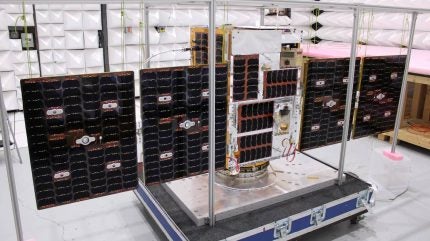
DoW Space Test Program’s (STP) STPSat-7 payload, at NASA Marshall Space Flight Center, Huntsville. Credit: DoW Space Test Program.
The US Naval Research Laboratory (NRL) has deployed three experimental payloads on the Department of War (DoW) Space Test Program’s Satellite-7 (STPSat-7) mission.
The launch took place on 7 April from Vandenberg US Space Force Base in California, with the payloads sent into orbit aboard a Northrop Grumman Minotaur IV launch vehicle as part of the STP-S29A mission.
Discover B2B Marketing That Performs
Combine business intelligence and editorial excellence to reach engaged professionals across 36 leading media platforms.
Find out more
The three NRL payloads comprised the Lasersheet Anomaly Resolution and Debris Observation (LARADO) instrument, the Global Navigation Satellite System Orbiting Situational Awareness Sensor (GOSAS), and the Gadolinium Aluminum Gallium Garnet (GAGG) Radiation Instrument (GARI-1C).
The mission aims to support the US Navy and strengthen national security by advancing data collection from space and demonstrating new technologies for satellites.
LARADO is intended to contribute data on orbital debris that is too small for ground-based tracking systems.
NASA began funding LARADO through its Heliophysics Division Space Weather Program in financial year 2022. The concept dates back to 2012, with development targeting deployment on STPSat-7.
NRL sensor development and applications section head and LARADO principal investigator Andrew Nicholas said: “LARADO is the next step in ensuring situational awareness in space. The instrument will detect and characterise small orbital debris that cannot be observed from the ground.”
GOSAS builds on previous work from the GROUP-C experiment, which operated on the International Space Station between 2017 and 2023. It is intended to enhance navigation and communication system reliability for military personnel.
NRL research physicist and GOSAS principal investigator Scott Budzien, Ph.D. said: “The GOSAS is a CubeSat-compatible, programmable dual GPS receiver designed to characterise the orbital GNSS environment and produce high quality ionospheric space weather products.”
GARI-1C expands on ground-based detection technology to test gamma-ray detectors for possible future defence uses, including identifying weapons of mass destruction from orbit.
The team’s focus is on assessing the suitability of commercially available components under space radiation conditions, which is significant for future operational hardware.
NRL Research Physicist and GARI-1C principal investigator Lee Mitchell, Ph.D. said: “GARI-1C is designed to space-qualify new gamma-ray detector technology for space-based defence applications. This detector technology offers improved energy resolution, lower power consumption and reduced size compared to similar systems, which is key to developing more advanced and efficient sensors for detecting threats from orbit.”
The US NRL, located in Washington, DC, conducts scientific and engineering research for the US Navy and Marine Corps in maritime, space, and information domains.
The NRL Space Science Division carries out research, development, test & evaluation in solar-terrestrial physics, astrophysics, and atmospheric science.