Where Drones Are Built and Troops Are Trained – A Journey to the Kharkiv Front
An inside look at Ukraine’s Khartia Brigade near Kharkiv, where soldiers face a war shaped by drones, pressure and an uncertain future.
Kyiv Post
75
14 min read
0 views
From the editors: This is the second part of our special feature covering the experience of Ukrainian soldiers with the Khartia brigade on the Kharkiv front. See the first part here.
Titan, the driver, leans into the room and calls out that the sky is clear. No movement above. We head outside.
Stray dogs pass by. We walk a few streets further, up to another neglected yard, another deserted dwelling, another door that opens.
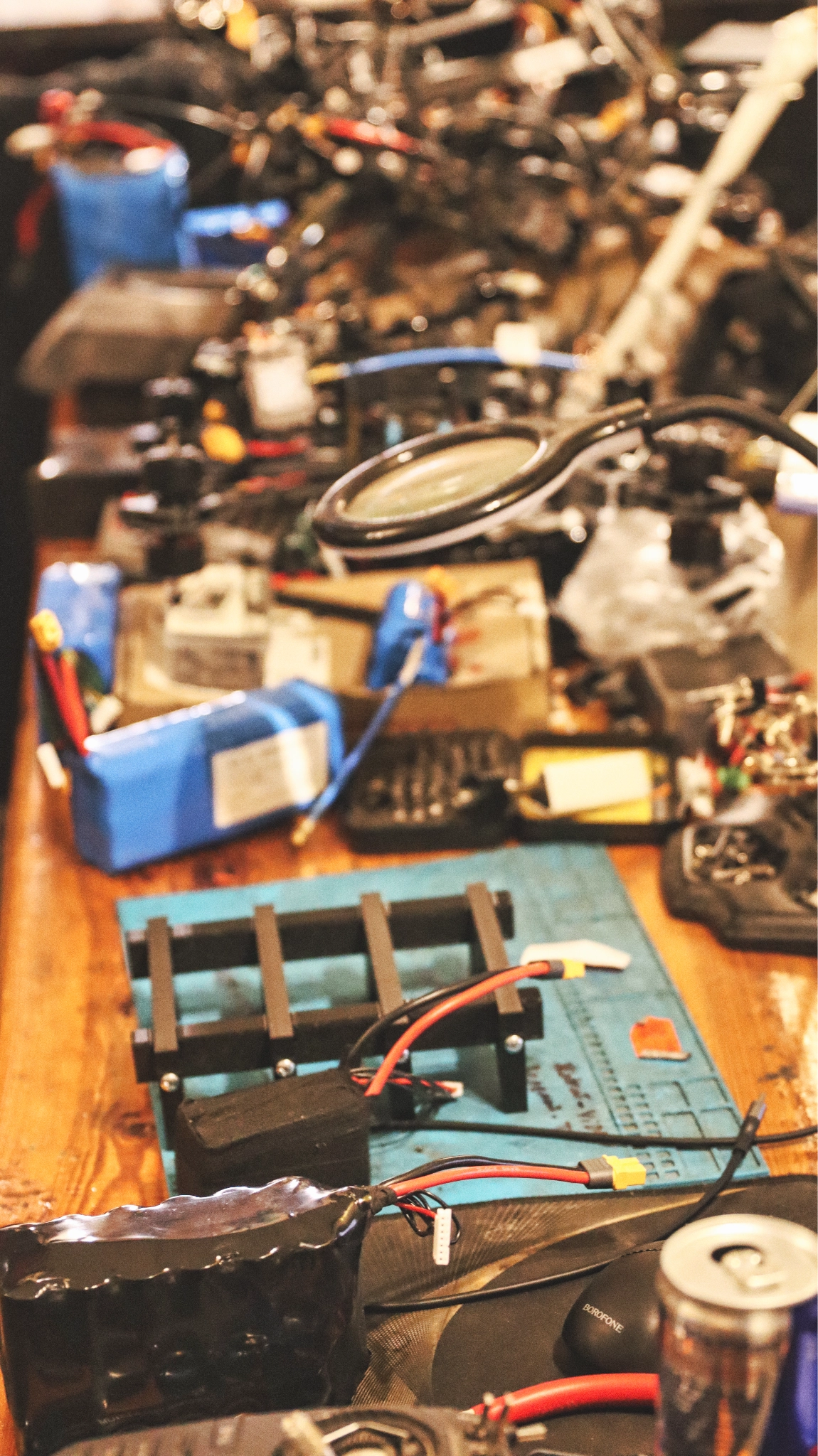
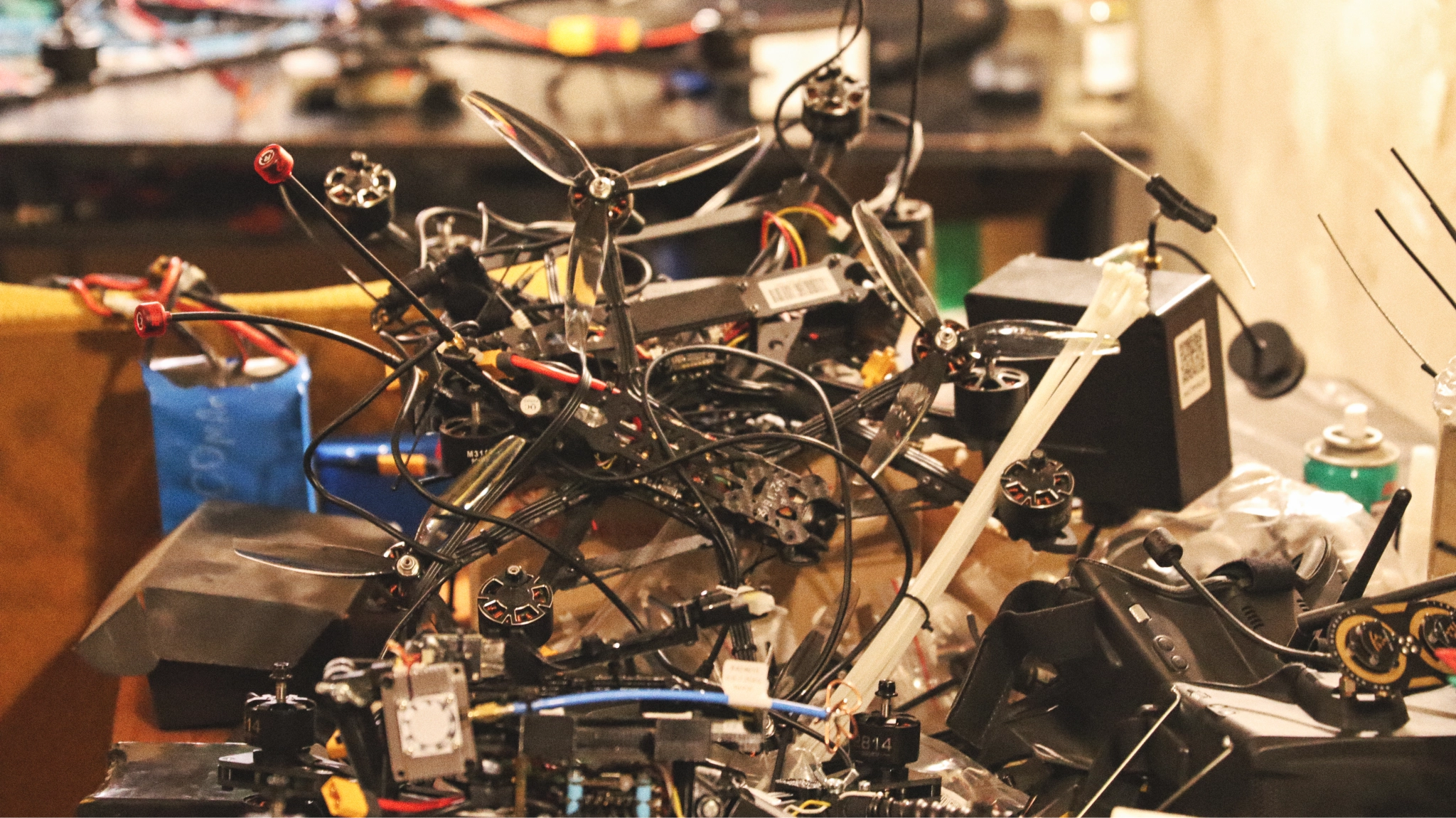
Inside, we step into what was once a living room, now filled with batteries, controllers, wires, frames, small components laid out in loose order. It looks like a mess. Men, obviously in a rush, move between tables and the floor, packing equipment into boxes – drones, spare parts, power units – everything that will be driven out to the positions shortly.
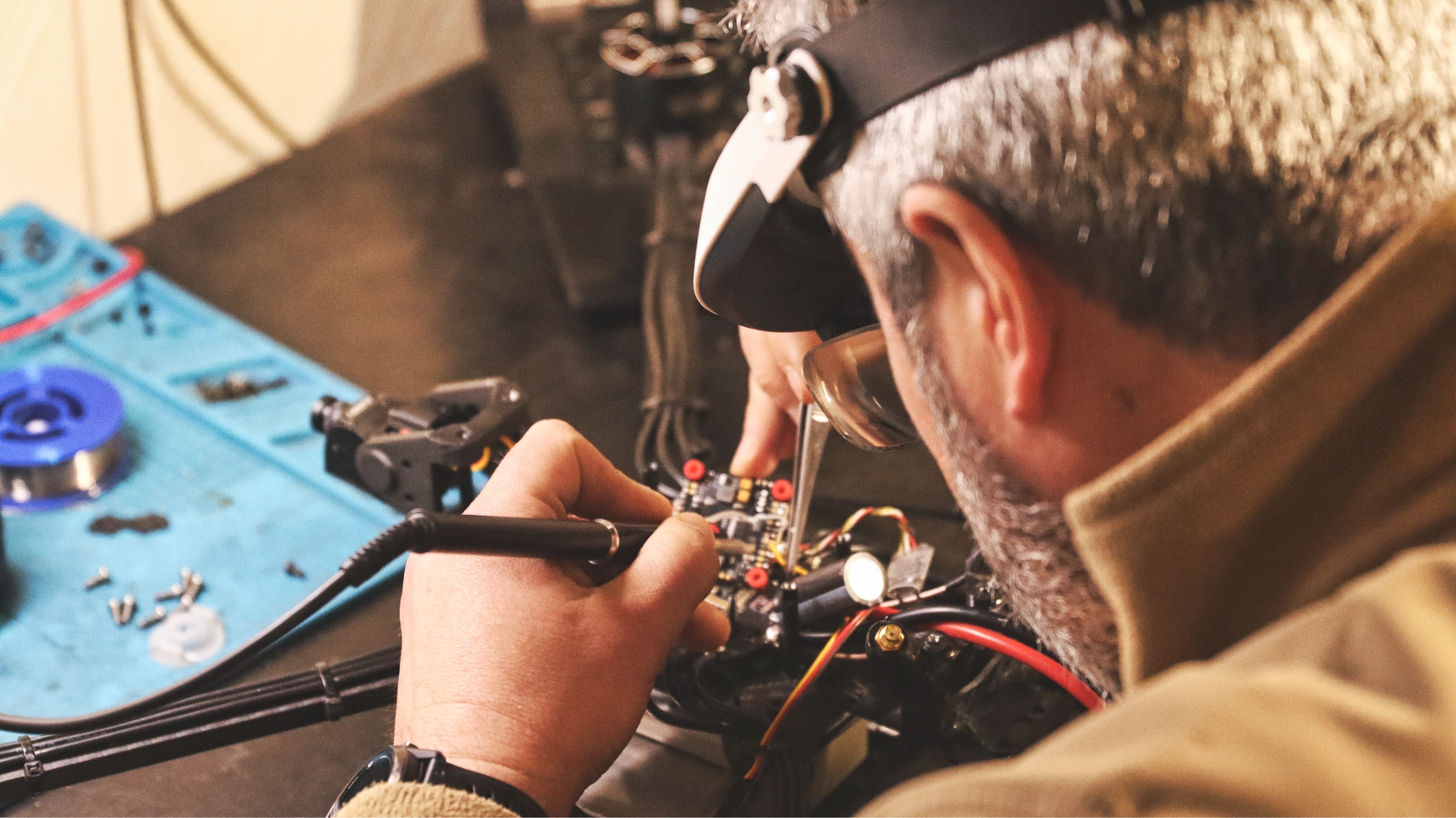
“Ray,” a drone technician of the Khartia Brigade, soldering microelectronic components inside a makeshift workshop outside Kharkiv, April 2026. (Photo by Korbinian Leo Kramer)
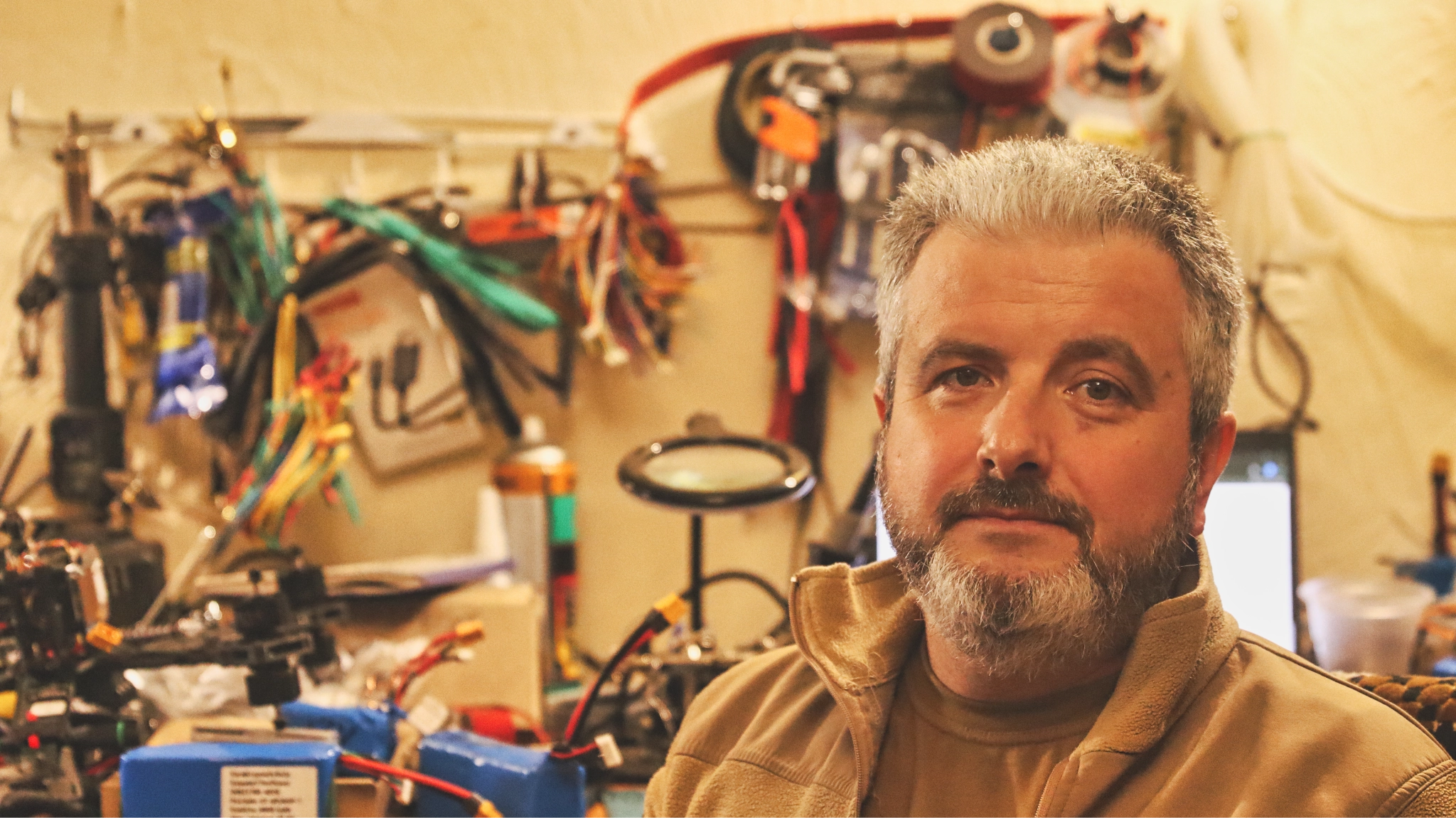
What is assembled here does not stay here for long. “This happens again and again,” says one of the men, who introduces himself as Ray. His job is to repair drones, prepare them, and adapt supplied models to the specific conditions at the front. From a small, dark room next door comes the sound of loud snoring. One of the pilots, Ray says, has just come back from the positions.
A 16-year-old youth died and several homes were destroyed after Russian UAVs targeted residential areas, an educational institution, and administrative buildings.
A Ukrainian flag hangs on the wall. On a screen in the corner, a live feed is running. Six small frames show different FPVs in flight, side by side. This is a former countryside dacha, improvised into a small drone lab.
Before going to war, Ray, a father of two, ran a small workshop in his hometown in western Ukraine. He worked with metal – precise work, he explains – producing adapters that allowed old Soviet lenses to be mounted on modern digital cameras. The tolerances were extremely tight, down to hundredths of a millimeter. It was delicate work, and it taught him the kind of accuracy he now uses here.
“At some point, I felt I had to do my part.”
He joined Khartia about six months ago. The decision came slowly, then all at once, as more and more people were being killed or wounded.
“At some point, I felt I had to do my part – to help keep the army strong,” he says.
At the same time, his business began to collapse. Workers left. Some tried to leave the country. Others were afraid to come to work at all. In western Ukraine, he notes, men were being picked up on the street.
“Ray” inside a makeshift drone workshop by the Khartia Brigade for repairs and adjustments outside Kharkiv, April 2026. (Photo by Korbinian Leo Kramer)
“I had no choice,” he says. If Ukraine gives up, he adds, what follows is already known. “Murder and rape – like in Bucha, Irpin,” referring to the streets littered with bodies outside Kyiv in 2022, revealed to the world days after Russian troops’ withdrawal.
Turning skills into weapons
Drones are nothing new to the 47-year-old. Back in 2024, he took engineering courses, built one himself from spare parts, learned how to fly and got certified. “From today’s perspective, that was the best decision I could have made.”
In Khartia, Ray explains, after basic infantry training, the idea is to find the right role for each person. So he told them he could solder very small electronic components with precision. “They gave me an opportunity,” he says. “I showed I’m capable of soldering very small electronic components – and now I’m here.”
He knows it is safer than being on the line. But more importantly, his skills are being used.
In practice, Ray is the one who makes the drones ready to fly. His task is to make sure they work properly, reliably, and for the mission they were prepared for – leaving the pilots to focus just on operating them.
One by one, he picks up different types of drones, pointing out their specific individual characteristics.
Too many different models, he says, create problems.
Some are one-way FPVs, kamikaze drones built for impact. Others return, like those used for logistics – dropping food, water, or smaller supplies to infantry on the zero line, where driving by car has become nearly impossible.
Hexacopters like the Vampire are different again: Multifunctional systems capable of carrying and releasing several mortar rounds before heading back.
“We can combine everything now,” Ray highlights. “It just depends on the purpose.”All the drones they are using here are made in Ukraine. They come through different channels: state structures, volunteers, private producers. What matters most is how easily they can be adapted once they arrive. Too many different models, he says, create problems.
“We try to keep things standardized,” he says. “With a limited number – let’s say around 10 – it’s much easier to tweak and adjust them.”
A war of constant adaptation
Suddenly, all eyes turn to the screen. A brief flare appears in one of the frames as one of his “babies,” as Ray calls them, just released its payload. A target goes up in flames. Mission accomplished, I would say. But no one reacts. The men register it and turn back to their work.
What happens in this room is not static. It is part of a process that changes constantly. “It’s a race every day,” he says. “We have to compensate with technological advantage. Otherwise we have no chance.” The Russians, he says, learn quickly. They test systems, and if something works, they produce it at scale. He mentions drones like the Lancet and the Molniya, which can carry up to 5 kilograms (11 pounds) of explosives, as examples of relatively cheap systems produced in large numbers and used to deadly effect.
Inside a makeshift drone workshop used by the Khartia Brigade for repairs and adjustments outside Kharkiv, April 2026. (Photo by Korbinian Leo Kramer)
He reaches for a Russian drone hanging on the wall like a trophy and takes it down. He points to the components inside – mostly Chinese. Only the frame is Russian, made of aluminium, easy to produce in factories.
These rooms are part of the front
Places like this are not just workshops – they are part of the front, small, smart cells that keep the system running. If the Russians learn their location, they will shell them heavily. “This is a more valuable target than killing several soldiers,“ Ray says. It’s not only surveillance drones that can reveal such sensitive positions. There are also traitors on the ground: “zhduny,” as he calls them, people who wait for the Russians and sometimes pass information. “We need to stay vigilant at all times,” he adds.
That vigilance, he says, now extends to everything. Russian forces have even begun copying Ukrainian supply packages dropped on the zero line. Instead of food or water, they contain explosives. He recounts a case in which a soldier picked one up and was severely wounded, losing his eyes and arms. Since then, they have been marked more clearly, with names and positions.
“The biggest danger,” Ray says, “is underestimating the enemy.”
“We have five minutes,” Kit chimes in.
Inside a makeshift drone workshop used by the Khartia Brigade for repairs and adjustments outside Kharkiv, April 2026. (Photo by Korbinian Leo Kramer)
Ray turns back to his work. Microchips, wires and small parts lie scattered across his desk, waiting to be soldered. Nothing here is idle.
The way things are developing, he says, can no longer be reversed. Where we have arrived now reminds him of “Terminator 2: Judgment Day” by James Cameron – a world where people live in bunkers while machines fight on the surface.
“We are pretty close to this.”
Where war and everyday life collide
Outside, the light is fading toward evening. We have barely stepped through the door when an explosion cuts through the air – a sharp crack overhead, then a plume of smoke hanging in the sky. A reconnaissance drone has just been shot down somewhere above the houses.
We rush back to the car, the engine starting right away. Titan maneuvers past deep potholes and points out the increased danger of drones along the road at this hour. In the fields next to me, camouflaged positions appear – small shelters covered with netting, blending into the terrain. The kind of places meant to be unseen from above.
We pass a few surprisingly well-kept gardens. In one of them, I see an elderly couple – she adjusting flowers, he coming over with a watering can to help. “Either they don’t understand what’s happening above them, or they simply don’t care anymore,” Cat remarks.
Back on the main road, everything feels like seconds. Ditches, nets, checkpoints again – and in the background, the concrete blocks of Saltivka take shape against a sky turning red.
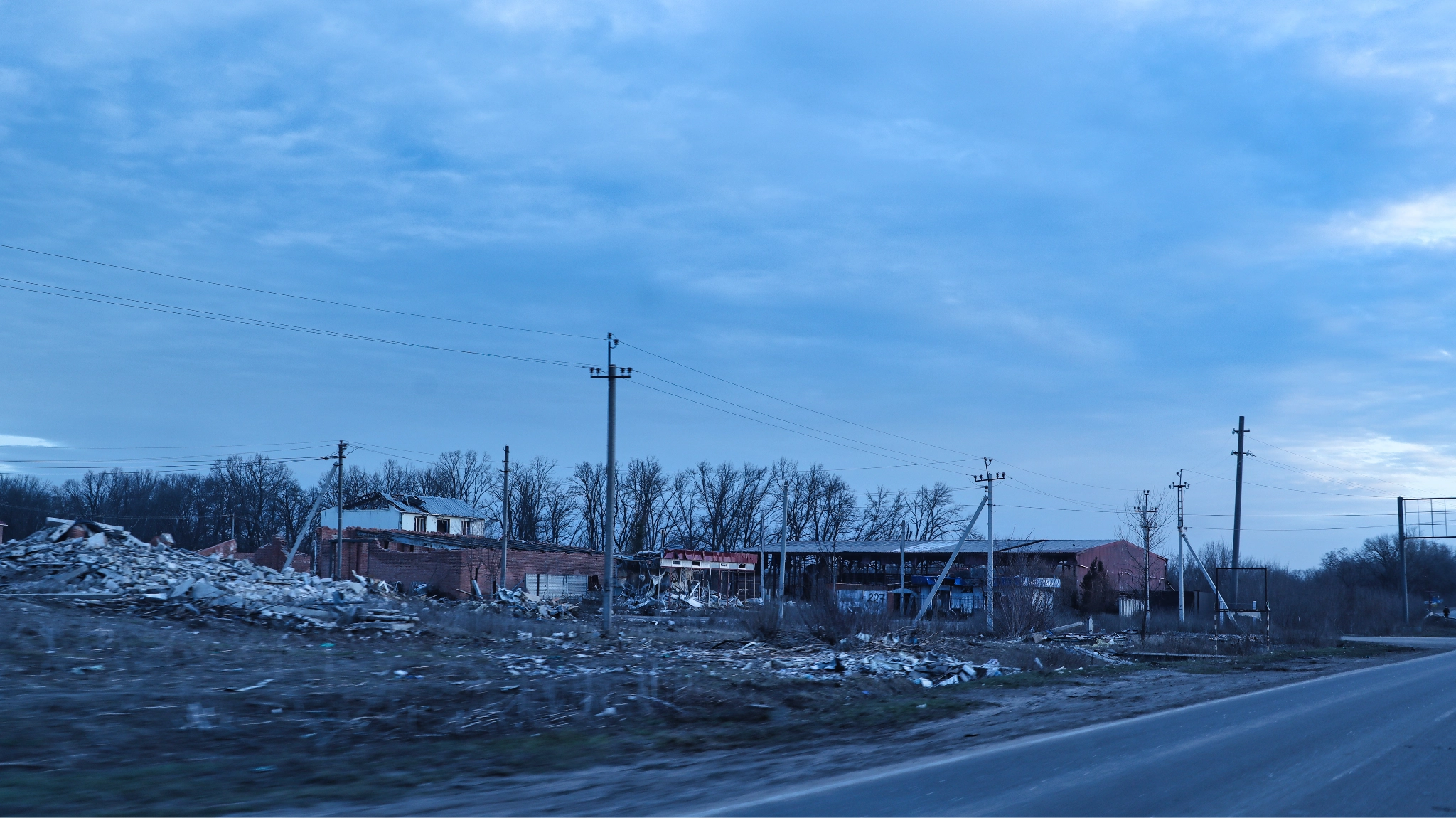
A road north of Kharkiv, with buildings destroyed by Russian shelling, at dusk, April 2026. (Photo by Korbinian Leo Kramer)
The transition is almost abrupt. Traffic, people on the street, the image of an apparent normality on the edge of the front.
On the training ground
A few days later, I am back on the road with Cat and Titan. We leave Saltivka behind once more and head out of the city, into open land. The sun stands high in the sky. Somewhere beyond the fields lies a large training ground – unofficial, unmarked, but very real.
By the time we arrive, the sound reaches us before anything else. Gunfire, in short bursts, then longer sequences. It doesn’t stop. Different units are spread across the terrain, each running its own drills.
“You repeat it until it becomes automatic.”
At one end, a group rehearses how to take a Russian position. A soldier runs toward a mock dugout, throws a grenade into a precise spot, then pulls back. Seconds later, the explosion. No one reacts. The next one steps forward.
Khartia Brigade soldiers during a live-fire training exercise outside Kharkiv, April 2026. (Photo by Korbinian Leo Kramer)
Khartia Brigade soldiers during a live-fire training exercise outside Kharkiv, April 2026. (Photo by Korbinian Leo Kramer)
Khartia Brigade soldiers during a live-fire training exercise outside Kharkiv, April 2026. (Photo by Korbinian Leo Kramer)
Khartia Brigade soldiers during a live-fire training exercise outside Kharkiv, April 2026. (Photo by Korbinian Leo Kramer)
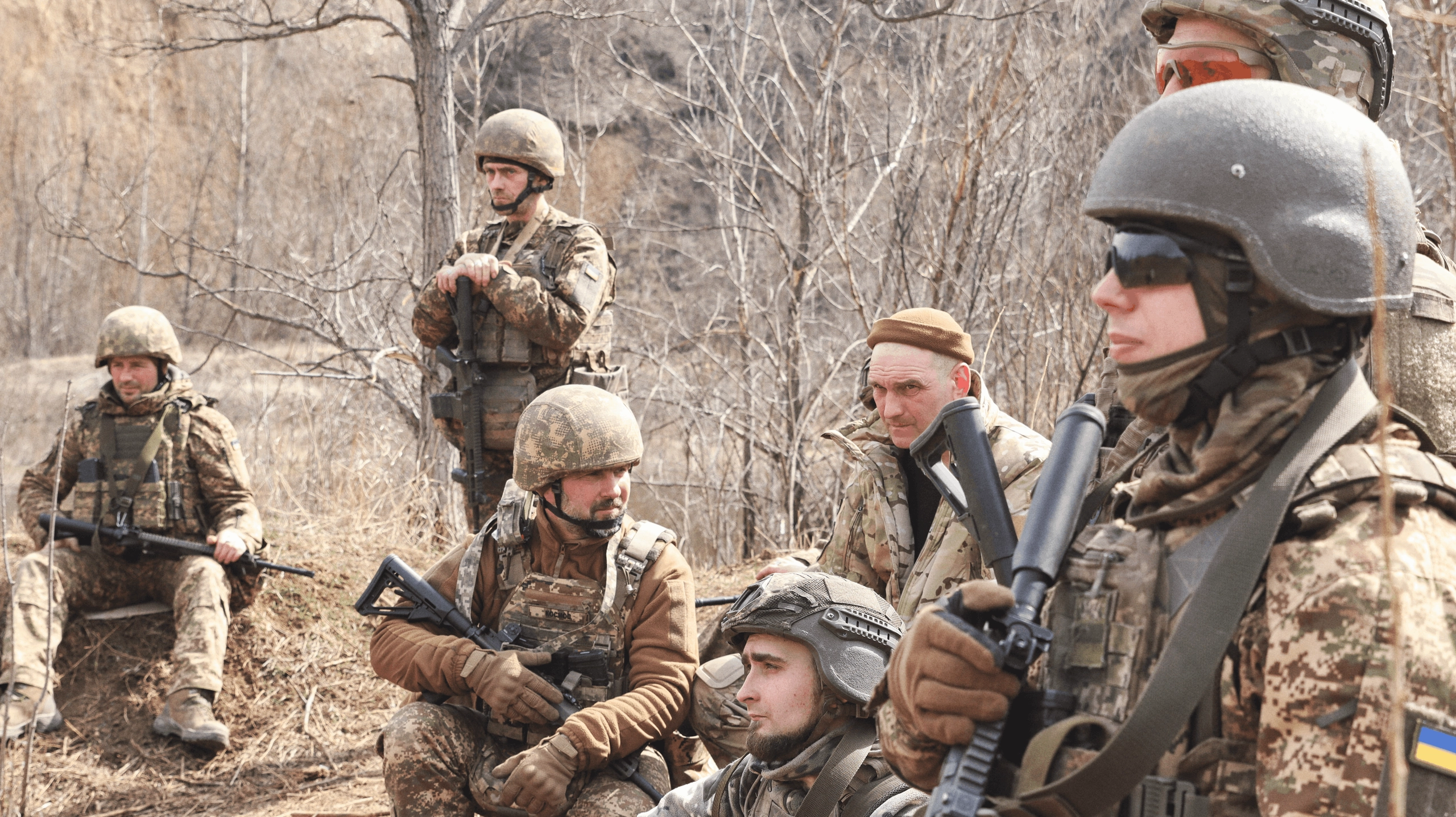
Further along, we reach the unit we came for. Around 10 men of different ages are lined up. Wooden target boards are set up in sequence. The instructor demonstrates the drill first. Then they follow, one by one. Down into the dirt, firing from prone, reloading, moving forward, taking cover behind a board, reloading again, advancing. The rhythm is constant.
From a warehouse to war
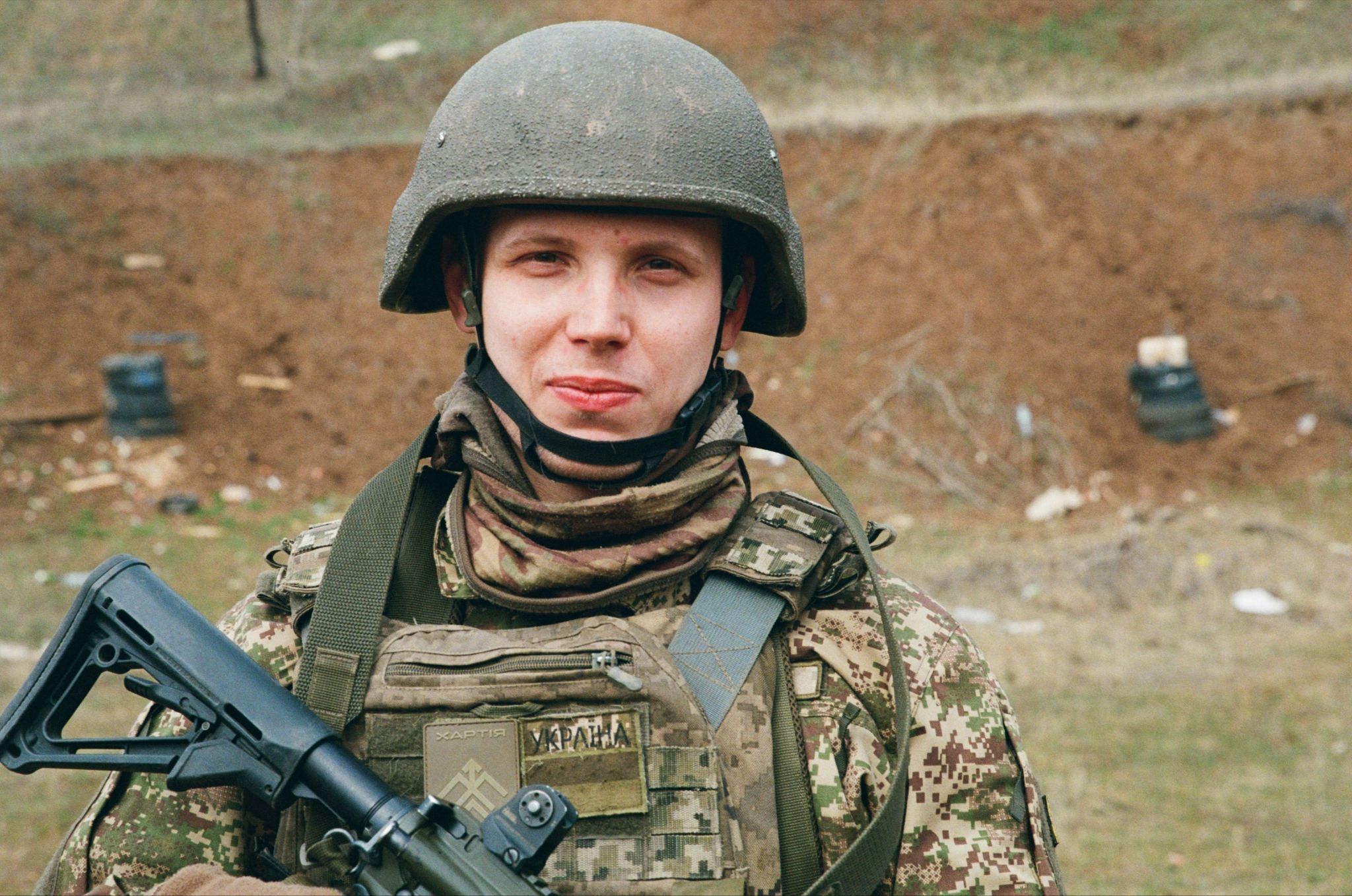
Extra stands among them, waiting for his turn. He is from the Slobidskyi district in Kharkiv, an industrial, residential area that has come under repeated Russian aerial attacks, including drone strikes on civilian infrastructure. He looks younger than he is. When he speaks, he pauses often, searching for the right words.
Before the war, the 28-year-old worked in a supermarket. Not at the cashier, he corrects with a small smile, but in the warehouse, handling goods, organizing deliveries, stocking shelves. “Completely civilian,” he points out. “No connection to the army at all.”
“Extra,” a soldier of the Khartia Brigade, during a training exercise outside Kharkiv in April 2026. Extra joined the army in 2024. (Photo by Korbinian Leo Kramer)
That changed in February 2024. He was standing at a tram stop, on his way back from visiting his grandmother, when recruitment officers approached him. “It happened coincidentally,” he says. “But I was ready.” He pushes his safety goggles up onto his forehead. “There was no shock. No fear. I accepted it consciously.”
At first, he served with the State Border Service of Ukraine. He stayed there for some time before the opportunity came to move on. Khartia had been present in the city long before that – billboards, graffiti, online campaigns. “I kept hearing that the level of preparation here is completely different,” he recalls.
As Khartia Corps commander Igor Obolensky has put it, the idea is simple: Join, and build a new army together.
What he found was a system built around repetition. When they are off the line, training runs almost every day. One week topography and tactics, followed by medicine, engineering, and fire training, rotating in cycles. “Everything I do here helps me,” he says. “You repeat it until it becomes automatic.”
Keeping the position alive
For Extra, the choice was clear: infantry. “Everyone thinks drones are safer. But it’s not like that.” He shakes his head. “Drone operators are priority targets now. The enemy doesn’t spare anything.” Artillery, aviation, drones – everything is used to find and destroy their positions.
His last mission with Khartia had little to do with what people imagine when they think of combat. As temperatures rose after a long winter of cold and mud, meltwater began flooding the front.
“We had to pump it out,” he says. “A lot.” The dugout was filling up, the position at risk. If the water reached the generator, everything would fail – power, communication, the whole place would become useless.
For three weeks, they worked on the site. Digging, reinforcing, clearing trenches. Soil was carried out and spread so it won’t be visible from above. “You cannot leave anything near the position,” he says. “Drones will see it.” Extra describes it without emphasis. It is more work than battle. Without it, the generator goes down – and with it the connection.
Who is still willing to fight
When asked about manpower, he answers cautiously. There is an overall shortage, of course, he admits. But here, it does not seem as extreme. “If it was,” he says, “I wouldn’t be here now. I would still be at the position.” Rotations are still possible, he stresses.
Part of it may lie in the brigade itself. Khartia has built a reputation – in its training, in its level of preparation, and in how it presents itself. As Khartia Corps commander Igor Obolensky has put it, the idea is simple: Join, and build a new army together.
Soldiers of the Khartia Brigade during an exercise at a training ground outside Kharkiv, April 2026. (Photo by Korbinian Leo Kramer)
Across the country, however, the picture is more complex. President Volodymyr Zelensky recently said Ukraine is bringing in around 30,000 to 35,000 people each month. What that number means in practice, however, is less clear.
Keeping them, moreover, has become its own challenge. Cases of soldiers leaving their units – during training or after deployment – are rising. In the first three and a half years of the war, more than 230,000 criminal cases were opened for going absent without leave.
For Extra, the reluctance to serve is something he has seen within his own circle. He knows people who have stayed away. “They are very afraid,” he notes. “Of explosions, of contact. It doesn’t make sense to try to convince or even force them.” They are proud of him, he adds. But they do not see themselves in the army. “Let them stay there. I protect them,” he says, with a certain resolve.
He pulls his safety goggles back down over his eyes, then reaches for his helmet. Another drill is about to begin. Paired up, they move forward – one firing, the other reloading at his back, then they switch. Extra is next.
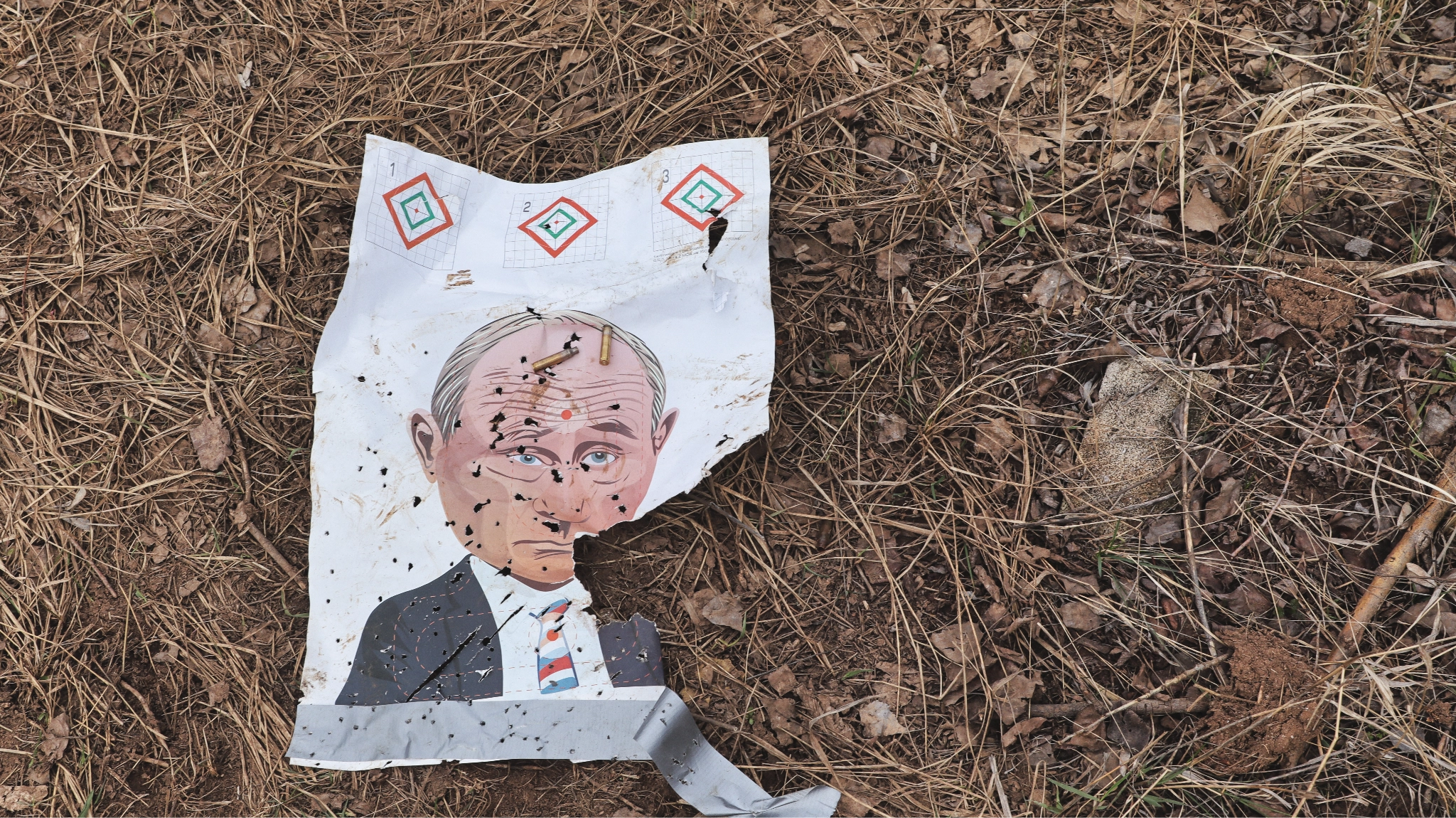
A shot-up paper target bearing the face of Russian President Vladimir Putin lies on the ground at a Khartia Brigade training site outside Kharkiv, April 2026. (Picture by Korbinian Leo Kramer)
As we leave the training ground, something catches my eye. A paper target lies in the grass, torn loose and carried by the wind. On it, the face of Russian leader Vladimir Putin, riddled with bullet holes.
It drifts slowly across the field, then disappears somewhere beyond the line of fire.