10 hours ago
Sarah RainsfordSouthern and Eastern Europe correspondent
With the US pulling out of trilateral talks with Russia and Ukraine, the EU is looking for potential candidates to step in.

10 hours ago
Sarah RainsfordSouthern and Eastern Europe correspondent

 Getty Images
Ukraine is urging the EU to help negotiate an end to the war with Russia, a topic that will be discussed in detail at an informal meeting of European foreign ministers in Cyprus.
The EU is actively considering re-engagement with Moscow over Ukraine as US efforts to mediate have ground to a halt and Russia steps up its deadly strikes.
Now, Ukraine's foreign minister has told the BBC that Kyiv is keen to introduce some "new dynamics" into the negotiation process.
"We need to move to a new format of talks with the Russian side," Andrii Sybiha said in a recent call, suggesting "more active participation by the European side".
Among the candidates rumoured for the role of envoy are both former German chancellor Angela Merkel and ex-Prime Minister of Italy Mario Draghi, but Sybiha wouldn't be drawn on any names.
A spokesperson for Draghi told the BBC he "prefers not to comment at this stage".
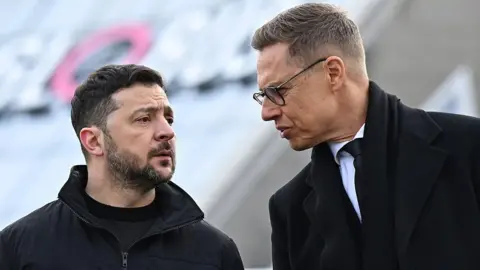
This weekend, Finnish President Alexander Stubb said he "probably couldn't answer in the negative" if he were offered the task, but only after Russia agreed to a ceasefire.
There is no hint of that.
Over the weekend, Kyiv was pummelled with missiles and drones in one of the most intense attacks of the war so far and Moscow has since threatened "systematic strikes" on the city, warning foreigners to leave and locals to beware.
Even as it escalates its aggression, Russia is accusing the EU of encouraging Kyiv militarily and so undermining US peace efforts.
So it's difficult to see it engaging with the Europeans in any meaningful way.
Russia prefers to talk to the US, partly for reasons of status and partly because President Donald Trump's envoys have been deeply unchallenging, pressuring Kyiv far more than Moscow.
Their approach has failed, and last week Secretary of State Marco Rubio said the US was not interested in hosting "an endless cycle of meetings that lead to nothing". He has since clarified that the US remains ready to mediate "if that opportunity presents itself".
Now the EU is looking to join the effort and ensure that any deal, if ever done, is the best for both Ukraine and European security.
 AFP via Getty Images
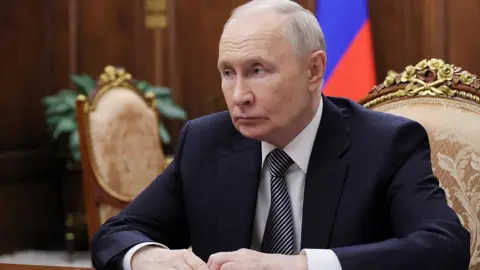
Vladimir Putin claims he is open to the idea as long as whoever is appointed "has not said all sorts of nasty things about us".
His own suggestion for an EU envoy, though, was German ex-chancellor Gerhard Schröder, a close ally of Moscow and long-time lobbyist for its interests.
The EU's foreign policy chief Kaja Kallas rejected the idea immediately: Schröder, she said, would be "sitting on both sides of the table".
The two-day gathering that opens in Cyprus on Wednesday will allow ministers to set out their countries' stalls with more freedom than a formal summit.
Since Russia's full-scale invasion in 2022, most have pursued a policy of isolation and sanctions, and not all agree on the wisdom of initiating even limited contacts.
Some, like Sweden and Lithuania, see Russia as squeezed now and want the pressure increased not eased. Others, like Italy, argue that it's unwise to stay on the sidelines any longer.
In March, Kallas circulated some starting points for discussion, described by one EU official as "food for thought". Her goal is to formulate a joint EU position regarding Russia – and set any red lines – before initiating contact.
Whilst the idea of appointing an envoy, perhaps even a group of them, will be floated in Cyprus, serious discussion would only happen at the level of EU leaders, potentially at their summit next month.
Meanwhile, Ukraine wants to "break the deadlock" and is pushing for progress, the EU official said.
"This must not become a prolonged process focused only on discussions about who should represent, how many people, and what format. No. This must happen quickly," Sybiha warned.
 AFP via Getty Images
In Kyiv, analyst Yaroslav Smovzh believes that engaging with Moscow is "doomed" unless the EU comes from a position of strength.
"There is a sense that Europe has somewhat lost its sense of agency in international affairs, especially regarding such an important large-scale war in Europe," says Smovzh, from the Adastra think tank.
"But if Europe wants to act as an independent and neutral intermediary it will not yield any results, just like the US did not achieve any success," he says, arguing that Russia needs to "be intimidated".
"So far Europe's response to Russia's behaviour in its [own] territory has been somewhat unconvincing."
As the EU talks about talks, Ukraine has been increasing the pressure on its neighbour itself with repeated deep strikes on Russian oil export facilities. It calls them its "long-range sanctions", and Moscow's latest large-scale attacks on Ukraine show that it's rattled.
That doesn't mean serious negotiations for peace are around the corner.
"There are no signals that Russia wants to end this war," MP Ehor Chernev from Ukraine's ruling Servants of the People party says.
But as US interest in pursuing that goal has waned he believes "new energy can be brought to this process" from Europe.
"They will represent the EU, which clearly understands the threat from Russia," the MP says.

NATO is reportedly preparing plans to rapidly deploy additional corps-level forces to defend the Baltic states in case of conflict with Russia, according to Reuters. The move follows Moscow expanding legal provisions for overseas troop use and renewed rhetoric over the rights of Russians in Latvia,
Yurii Ihnat told Radio NV that Ukraine hopes its SAMP/T air defense systems will be capable of intercepting ballistic missiles, though such use has not yet been confirmed in combat on May 27.

Due to new Russian attacks, as of the morning of May 27, power outages have affected consumers in five regions; electricity consumption has increased.
Russia is currently incapable of launching a large-scale offensive against NATO countries, but warned the alliance must remain prepared for sabotage and provocations, Radosław Sikorski said on May 27.