Central Asia’s republics are no longer the chess pieces of empires

When people speak of the Great Game, they usually mean the 19th-century rivalry between the British and Russian empires for influence over Central Asia. It conjures up images of spies crossing deserts, mountain fortresses and imperial intrigue – an era vividly brought to life in Peter Hopkirk’s book

South China Morning Post
75
2 min read
0 views
Central Asia’s republics are no longer the chess pieces of empires

When people speak of the Great Game, they usually mean the 19th-century rivalry between the British and Russian empires for influence over Central Asia. It conjures up images of spies crossing deserts, mountain fortresses and imperial intrigue – an era vividly brought to life in Peter Hopkirk’s books, which first awakened my fascination with the region.

A century and a half after the Great Game, another contest is unfolding across the same region. To the north is Russia, the region’s traditional political and security partner. To the east is China, its largest trading partner and an increasingly important investor. Turkey, the European Union and the United States are also seeking a greater presence.

Yet this new great game is being played by different rules. Central Asian republics are no longer prizes to be won. They have become increasingly confident players in their own right.

In his book, Great Game On: The Contest for Central Asia and Global Supremacy, former Australian ambassador to China Dr Geoff Raby argued that China has first and foremost been a Eurasian power. What’s changed, he said in response to my emailed questions, is that “the old division of labour in which Russia provided the region’s security and China its economic support through trade and investment has ended”. Russia’s invasion of Ukraine had weakened Moscow’s authority and its capacity to act as the region’s security guarantor. Meanwhile, China’s influence is expanding.

The war did not create these trends, he said, but accelerated them.
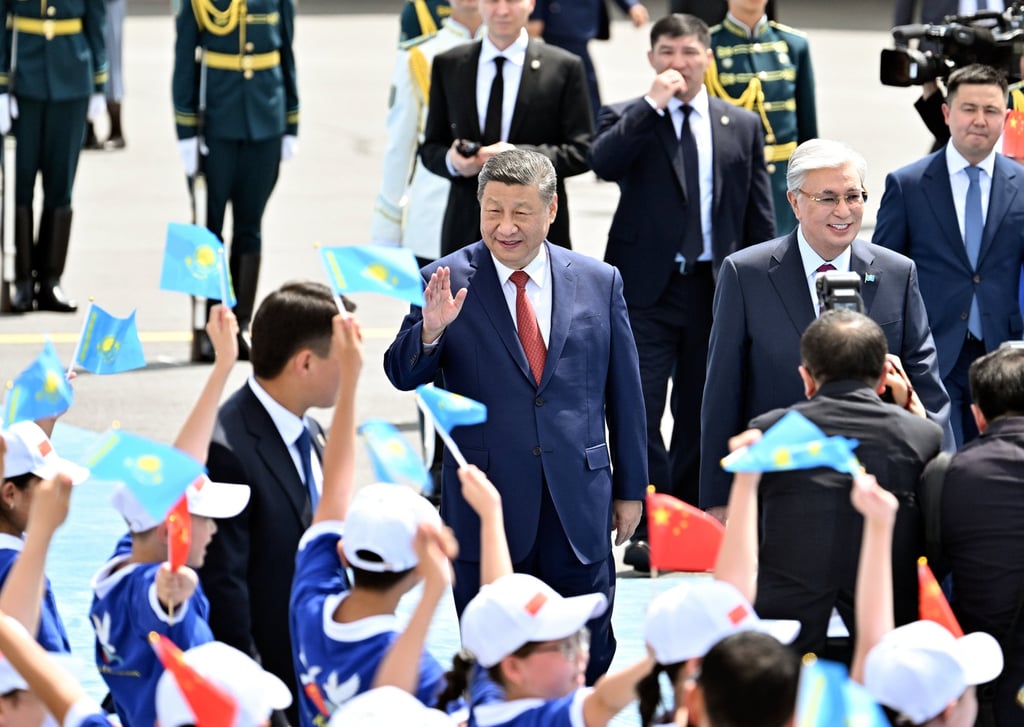
Chinese President Xi Jinping (centre) greets children as he walks beside Kazakh President Kassym-Jomart Tokayev (second right) in Astana, Kazakhstan, on June 16, 2025. Photo: Xinhua

Chinese President Xi Jinping (centre) greets children as he walks beside Kazakh President Kassym-Jomart Tokayev (second right) in Astana, Kazakhstan, on June 16, 2025. Photo: Xinhua

That changing balance was on display at last year’s China-Central Asia summit in Astana. Bringing together President Xi Jinping and the leaders of all five Central Asian republics, it reflected both China’s growing confidence and the region’s rising strategic importance. The meeting also showed Beijing’s determination to directly engage Central Asia beyond Russian-led institutions. While much Western commentary portrayed this engagement as another step in China’s expanding influence, the reality is more nuanced.

Share this article

Related Articles

China Citic Tower plane crash pilot ‘suffered from anxiety’
🇨🇳🇹🇼China vs Taiwan
South China Morning Post

China Citic Tower plane crash pilot ‘suffered from anxiety’

The pilot of a small plane that crashed into Beijing’s tallest building last week had long suffered from anxiety and discussed “ending his life” in his diary, authorities in the Chinese capital said on Thursday. In a brief summary of an investigation, the Chaoyang district government said the pilot

há aproximadamente 4 horas1 min
🇨🇳
🇨🇳🇹🇼China vs Taiwan
South China Morning Post

Sun is setting on US dominance of the world, scholar Wu Xinbo says

Wu Xinbo is the dean of the Institute of International Studies at Fudan University in Shanghai and a leading Chinese researcher on the US. In this interview, he analyses how shifts in US foreign policy are changing the relationship between the two countries. SCMP Plus readers get early access to art

há aproximadamente 4 horas1 min
China bans pet anaesthetic tiletamine after waves of young people vape drug
🇨🇳🇹🇼China vs Taiwan
South China Morning Post

China bans pet anaesthetic tiletamine after waves of young people vape drug

China has banned tiletamine, a common veterinary anaesthetic, after its recreational inhalation among young people escalated sharply. Since July 1, the compound has been classified as a controlled substance and is regulated as strictly as fentanyl. Tiletamine has a chemical structure similar to keta

há aproximadamente 5 horas1 min
China’s Wang Yi to test whether transatlantic turmoil can soften Europe’s Nordic hawks
🇨🇳🇹🇼China vs Taiwan
South China Morning Post

China’s Wang Yi to test whether transatlantic turmoil can soften Europe’s Nordic hawks

Chinese Foreign Minister Wang Yi kicks off a rare tour of Europe’s Nordic countries on Thursday, as Beijing tests whether it can use shifting geopolitical sands to find openings among some of the bloc’s most China-critical governments. The veteran diplomat will be in Denmark on Thursday and Friday f

há aproximadamente 7 horas1 min