Asia Pacific
The new vessels are among 19 ships that India plans to add this year to enhance its naval prowess.
By Anjana Pasricha
Jun 23, 2026, 11:31 AM
The country has made strides in constructing complex naval platforms but remains dependent on foreign suppliers for key technologies.

By Anjana Pasricha
Jun 23, 2026, 11:31 AM
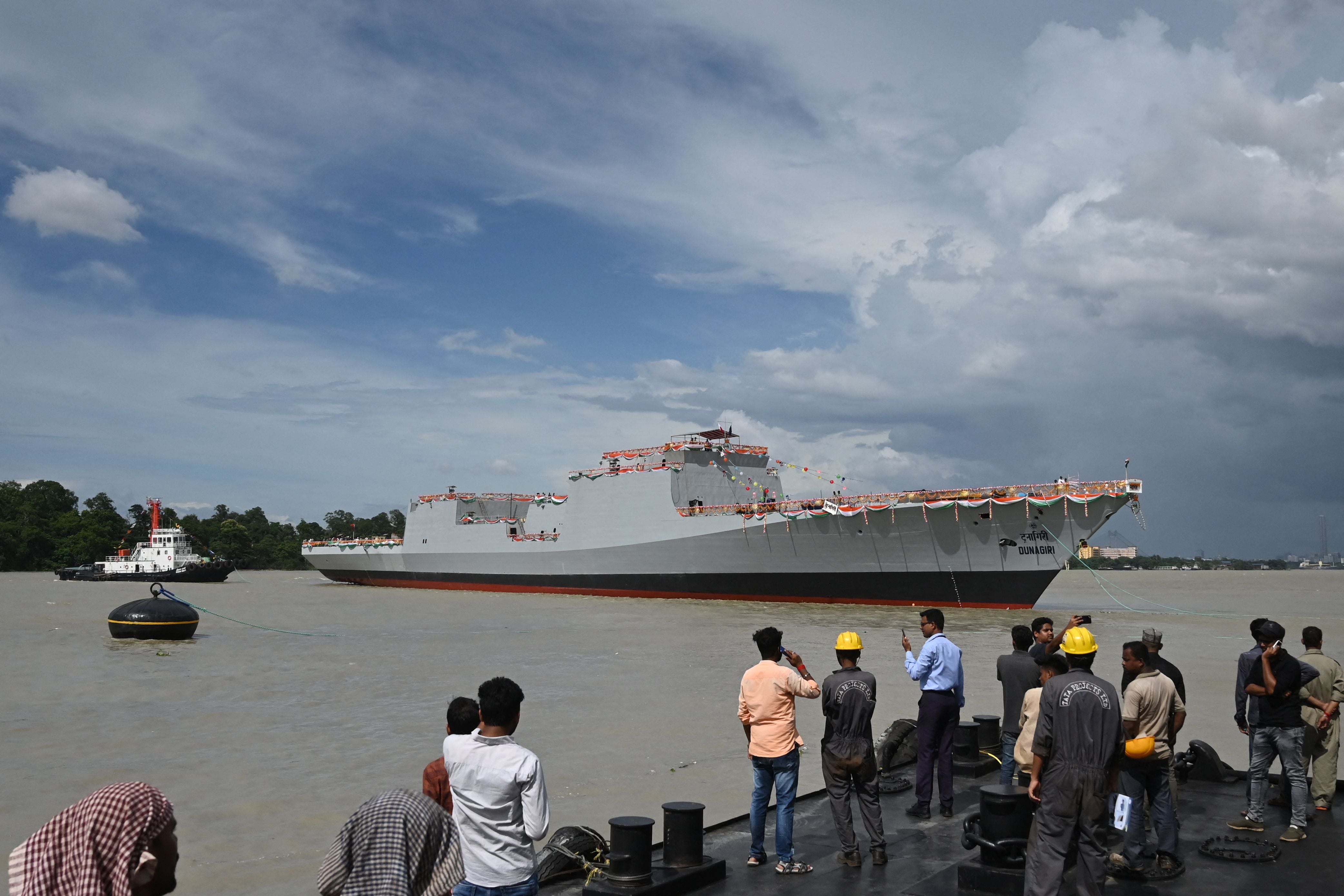
NEW DELHI — India has commissioned three domestically built naval vessels—a multi-role stealth frigate, an anti-submarine warfare platform, and a survey ship—as it accelerates both its naval modernization efforts and its push to design and build advanced naval platforms indigenously.
The most significant induction, which took place Sunday in the eastern city of Kolkata, was the stealth frigate named “Dunagiri.” One of India’s most advanced surface combatants, it is nearly 149 meters in length and displaces around 6,600 tonnes.
Equipped with advanced weapons, sensors and stealth technologies, the new warship is designed to perform air-defense, anti-surface, anti-submarine and long-range strike missions simultaneously.
In a statement, the Defense Ministry said the frigate represents a leap in indigenous warship design and combat readiness. “Built using modular construction techniques and armed with supersonic surface to surface missiles, advanced air defense systems, MR Gun, close-in weapon systems and advanced antisubmarine warfare capabilities, the frigate is designed for high-end operations.”
The warship is the fifth in a class of stealth guided-missile frigates inducted since last January. Armed with Brahmos cruise missiles, MF star radar, and Barak-8 surface-to-air missiles, these multi-role platforms will gradually replace aging warships. Two more frigates are scheduled for induction in the coming months.
The other two ships commissioned on Sunday will augment the navy’s capabilities in anti-submarine warfare and maritime surveillance. The increasing deployment of submarines by China and other countries in the Indian Ocean region has made these naval platforms are significant for New Delhi.
The anti-submarine warfare shallow water craft, Agray, is equipped with lightweight torpedoes, indigenous rocket launchers, and shallow-water sonar systems to detect, track and engage enemy submarines operating close to India’s coastline. The third vessel, Sanshodhak, will support hydrographic survey of coastal waters.
The three ships were built by a state-owned shipyard, Garden Reach Shipbuilders & Engineers in Kolkata with about 75–80% domestic content, according to the Defense Ministry.
Building and designing naval vessels is considered one of the more successfulachievementsof India’s efforts to increase domestic defense manufacturing and reduce its massive reliance on imports. However, analysts point out that while India is constructing complex naval platforms at home, it still remains dependent on foreign suppliers for key technologies such as propulsion systems and naval radars.
“India has done pretty well in terms of designing warships, but it still has a lot to do regarding the propulsion package of ships. It is also import-dependent on big-ticket ordnance such as missiles, guns and heavy torpedoes and so on,” according to retired Commodore C. Uday Bhaskar, director of the Society for Policy Studies in New Delhi.
“In the frigate Dunagiri for instance, the guns are with Italian collaboration, the engines have come from GE (General Electric) USA. But what has been achieved is positive,“ he said.
Indian Prime Minister Narendra Modi emphasized India’s goal of enhancing domestic defense production at the commissioning ceremony for the ships on Sunday. “Today India no longer wants to remain a mere buyer in the defense sector,” he said. “Our military power cannot become a market for the world, The definition of our power lies in self-reliance.”
The three new ships are among 19 vessels that India plans to add this year to enhance its naval prowess as protection of critical sea lanes becomes a priority amid rising geopolitical uncertainties. About 90% of India’s trade by volume and vital energy imports come via sea.

It marks the first time both chambers approved directing a president to remove armed forces from hostilities since the War Powers Act was adopted in 1973.
It marks the first time both chambers approved directing a president to remove armed forces from hostilities since the War Powers Act was adopted in 1973.

Chief of Space Operations Gen. Chance Saltzman sported the first wear-test asset of the mess dress at an Air Force graduation ceremony in mid-June.

Officials say the new tool will move the Marine Corps from being data-rich but information-poor to a state of information superiority.