
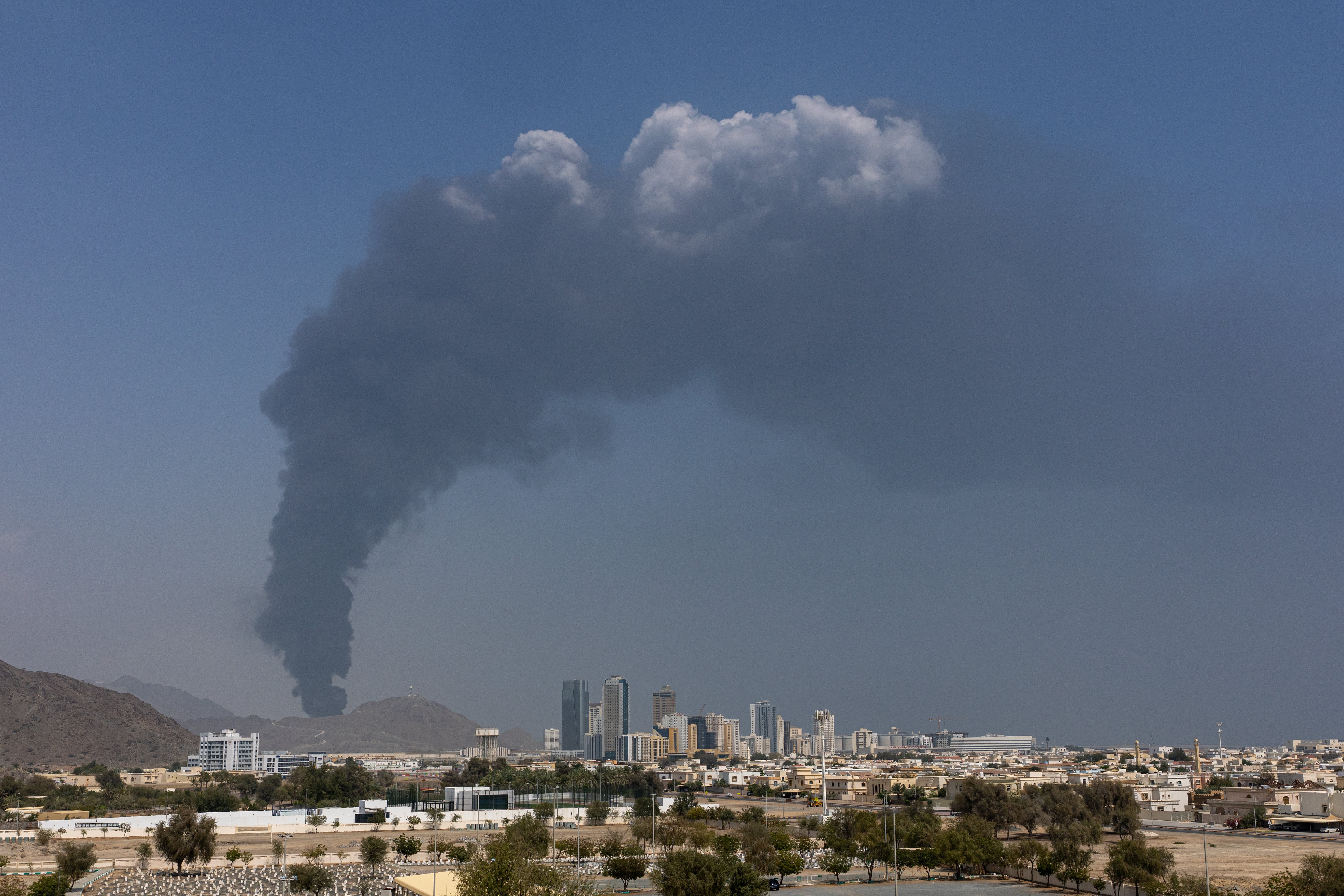
MILAN — Iran’s drone swarm tactics against Gulf states are prompting calls for cheaper regional defense layers that would avoid interceptor exhaustion, as experts warn of the possibility of a prolonged drone war across the Middle East.
Figures published by Gulf defense ministries indicate that as of March 3, Iran has launched more than 540 missiles and carried out over 1,450 drone strikes against regional countries, with drones constituting roughly three-quarters of the attacks, Reuters reported.
While the patterns seen since the start of the Iranian attack window resemble the saturation logic observed in Ukraine, where large waves of cheap one-way attack drones combined with ballistic missiles are deployed to overwhelm defensive systems, analysts note some differences in their roles.
“In Ukraine, Shahed-type drones often serve as nightly, persistent harassment and infrastructure attrition tools, whereas in the Gulf they’re being used inside a broader missile campaign intended to stretch the Gulf and U.S.-aligned air defenses across multiple states, bases and urban areas simultaneously,” Kristian Patrick Alexander, senior fellow and lead researcher at the UAE-based Rabdan Academy, said.
Thus far, Gulf countries have reported high interception rates of missile attacks, and to a lesser extent, against low-flying drones. For example, data published March 4 by the United Arab Emirates, which has absorbed a large number of the offensives, claimed military forces detected 941 drones and intercepted 876 of them.
Some of the weaponry used by countries and their allies to shoot down low-cost drones includes the U.S.-made Patriot and Terminal High Altitude Area Defence (THAAD) systems as well as Rafale fighters, F-15s and Eurofighters.
Francesco Schiavi, research fellow at the Middle East Institute Switzerland, concurs that one of the main challenges for the region will be endurance, especially as the fighting continues.
“Each interception carries a financial and logistical cost – estimates suggest that for every dollar Iran spends producing drones, Gulf states may spend $20-$28 on defensive fire, with individual interceptors often costing more than $1 million,” Schiavi added.
Both experts advised that countries under attack must urgently look to cheaper and scalable counter-drone layers: electronic warfare, jammers, guns or close-in weapons, directed energy, and enhanced shared air picture coordination.
“The ‘winning’ defense will be the one that can kill lots of targets cheaply without burning premium interceptors – without cheaper layers and better integration, the cost curve favors the attacker,” Alexander said.
Meanwhile, Tehran’s offensive arsenal, already degraded by U.S. and Israeli air strikes, is also running lower, said Federico Borsari, non-resident fellow at the Washington-based Center for European Policy Analysis
What to watch
As hostilities drag on, subject experts highlight three important factors to monitor: the type of attacks, the nature of targets, and the performance of strike weapons.
According to Alexander, one tactic to watch is whether Tehran will continue to send attack drones in big waves or if they will be used in sequenced packages to probe radars before firing missiles.
Schiavi adds that it will be important to pay attention to the strike pattern Tehran adopts: Until now, the regime has followed a dispersed approach, targeting several Gulf countries at once with a mix of weapons, but it could shift toward true saturation attacks as observed in Ukraine.
The primary targets of Iranian attacks have so far been military bases and embassies. It remains to be seen if Tehran is able to expand the target set to include more critical infrastructure, such as ports, logistic hubs, or energy facilities, which experts say would signal an escalation.
Sam Bendett, advisor at the Center for Naval Analyses, said he’s keeping close tabs on the flight ranges of Iran’s Shahed drones, and the variety of similar weapons the country has in its arsenal.
It will also be important to see if Washington’s role changes as the conflict continues, considering that Gulf countries’ interception capabilities are closely tied to U.S. technology.
“Gulf air defense systems and their performance remain closely linked to U.S.-enabled radar coverage, early warning, and operational coordination – interceptions over Qatar, for example, rely heavily on radar networks connected to Al Udeid Air base, while missile engagements in Kuwait occur in airspace shared with American aircraft,” Schiavi added.
Elisabeth Gosselin-Malo is a Europe correspondent for Defense News. She covers a wide range of topics related to military procurement and international security, and specializes in reporting on the aviation sector. She is based in Milan, Italy.

