4 hours ago
Tom BatemanUS State Department correspondent
Iran appears emboldened by the outcome and its leaders may sense Trump's appetite for risk is low.

4 hours ago
Tom BatemanUS State Department correspondent
Israel's tit-for-tat strikes with Iran over the weekend, despite US President Donald Trump's call for Prime Minister Benjamin Netanyahu to hold fire, threatened to thrust the Middle East back into another round of direct confrontation between Tehran and Washington.
Israel bombed sites in Iran for the first time since a ceasefire in April, after Iran fired missiles at Israel, in what Tehran said was retaliation for Israeli strikes on Lebanon's capital, Beirut.
The current web of fractious alliances and dysfunctional ceasefires shows how dangerously destabilised the region remains, more than three months after the US and Israel launched their war on Iran.
The escalation also highlights three points about the current trajectory of the war:
After Iran's missile attack on Israel on Sunday, Trump spoke to several journalists telling one he was "going to call [Netanyahu] right now and tell him not to retaliate".
The implication was an Israeli counterattack could jeopardise his perilously fragile diplomacy with Tehran.
Hours later, Israel attacked Iran. Trump told the BBC on Monday afternoon that Israeli planes were "already on their way" when he spoke with Netanyahu.
In a brief phone call with the BBC, the US president denied the Israeli PM had defied him, saying: "If I tell him to do something, he does it."
On the face of it, Trump failed to stop Netanyahu, another escalation in a tense series of exchanges between the two leaders.
"We're in the final throes of what will be a very, very good deal," Trump said on Tuesday.
When asked whether it would be matter of days or weeks, he said it could take "two or three days" and the Strait of Hormuz would open immediately after.
Last week, Trump reportedly dished out an expletive-laden rant at Netanyahu, calling the Israeli leader "crazy" for wanting to attack Beirut.
Netanyahu said strikes on Beirut were necessary amid the Hezbollah threat against northern Israel.
Trump felt his behaviour threatened his own attempt to reach a deal with Tehran to reopen the Strait of Hormuz and secure assurances on Iran's nuclear programme.
In an interview with the New York Post last week, Trump said he was perturbed by Netanyahu's "constantly fighting with Lebanon".
So did Netanyahu defy Trump with its latest strikes on Iran?
Although that's one prevailing narrative, the answer is almost certainly no.

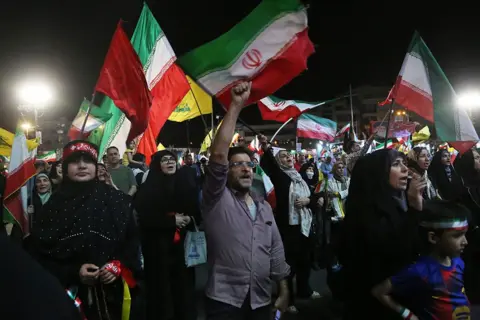 Anadolu via Getty Images
Israel's subsequent actions suggest Washington at least gave limited consent, but as the president would see it, proceeding with caution and pushing for one round only.
As the veteran US negotiator Aaron David Miller told the BBC on Monday morning - Trump gave Netanyahu a "blinking yellow light".
As a practical matter, Israel could not have have attacked Iran without at least Washington's tacit approval.
The US currently has its biggest military buildup in the region since the invasion of Iraq.
It has hundreds of military personnel in Israel liaising with the Israel Defense Forces (IDF).
In this case Israel would have needed to co-ordinate with US forces in the region over air routes.
The IDF briefed Israeli journalists after the strikes there was "full co-ordination" with US Central Command.
It said the US military also helped shoot down missiles fired by Iran at Israel.
By Monday afternoon Washington time, both Israel and Iran were signalling the round between them was over.
This is where Trump would want things to stand.
His messages on Sunday night that he would stop Netanyahu may have been meant for Tehran's consumption to distance Washington from Israel's strikes.
Or he may have genuinely intended to stop him, but was persuaded otherwise by Netanyahu.
While the Israelis will have calculated they could not let Iran's missile strikes pass without retaliation, Iran's calculation for launching the strikes here is critical.
This was the first time Iran fired at Israel in response to an Israeli attack on Lebanon (rather than in direct retaliation for an Israeli strike on Iran).
Iran was trying to force its point about linking two ceasefires - its own with the US and one that exists in name only between Israel and Hezbollah.
It was also testing Trump's response.
How far would the Americans support an Israeli counterattack on Iran?
Would the Americans join in themselves?
The more dispute they can create between the US and Israel over the future direction of the war, the better as far as Tehran is concerned.
In the end, Trump chose distance - at least in public - continuing to push the diplomacy with Tehran.
 Anadolu via Getty Images
In an interview with NBC on Sunday, hours before the flare-up, he reiterated his view that a deal with Iran was "very close".
After it, he framed Israel and Iran in a similarly dismissive light, saying each had had "their fun" and now it was time for the talks.
Iranian leaders appear emboldened by the outcome of the confrontation.
President Masoud Pezeshkian suggested Iran's military strikes on Israel strengthened its negotiating position with the US.
He called "diplomacy and defence" the "two wings of national power".
"We have neither abandoned the field nor the negotiating table," he posted on social media.
Iran's economy is under massive pressure, worsened by the US naval blockade of its ports.
Its leadership wants at least two things from the negotiations with Washington as a priority.
One is access to money, in the form of sanctions relief and the unfreezing of tens of billions of dollars from its oil revenues.
The other is to limit Israeli escalation against Hezbollah in Lebanon, as it sees Hezbollah as deterring further Israeli strikes against itself.
Given the pressures on the US economy from high oil prices caused by Iran's closure of the Strait of Hormuz, in a US midterm election year, Tehran is likely to have sensed that Trump's appetite for risk is currently low (although each further escalation may be pushing his patience).
That means Iran is likely to keep trying to push its two points up the agenda, to try to "front load" sanctions relief and unfreezing assets in the proposed deal with the US, sensing Trump is keener to get an agreement than to return to war.
Trump was asked in his interview on Sunday if he would unfreeze any Iranian assets or lift any sanctions upfront as a part of a deal.
His answer: "No."
That might be one reason there's still no agreement.
But the chance remains significant of growing destabilisation in the region potentially pushing the US and Iran into another round of direct fighting.
Iran's ticket allocation for the World Cup has been pulled just days before football's global showpiece kicks off, leaving fans in the lurch after they had already made plans to attend the matches.
Any deal with the ayatollahs is a betrayal of freedom," said one Tehran resident. "They do not attach any value to the people, and are not bound by any value or agreement."
Attending as a guest of Knicks president James Dolan for Game 3 of the NBA Finals matchup against the Spurs, Trump heard the boos from the raucous crowd inside MSG.

Israeli airstrikes continue in southern Lebanon Separate Israeli strikes targeting areas around Tyre continue since early Tuesday morning. At least eight people have been killed after an Israeli airstrike on a housing area in the city of