3 hours ago
Tessa Wong
Stanford said the papers, which mentioned the Tiananmen Massacre, would be banned if returned to Beijing.

3 hours ago
Tessa Wong

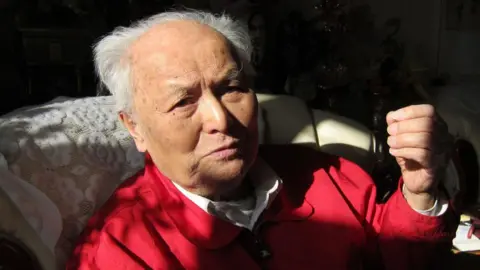 SCMP via Getty Images
A court in California has ruled that Stanford University can keep the diaries of a former secretary to Mao Zedong, the founder of modern China.
Li Rui, a top official known for his criticism of the Chinese Communist Party (CCP) in his later years, had meticulously kept diaries of his time within the party.
Li's daughter began donating his diaries to Stanford when he was still alive, saying this was per her father's wishes. But following his death, his widow sued for the documents to be returned to Beijing.
Stanford framed the case as a fight against Chinese government censorship, arguing it was the rightful owner of the diaries and that they would be banned if returned.
On Tuesday, the court ruled the donation made to the Hoover Institution at Stanford was "lawful and in accordance with Li's wishes".
The decision "ensures one of the most valuable firsthand accounts on the history of modern China will be freely available for study", said Condoleezza Rice, the former US Secretary of State who is the Hoover Institution's current director.
During the trial, Stanford's lawyers had argued that Li Rui had given the papers to them as he "understood that the [CCP] regime would seek to suppress his account of modern Chinese history" and he "feared that the materials would be destroyed".
The papers include diaries which Li kept from 1938 to 2019 covering much of the CCP's rule, as well as correspondence, minutes from meetings, notes about his work, poetry and photographs.
Most famously, the diaries include his eyewitness account of the Tiananmen Massacre, which he saw from a balcony overlooking the square and labelled as "Black Weekend" in English in his records. It is a highly sensitive issue that is rarely discussed in China.
His account describes the soldiers shooting at the demonstrators gathered at the square, armoured vehicles crushing barricades put up by the protesters, and soldiers shooting at buildings around the square including the one he was in.
A prominent CCP figure known for his reformist views, Li was both venerated as a party elder and also shunned for his unsparing, sharp-tongued criticism of leaders, including President Xi Jinping. His writings were censored and his books banned in China.
His daughter, Li Nanyang, began donating his papers to Stanford in 2014 when he was still alive.
In a 2019 interview with BBC Chinese after his death, she said this fulfilled her father's wishes.
That year Li Rui's second wife, Zhang Yuzhen, filed a lawsuit against Li Nanyang - her stepdaughter - in China.
Zhang argued that Li Rui wanted her to decide which of his documents would be made public and they were wrongfully given to Stanford.
She also said that since the publicly accessible diaries contained "deeply personal and private affairs" of her life with Li, their display caused her "personal embarrassment and emotional distress".
A Beijing court ruled in her favour and ordered the diaries to be handed over to her.
The trial that began in California in 2024 was for a separate lawsuit launched by Stanford against Zhang in the US, where the university asked to be declared as the lawful owner of Li Rui's papers.
On Tuesday, Stanford's lawyers said that Li Rui was "very clear in his diaries and conversations that he intended for his historic documents to be preserved and maintained" by the Hoover Institution.
"We are very pleased with the court's decision, that Mr Li's wishes will be honoured and that these important materials will remain with Hoover and Stanford and accessible to all who are interested."
Zhang died during the trial proceedings. The BBC has contacted the US lawyers who were acting for Zhang for comment.

European stock markets opened higher after the US president said the conflict would "end very soon".

Prime office supply in mainland Chinese cities and Hong Kong is estimated to peak this year, while demand remains hampered by an economic slowdown and global uncertainties, according to Cushman & Wakefield. At the end of 2025, premium office inventory in 21 major cities in Greater China – including

Against a backdrop of war and global uncertainty, Chinese Premier Li Qiang delivered a clear message at the recent China Development Forum: China is committed to being a “harbour of stability” for the world. The forum, which drew CEOs from global companies such as Siemens, Nestlé and Apple, signalle

It's a turnaround for Beijing, whose official response has been muted so far. Why is China stepping in now?