The South Korean authors rising above a tide of hate to become bestsellers
10 hours ago
Leehyun ChoiSeoul
A quiet revolution is unfolding as women writers carve out space in the wake of an anti-feminist backlash.

10 hours ago
Leehyun ChoiSeoul

 BBC/ Hosu Lee
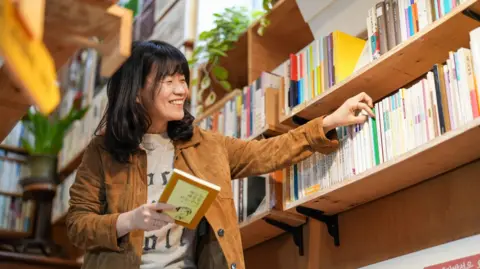
When Seen Aromi's memoir documenting the joys of singlehood hit the shelves in early 2024, it became an instant bestseller.
Women young and old, single or married, those with children and without seemed to relish So What if I Love My Single Life!, drawing "second-hand satisfaction" from Seen's confident retorts to unsolicited advice, or finding in it the freedom to be "unapologetically single".
But soon her success encountered a deluge of criticism and hate online, largely from men. They told her she would die lonely, called her selfish, and accused her of "betraying her country".
Embracing female independence and challenging patriarchy has become increasingly dicey in South Korea, where young men have driven a huge backlash against feminism.
Discrimination, harassment and sexual violence against women remain huge challenges, but feminism has become such a polarised term here it is often levelled as a grave charge, inviting witch-hunts online and censure offline.
Now women are carving out a space to share their stories in what is shaping up to be a quiet revolution in the country's literary scene.
This year women swept the country's most prestigious literary prize - the Yi Sang Awards - winning in all six categories for the first time. Book talks, and reading and writing rooms called guelbang, have sprung up, offering time and space for women to gather and - crucially, they emphasise - grow as a community.
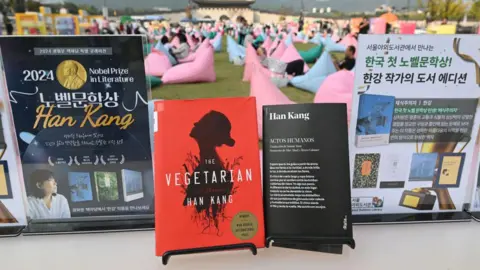
Han Kang's historic Nobel Prize win in 2024 aside, women's voices haven't always been that prominent in Korean writing.
However, the country's MeToo movement in 2016 "encouraged ordinary women to speak up", says Eunyu, an author who launched her writing room in 2011. She prefers using her pen name.
Even as the revolt against anything deemed feminist grew, more women began to teach writing classes or hold reading sessions, making these spaces more accessible for other women.
"Many of the women who joined as attendees have gone on to become writers in their own right," Eunyu adds.
"I've seen countless instances of attendees digesting their pain, restoring their sense of self and confidence through the act of writing. While these shifts are deeply personal, when they unfold in a community they can often inspire a chain of reaction. In that sense, what we're witnessing here is a slow - but sure - revolution."
 Getty Images
In South Korea, the story Seen is telling is radical.
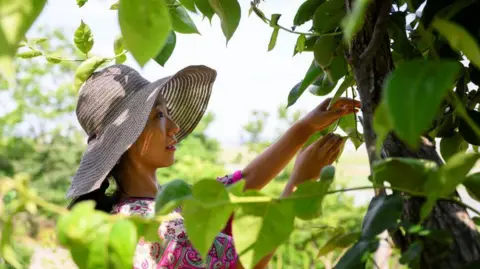
She bought a countryside home when more than half of the population lives in the greater Seoul area. She decided not to marry or have children while South Korea struggles to lift birth rates. And she is enjoying the life she has chosen - be it assembling a hearty salad from freshly picked vegetables, or journaling in a cozy living room done up exactly how she wants.
"I'm not claiming that everyone should abandon marriage or look down on married people in any way," Seen says. "I simply wrote about how making my own choices, prioritising my desires, has led me to truly enjoy my life. I felt that people were really waiting to hear stories like mine."
They were, it turns out. "As someone who's been questioning whether marriage is really right for me, this book made me tune into my inner voice," one reader wrote online.
Another said: "My life might have been different if I'd read this book before I married. Back then, I never realised that marriage was optional."
The book's success has since brought its 39-year-old author a six-figure international translation deal with Penguin.
She is far from alone. Sales of translated Korean books more than doubled in 2024, compared to the previous year. As global interest in Korean culture swells, the country's writers are breaking into the international market.
The result is a rich, varied list. The Old Woman With the Knife is Gu Byeong-mo's story about Hornclaw, a legendary assassin in her 60s contemplating retirement while navigating loneliness.
In Kim Cho-yeop's sci-fi anthology - If We Cannot Go at the Speed of Light - a once-famous scientist stranded on a defunct space station dedicates her life to reuniting with her family located light years away.
After her sister's suicide, author and singer Lang Lee unpacks the trauma, from the Korean war to domestic violence, that haunts the women in her family in her new memoir.
There is a touch of the smash hit K-pop Demon Hunters in Esther Park's The Legend of Lady Byeoksa - a tale of a cross-dressing female demon-slayer's doomed love in the Joseon era.
 Getty Images
As the publishing scene blooms, it has become an outlet for conversations that no longer seem viable in public spaces.
At their height, anti-feminist campaigns targeted public figures, from popular actors like Gong Yoo and Bae Suzy to K-pop idols. Male fans even burned merchandise connected to female pop stars after they spotted them reading a feminist novel or carrying a phone case with the phrase "girls can do anything".
Out of fear of repercussions, many women - and even men - are opting for what they call "stealthy feminism".
For many, the growing number of guelbang, or reading and writing rooms, are a welcome break from what they feel is a kind of suffocation.
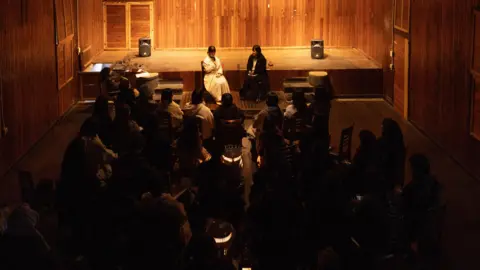
On a recent Saturday afternoon, around 50 women had lined up outside an old church on a sleepy street in Daejeon city, 160km (99 miles) south of Seoul.
They had come from all corners of the country to attend a talk by feminist author Ha Mina. One mother had brought along her toddler daughter.
"We listen to each other's stories here - and that experience can be transformative," says Ha, especially amid Korea's cut-throat competition and the immense pressure to succeed.
But these workshops, she explains, are "a safe space for women to make mistakes and grow, perhaps for the first time in their lives".
As an aspiring writer, Ha Mina took a number of writing classes led by male poets and novelists but, she says, "toxic, predatory behaviour was commonplace".
Years down the line, joining a writing class taught by a female writer who became her mentor changed her life.
In her first book, the critically acclaimed Crazy, Freaky, Arrogant and Brilliant Women, she interviewed some 30 young, South Korean women while investigating depression in the female population - and found that it was inseparable from social expectations and gendered violence.
Making their stories visible profoundly healed her, she says. "I stopped having suicidal thoughts after publishing this book. Isn't that incredible?"
 Sunah Shin
It's hard to pin down a single motive that draws so many women - other than the fact that they are all seeking a room of their own, a place where they say they can find some freedom, a little bit of adventure, but most of all, as one of them put it, they can speak their mind feeling "safe and at ease".
"I don't need to censor myself, whether we are talking about our experience of sexual violence, discrimination, or our desires and sexuality," says Kim Gahyun, 28, who was in Daejeon that day.
And meeting all these other women has opened her eyes, she adds: "Womanhood is not a singular experience and we can't be boxed into the same category."
That diversity especially resonates with 36-year-old Choi Suwon.
"It's not just women, people of all sorts of minority backgrounds bring their unique stories to the table, and we listen to each other no matter how far they are from 'the norm'. Writing and sharing my stories in these spaces make me feel a deep sense of liberation."
For others, like 29-year-old Lee Hae, these spaces are "the perfect treat I needed".
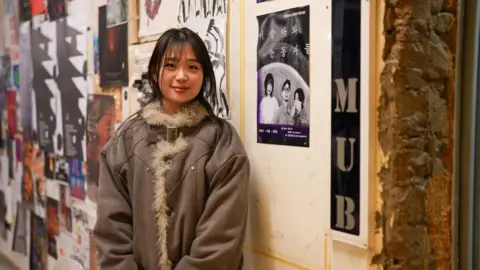
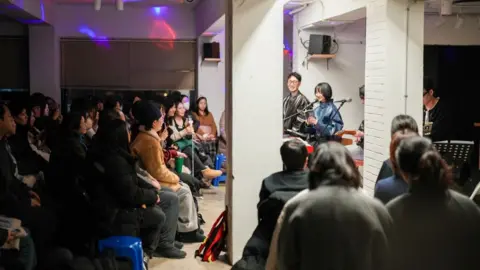
She had just taken a two-hour ride on the bullet train from Daegu to attend Lee Sulla's "book concert" in Seoul - an evening of music and author-led readings.
 BBC/ Hosu Lee
"I love reading Lee's and other contemporary women writers' works, because I can really empathise with these stories," she says.
Lee was voted the "most prominent contemporary Korean Writer" in 2023 by one of the country's largest book retailers after publishing her subversive debut novel, In The Age of Filiarchy.
Much like in Lee's life, the novel's protagonist emerges as the new head of her family, reversing its fortunes as her independent publishing business thrives. She hires her mother Bokhee as her chef and assistant, and her father as her driver and housekeeper.
For the first time Bokhee is compensated for her labour as the family's cook, while the stripped patriarch Woongyi is content with his daily routine: cleaning the house, feeding the cats and driving his daughter around.
Lee's subtle writing, and inviting, humorous style turned the book into a widely read hit and, she says, older men often attend her talks too. But her bold reimagining of family won the hearts of so many women.
"What I depict are not grand, ground-shaking events, only small shifts in the dynamics of a family," Lee says.
"But these can be potent enough to create a completely new order."
 Hosu Lee
More weekend picks

Qiu has been scouring Shanghai’s labour agencies for a job for her 58-year-old father – a former mechanic from neighbouring Jiangsu province caught in a frustrating limbo. While he is still years away from the official retirement age for rural migrants, his struggle to find work underscores a parado

During Vice-President Han Zheng’s visit to Nairobi in March, China signed a cash grant for drought relief and recently delivered food aid to Somalia, Togo, Zimbabwe and Zambia – helping 217,057 people in Zambia and providing Zimbabwe with 5,000 tonnes of rice. Du Xiaohui, director general of the for

Taiwan must urgently overhaul its civil defence and rethink its energy strategy to withstand a potential blockade, experts warned at a tabletop exercise, describing existing preparedness as “too romantic” for a real-world crisis. The two-day 2026 Political, Economic, Military and Societal Tabletop E

For the first time in its history – and in a striking departure from its long-standing doctrine of minimal economic intervention – Hong Kong is preparing to draw up a five-year plan. Chief Executive John Lee Ka-chiu has asked all policy bureaus to help draft proposals by the end of the year. To lead