
If you are a foreign volunteer rebuilding homes outside Kharkiv, an expatriate resident running a co-working hub in Lviv, a VC scouting Series A deals in Kyiv, or a member of the worldwide Ukrainian diaspora weighing a permanent return, you have probably noticed that every group chat lights up whenever someone asks, “Do I need a Ukrainian passport to keep doing what I’m doing here?”
The short answer is no - citizenship is not a prerequisite for volunteering, investing, or settling long-term. The more interesting answer is that the rules of the game shifted dramatically after the Verkhovna Rada’s January 16, 2026, reforms. Dual and even multiple citizenship, once unthinkable, is now legal under carefully drawn conditions. As someone whose life, capital, or family ties span borders, you need to know when these changes open doors and when they introduce hidden obligations such as conscription or new tax liabilities.
JOIN US ON TELEGRAM
Follow our coverage of the war on the @Kyivpost_official.
In the next few minutes, we will cover exactly that: a concise history from 1991 to the present, the mechanics of acquiring Ukrainian citizenship in 2026, the language-exam hurdle, simplified procedures, wartime risks, and embassy-based work-arounds.
From Independence to Multiple Passports: A 35-Year Snapshot
Ukraine’s citizenship story starts in the chaotic months after the Soviet breakup. The 1991 Law on Citizenship invented the modern Ukrainian passport and, by a two-vote margin, rejected dual citizenship. Single allegiance remained the rule through the tweaks of 1997, 2001, and 2005.
The 2001 overhaul (Law No. 2235-III) broadened eligibility for descendants, yet it doubled down on the “one passport only” doctrine written into Article 4 of the Constitution. In practice, many Ukrainians quietly held a second passport, but the state could, at least on paper, strip them of citizenship if it found out.
The picture changed in three phases:
- 2021 - Ukrainian-language proficiency became a formal prerequisite.
- 2023 - Exams on the Constitution and history were added (Law No. 2996-IX).
- 2025 - The Verkhovna Rada adopted Law No. 4502-IX, legalizing multiple citizenship, effective January 16, 2026.
That final milestone is what every volunteer coordinator, investor, and diaspora family should imprint on a mental timeline: it is the day Ukraine entered the select club of countries that let their citizens and, crucially, newcomers keep more than one passport yet still reserve the right to treat a dual national solely as Ukrainian on home soil.
What Actually Happened on January 16, 2026?
Four key elements came into force:
- Multiple citizenships became legal if your other passport comes from a “friendly state” on a Cabinet-approved list (currently the U.S., Canada, Germany, Poland, and the Czech Republic).
- Ukrainians who pick up a listed-country passport no longer lose their Ukrainian one.
- Foreigners from the listed states can naturalize without renouncing their birth nationality.
- Everyone - no exceptions - must pass exams in the Ukrainian language, history, and the Constitution (we will unpack the carve-outs later).
Those bullet points drive practically all changes to Ukrainian citizenship law that matter to volunteers weighing long-term stays, expatriates finalizing property purchases, investors structuring holdings, and diaspora members planning a comeback.
Naturalization Basics for Busy Residents and Investors
You finally reach the section of the article your community WhatsApp group keeps requesting: “Just tell me how to get the passport.”
Eligibility Filters at a Glance
To qualify today, a foreign adult must generally:
- Hold an immigration permit and have five years of continuous legal residence in Ukraine (one year if serving in the Armed Forces during martial law).
- Demonstrate lawful income or investment capital.
- Prove knowledge of Ukrainian (B1 level for everyday conversation).
- Pass the 45-question test on the Constitution and history.
- Write a formal pledge to obey the Constitution and laws.
- Renounce previous nationality unless you are from one of the five “friendly” countries or fall under another statutory exception.
The procedural funnel starts at district branches of the State Migration Service and ends with a presidential decree. Average processing time pre-war was eight months; under martial law, some categories are paused entirely, a point we will discuss in the risk section.
Let’s place a spotlight on immigration services in Ukraine, the agencies you or your legal counsel will primarily engage with: the State Migration Service (SMS) handles in-country filings, while consulates process diaspora applications. Expect asynchronous document traffic between Kyiv and your local embassy, not the overnight velocity your courier provides.

Dual and Multiple Citizenship in Practice
Before we zoom in on the exams, you need operational clarity on how dual nationality plays out day to day. The statute spells it out: while physically in Ukraine, a dual citizen is treated only as a Ukrainian. That means:
- No foreign consular protection.
- No escape clauses if martial law bars male citizens aged 18-60 from leaving the country.
- All civic duties - taxes, mobilization, and jury service - apply.
For diaspora Ukrainians returning with U.S. or Canadian passports, and for investors holding weekend site visits, this is not trivia. If you naturalize and cross the border into Ukraine, your other country’s embassy cannot help you if the Military Commissariat issues a draft notice. The U.S. Embassy’s landmark June 2024 security alert is blunt about it.
Use-Cases Where Dual Citizenship Is a Real Advantage
- Rapid border crossings for EU client visits: Ukraine’s biometric passport opens Schengen doors.
- Simplified property ownership: only citizens can directly own agricultural land.
- Estate planning for diaspora families: easier inheritance of Kyiv or Odesa apartments.
- Corporate governance: boards in strategic sectors may soon require a Ukrainian majority.
But those perks evaporate if the passport drags a young entrepreneur into involuntary military duty. Make sure every advisor addressing what changed in Ukraine citizenship law highlights this nuance.
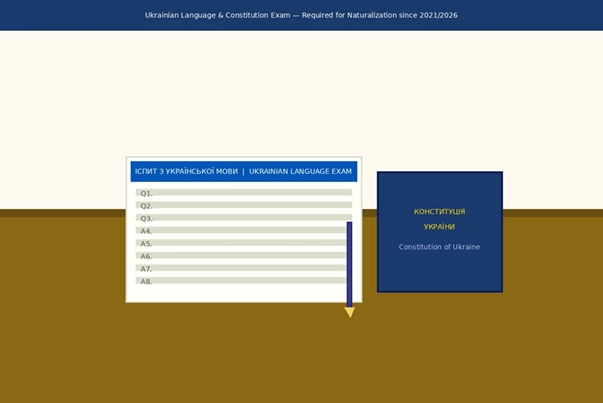
The Language and Knowledge Exams - New Gatekeeper or Manageable Hurdle?
Applicants often underestimate the time cost of compliance tasks. Ukraine citizenship law amendments of 2026 turned the Ukrainian-language certificate from an elite option into a mandatory precondition, effective immediately.
Examination logistics:
- Price: 9,984 UAH for language; 9,984 UAH for the Constitution + history bundle (about USD 500 total).
- Test centers: Kyiv, Lviv, Kharkiv - nowhere else.
- Retake window: next available slot; the queue in Kyiv is currently two months.
- Shelf life of certificates: unlimited.
Study notes for your planning spreadsheet: the language test is B1-level conversational Ukrainian, not an academic gauntlet. The Constitution/history quiz, however, stumps many fluent speakers because it wades into legal minutiae.
Who Does Not Have to Sit the Exam?
Under changes to Ukrainian citizenship law, the only full exemptions belong to:
- Foreigners who have already earned a state award while serving in the Armed Forces.
- People whose fast-track naturalization is of “state interest” (typically big investors, Nobel-level scientists).
- Children who gain citizenship via adoption or parentage.
A two-year deferral (but not an outright waiver) applies to wartime contract soldiers and certain humanitarian volunteers. Everybody else, including diaspora applicants proving descent from a Ukrainian grandparent, must eventually sit for the tests.
Simplified Procedure - Why Only Five Countries?
When the Cabinet issued the resolution in November 2025, many expected a long roster of EU allies. The political calculus produced five names: Canada, the United States, Germany, Poland, and the Czech Republic. Nationals of these states can file a declaration recognizing themselves as citizens of Ukraine rather than a notarized renunciation letter. Everything else, residence, income, and exams remain unchanged.
From the perch of an international investor or returning diaspora family, the big win is administrative, not substantive. Your Polish co-founder still needs five years of legal stay or another statutory ground; she just avoids the Catch-22 of persuading Warsaw to cancel her existing passport. Ukraine citizenship law amendments 2026 mention expansion of the list “after assessment of pilot outcomes,” but no timetable exists.
Territorial Origin Shortcut
Article 8 of the core statute lets anyone with a parent, grandparent, or sibling born in pre-1991 Ukraine skip the five-year residence rule. A standard registration via a consulate can grant the passport in three to five months, provided the applicant can fly to Ukraine for the exams. Again, what changed in Ukraine’s citizenship law is the mandatory test requirement for this category as of 2026.
Risks Under Martial Law
No one likes surprises - least of all a volunteer medic or a diaspora entrepreneur with a ticking project timeline. Two risk layers demand explicit briefing.
Layer 1 - Application Freeze for the “General” Queue
Since August 2024, Ukraine has suspended the acceptance of regular naturalization petitions from citizens of the russian federation until martial law ends plus twelve months. Applications from all other foreign nationals continue to proceed under standard statutory guidelines. The intake window stays open only for:
- Foreign military personnel.
- People of “state interest.”
- War-related volunteers with temporary residence permits.
If your only claim is five years of residence teaching at an international school, your file collects dust until peace comes. Ukraine citizenship law amendments 2026 did not override that freeze.
Layer 2 - Mobility Lockdown for Men 18-60
Under the mobilization statute, male citizens cannot cross the border during wartime unless medically exempt or accompanying disabled dependents. A newly naturalized dual national is 100% subject to that rule once he enters Ukraine. Plan volunteer rotations or business trips accordingly.
More than one Canadian-Ukrainian philanthropist learned this the hard way when attending a grant ceremony in Odesa and remained unable to leave. The issue is not hypothetical; multiple Western embassies keep the warning live on their sites.
Embassy Route - Does Remote Paperwork Solve the Problem?
Clients often ask, “Can I finish the process entirely from Berlin?” Partly, yes. Ukrainian consulates accept applications, fingerprint cards, and sworn translations. But the exams are only in Kyiv, Lviv, Kharkiv. Therefore, the applicant must physically travel at least once. If martial law is still active, the mobility trap springs on male applicants of draft age.
Diaspora families should time embassy filings with family-visit calendars: schedule the exam trip the same quarter as a planned holiday, or postpone until after demobilization rules relax.
Alternative Pathways for the Determined
Not every volunteer coordinator or angel investor has a Ukrainian granny. Here are the three non-standard routes you might explore:
1. Military Service Fast-Track
One year of contract duty in the Armed Forces unlocks the passport, exams included. It is risky, obviously. Yet for some already enlisted foreign fighters, this is the only legal immigration path.
2. Presidential Decree for “State Interest”
Founders who deploy massive capital, donate critical technology to the armed forces, or create significant local employment can bypass standard, multi-year naturalization timelines via a presidential decree. Under Article 9 of the Ukrainian Citizenship Law, individuals whose admission represents a formal ‘state interest’ or who have provided ‘outstanding services’ to the country can be granted expedited citizenship directly by the Office of the President.
3. Standard Naturalization Post-War
If none of the above fits, the vanilla five-year track will reopen after martial law. Begin gathering residence permits, tax filings, and language-course certificates now so the petition is turnkey on Day 1 of peacetime.
Each option has a different risk-reward profile. Use a matrix in your planning session: Urgency vs. Life Goals vs. Legal Exposure. Update quarterly because changes to Ukrainian citizenship law continue at an unusually rapid cadence.
Quick Reference: Key Facts at a Glance
Conclusion
In an era when passports influence where aid flows, where capital is deployed, and where families reunite, knowing what changed in Ukraine citizenship law this year can save your humanitarian mission from disruption, keep an investment schedule on track, and smooth a diaspora homecoming.
We covered the sweep of reforms from 1991 to Ukraine citizenship law amendments 2026, showed how the multiple-citizenship rule works, dissected the language-exam obstacle, weighed wartime risks, and listed the realistic paths for those without blood ties to Lviv.
The new law is generous on paper but unforgiving in practice if you ignore the fine print. Use that knowledge the next time a fellow volunteer, an expatriate colleague, an investor partner, or a cousin in Chicago asks: “Should I get a Ukrainian passport?” Now you have a structured, evidence-based answer that blends empathy with operational precision, a hallmark of effective cross-border engagement.


