A rumour, a lynching in India and a long wait for justice
9 hours ago
Abhishek DeyGuwahati, Assam
A court has convicted 20 people for the 2018 mob lynching of two men falsely accused of kidnapping children.

9 hours ago
Abhishek DeyGuwahati, Assam

 BBC
BBC
One summer afternoon in 2018, two men set out on a road trip into the Karbi Anglong region of India's northeastern Assam state. They never came back.
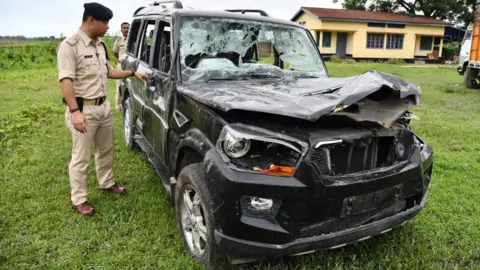
Abhijeet Nath, a 30-year-old businessman, and Nilotpal Das, a 29-year-old musician, were driving from the city of Guwahati. By evening, their journey had taken them to a village, where they were surrounded by a mob that suspected them of being "child kidnappers" and beaten to death.
The case drew national attention - not only for its brutality, but because it reflected a wider pattern of violence emerging at the time. Across parts of India, rumours about child-abduction gangs were spreading rapidly through WhatsApp messages and viral videos, fuelling suspicion of strangers and, in some cases, mob attacks.
Nearly eight years later, the lynching is back in the headlines after a court in Assam convicted 20 people, finding them guilty of murder and participation in an unlawful assembly, while acquitting 25 others for lack of evidence "beyond reasonable doubt". The sentencing is on Friday.
Those convicted have denied the allegations. They have the option to appeal against the verdict in a higher court.
In its order, the sessions court said: "This is not a simple case of murder. The involvement of [the] entire locality is established from the evidence on record."
But for the victims' families, the ruling has fallen short of their expectations of justice, with the acquittal of more than half of the accused being a key concern.
Das's father, Gopal Das, told reporters the family was "not satisfied", adding that they would consult with their lawyer on possible next steps and that they sought the strictest punishment for those convicted.
Nath's family has expressed similar concerns, saying they were considering legal options over the acquittals and hoped for government support.
 AFP via Getty Images
The judgment, passed on Monday, uses witness statements and police evidence to describe what happened that June evening in 2018.
According to witnesses, a "hue and cry" drew villagers to the spot where Nath and Das were being held. The court records a crowd of around 150-200 people, with at least 50 directly participating in the attack using sticks and other weapons, which led to the deaths.
The judgment does not establish a clear reason for why the men were travelling to Karbi Anglong, around 180km (112 miles) from their homes in Guwahati. But their parents told the court that the two were keen travellers who often explored places together.
Police said they believed the men stopped in Panjuri Kachari village, where they were killed, to ask for directions. A rumour that the men were child abductors spread in the area, drawing a crowd, according to court documents.
The families learnt of the killings after Nath's father tried calling his son.
A stranger answered and told him Nath had been killed and that the news would soon appear on television, according to witness statements. The families set out for Karbi Anglong soon after.
Separately, police said they received reports of two men being assaulted in the village and rushed to the scene. The victims were taken to a local hospital, where they were declared dead.
In the weeks that followed, dozens of arrests were made. A chargesheet was filed in 2024 against 48 people, three of whom were later found to be minors and their cases transferred to a juvenile court.
Of the remaining 45 accused, 25 were found to be innocent, defence lawyer Manas Sarania told reporters earlier this week.
The ruling has renewed focus on one of the most widely discussed cases of mob violence in recent years which sparked protests and demands for accountability.
At that time, there was a wave of attacks fuelled by rumours circulating across parts of India - often spread through WhatsApp messages and viral videos alleging the presence of child-abduction gangs. Sometimes amplified by local media, these messages stoked fear and suspicion of strangers.
Similar lynchings had already been reported in Tamil Nadu, Karnataka and Telangana, with more incidents later emerging in Maharashtra, Tripura and elsewhere, as police struggled to curb the spread of misinformation on social media and messaging platforms.
The federal government, however, said at the time that there was no evidence linking these cases to the rumours circulating online, sparking outrage. Lawmakers raised concerns about the spread of "fake news", particularly on WhatsApp, while the Supreme Court urged the government to consider an anti-lynching law.
 Bloomberg via Getty Images
The incidents also put pressure on WhatsApp, eventually prompting the government to warn the platform that it could face legal consequences if it remained a "mute spectator". The company later introduced limits on message forwarding, labelled forwarded messages and launched public awareness campaigns.
In the years since, the killings have raised broader questions about how such rumours can be contained - and who is responsible for stopping them.
A 2021 UNICEF study found that false information can spread faster and more widely than verified facts, particularly when it provokes fear or anger, making it harder to contain.
"Technology companies alone cannot address problems rooted in society," said Prateek Waghre, a tech policy researcher.
Measures such as restricting how messages are forwarded can slow the spread of misinformation, he said, but may also affect the flow of legitimate information.
On platforms like WhatsApp, where messages are protected by end-to-end encryption and can only be read by the sender and recipient, monitoring content is inherently difficult. Any attempt to directly moderate such messages, Waghre added, could require weakening those protections and raise broader concerns about privacy.
The episode also became a turning point for law enforcement agencies. Kuladhar Saikia, Assam's former police chief, said the response to such incidents shifted in the years that followed.
Authorities came to see that blunt measures - such as suspending internet services - offered only temporary disruption and did little to address the underlying spread of rumours.
"Instead, we focused on grassroots outreach, working with community leaders to verify information and discourage rumours," Saikia added.
But for the families at the centre of the case, those debates feel far removed.
For them, the verdict marks only another step in a case that has stretched on for years - one that does not alter what was lost on that summer day in 2018.
Nath and Das never returned home, and their deaths continue to shape the lives of those they left behind.

The woman got stuck waist-deep in a pit latrine in the Australian outback after it gave way.

The widely circulated image had prompted authorities to move their search operation.

Just weeks before US President Donald Trump’s planned visit to Beijing next month, China is sending two giant pandas to Atlanta in what observers describe as a “goodwill gesture” amid persistent tensions that range from trade to broader security issues. The China Wildlife Conservation Association sa

Several writers have cut ties with the University of Queensland Press for cancelling the book.