8 hours ago
Yogita Limaye,South Asia and Afghanistan correspondentand
Mahfouz Zubaide
More than 1,100 Afghans evacuated by the US fear their route to promised resettlement is closed for good.

8 hours ago
Yogita Limaye,South Asia and Afghanistan correspondentand
Mahfouz Zubaide

 Getty Images
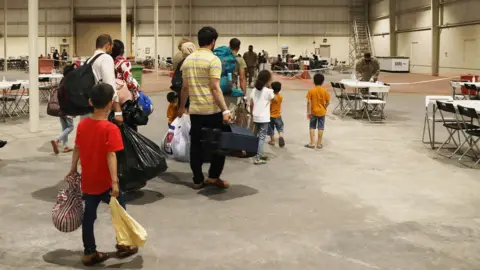
For 18 months, Alia has been waiting in a transit camp in Qatar for her promised resettlement to the US.
But now that route appears to have closed for good. Where she and hundreds of other Afghan evacuees will end up next is unknown.
Going back home to Afghanistan is not an option. It is too dangerous, Alia says. And since the US and Israel began a war with Iran, the evacuees are not safe where they are either.
"We have been betrayed. Not by the American people, but by those in government who had promised to take us to safety in America," says Alia, who worked as a lawyer in Afghanistan before the Taliban took over the country in 2021.
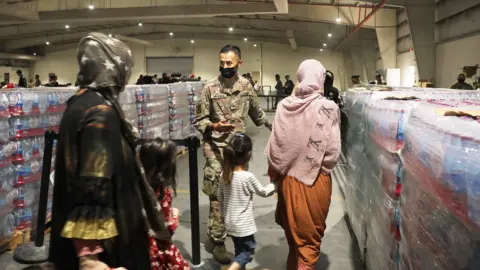
Alia - whose name has been changed for her safety - is among a group of more than 1,100 people evacuated from Afghanistan by the US who are now stuck in limbo in Camp As-Sayliyah (CAS) in Doha.
The camp – a former US army base – is where thousands of Afghan evacuees have been processed for resettlement to the US under Operation Allies Welcome, which was launched by the Biden administration after the return of the Taliban and the chaotic US withdrawal.
 Reuters
Earlier this year, the Trump administration announced it would close the camp by 31 March and that the evacuees would not be taken to the US, plunging hundreds like Alia into fear and uncertainty.
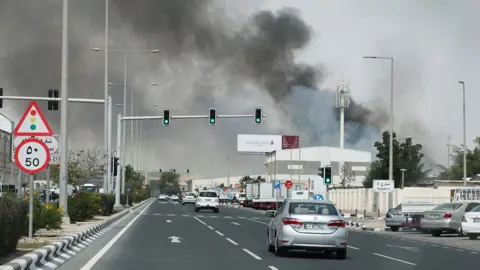
Their anxiety has surged since Qatar started to be hit by Iranian attacks. CAS is roughly 12 miles (19km) from Al-Udeid US air base, which has been repeatedly struck by Iran.
The group has collectively sent out this message: "The danger is not directed at Qatar itself, the actual targets are American bases in Qatar one of which is us... The emotional situation of children, pregnant women and the elderly is concerning. People wander about the corridors and cry."
They have appealed to US President Donald Trump to make a one-off exception for them due to the volatile situation.
"This group of people are not just random refugees that showed up in Qatar. They were brought there by the United States government and told that they would be moving to the United States," says Shawn VanDiver, a US military veteran who runs AfghanEvac, a charity that has helped resettled Afghans who aided the US effort.
"These are all people that for one reason or another were connected to the United States mission [in Afghanistan]. And because of that connection, they're in danger."
 Getty Images
The evacuees' route to the US has been slowly shutting down since Trump took power.
Then in June, he suspended the entry of Afghan nationals into the US as part of a wider travel ban.
The possibility of any exception being granted to the evacuees became virtually impossible after an Afghan man shot and killed a National Guard member and severely injured another in Washington DC in November.
The announcement of the closure of the camp was the final blow.
"I worked honestly and faithfully with the Americans for years," fellow evacuee Latif tells the BBC. He breaks down as he speaks.
The elderly man - whose name has also been changed for his safety - worked at a US base in Afghanistan. The BBC has seen evidence of his employment.
"They never saw any betrayal from me," he said. "I am under so much stress that it's made me ill. My wife is also unwell. This is not human rights."
Alia says: "Our living situation has felt like a slow death ever since Trump came to power. I am heartbroken and suffering from anxiety."
The evacuees told the BBC that initially the US state department had tried to tell them to return to Afghanistan.
"I told them either you or the Qataris can kill us and send our dead bodies back to Afghanistan but we will not go back alive," says Latif. "I worked for 14 years against the Taliban. How can I go back?"
Alia says she defended many women in domestic abuse cases against their husbands, and some of those men are now in government.
"The people I helped convict are now in power. They will seek revenge against me," she says.
When they seized power in 2021, the Taliban announced an amnesty for anyone who had worked with the former military or government. But Latif and Alia do not believe the assurances.
The US state department has clarified that it is not forcibly returning any evacuees to Afghanistan, but that some have voluntarily returned. It did not confirm whether it was paying those returning to Afghanistan, but sources have told the BBC that evacuees were offered $4,500 (£3,338) for the main applicant, and $1,200 for each of their family members.
The amount would help a family get by for roughly 18 months to two years, but with the Afghan economy in crisis and people struggling to find work, returnees would find it hard to get a sustainable source of income.
The vast majority of evacuees remain in Qatar.
The US state department has said it is in talks with third countries to take in the evacuees. In a statement to the BBC it defended the move, saying it was "not appropriate or humane to keep this group of individuals on the [CAS] platform indefinitely".
It also added "the CAS platform was the legacy of the Biden administration's attempt to move as many Afghans to America as possible - in many cases, without proper vetting".
VanDiver disputes this claim. "This is not based in fact. The vetting is strong. We were at war there for 20 years, and all these people that served alongside us and their families, they got vetted over and over and over again."
The US state department did not respond to questions about which third country the evacuees would be relocated to or by when they would be told.
Alia says: "We came here because we were told we would go to America. If America does not happen, we want an alternative like America."
VanDiver believes the only right solution is to bring the evacuees to America: "I don't know how any future partners can trust us if we don't keep our word to the Afghans who stood by us for 20 years."
After having lived through decades of war in their own country, and having escaped the possibility of reprisal and persecution there, the Afghan evacuees are now caught in another nightmare.

Manufacturers stopped operations after supplies of propane and natural gas reduced sharply in recent days.

As the war in Iran rages and the consequences of the shock to commodity markets become clearer, the vulnerability of Asia’s economies tops the list of concerns in the research reports of investment banks. The region’s reliance on energy imports from the Gulf has come under scrutiny. The facts speak

China’s urban youth unemployment rate fell in February for the sixth consecutive month, though the marginal improvement provides little reprieve for jobseekers in a challenging post-holiday labour market. The jobless rate for the 16-to-24 age group, excluding students, edged down to 16.1 per cent in

Chinese authorities have renewed their push for stricter oversight of the electric vehicle (EV) market, urging carmakers to move away from aggressive discounting and focus instead on technological innovation. The directive comes as domestic manufacturers struggle with cooling demand and the phasing