3 hours ago
Anna HolliganAmsterdam
Two years ago the Netherlands banned phones in schools. Now the government wants to go further, pushing to restrict social media for under‑16s.

3 hours ago
Anna HolliganAmsterdam

 BBC
BBC
Two years ago, Dutch schools banned smartphones to reduce distractions, enhance student concentration, and encourage better academic performance. Since then, mobile phones, smartwatches and tablets have been exiled from classrooms, corridors and canteens in schools across the Netherlands.
Now the Dutch government wants to go further, pushing to restrict social media for under‑16s and calling for an EU‑wide 15+ age limit for apps like Instagram, TikTok and Snapchat.
At Amsterdam's Cygnus Gymnasium school, a fluorescent yellow sign on the school gates warns pupils streaming in on their bikes: "Attention: from this point on, your phone must be in your locker. Thank you."
The catchy (in Dutch at least) slogan – "Telefoon t'huis of in de kluis" (Phone at home or in the locker) – now applies nationwide.
Rather than passing a law, the government opted for a national agreement with schools, parents and teachers, arguing this would secure buy‑in and bring in the rules quickly without a lengthy legislative battle.
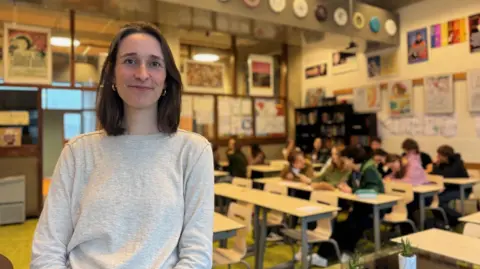
In the school corridor, outside an English classroom decorated with artwork depicting various Shakespeare plays, friends Hena and Fena confide they have mixed feelings about the ban.
"Since the ban we have to watch out for the teachers, so they don't take the phones," they say. "I think it's annoying but not like it's violating our rights or something like that.
"Maybe now we are a little bit more in the moment. In the break no one is really on their phones."
Their teacher, Ida Peters, notices the difference too. "As a teacher you're always trying to get kids' attention. It's always a challenge to get that focus in class, and now their phones are less present, that certainly helps."
Smartphones are not meant to be out in UK classrooms either, but with no national rules on where they should be the rest of the day, schools and teachers are left to improvise.
In the Netherlands, the nationwide agreement means the onus is off the teachers. Ms Peters feels this Dutch approach has liberated staff. "There's less friction in class management," she says.
"In the hallways there used to be a lot of checking the phone; now it's more relaxed, a calmer atmosphere, not too worried about anything else going on."
Phones aren't allowed at breaks or school parties either, Ms Peters adds, so pupils don't worry that they might be photographed and put up on Snapchat or Instagram. "And when kids are more relaxed, their learning outcomes improve."
Early data backs up her impressions.
A government‑commissioned study of 317 secondary schools found that about three‑quarters reported better concentration since phones were banned.
Almost two‑thirds said the social climate had improved, and around a third saw better academic performance. Other surveys suggest less bullying when devices are taken out of the school day.
Fifteen‑year‑old Felix and Karel, in the standard uniform of oversized hoodies and jeans, spend between two and five hours a day on social media.
Karel keeps his phone charging beside his bed and checks messages as soon as he wakes up; Felix waits until after breakfast.
"When I first heard the news, I thought, 'I want to switch schools because this isn't what I came here for,'" one of them admits. "But I haven't really felt a downside of it. If it happens in the UK, I think it will have a positive impact on the students."
In the Netherlands, the debate has already moved onto social media.
The Dutch government officially advises that children under 15 should stay off social media, and the new government coalition wants a Europe‑wide, enforceable 15+ minimum age backed by age‑verification. They argue that if states can restrict alcohol or gambling, they should also act when platforms are designed to be addictive.
The three parties in government hold only 66 of 150 seats in parliament, so they need support from others, and any binding rule on children accessing social media would have to be negotiated at EU level. But public opinion appears to be shifting in their favour.
A Unicef survey of more than 1,000 Dutch children and teenagers found that 69% favoured a social media ban for under‑18s.
In the same survey, 28% said platforms should be off‑limits for under‑12s altogether, arguing that younger children should "still be playing outside instead of on their phones" and describing social media as addictive, unsafe and bad for their mental health.
An annual social media survey by research agency Newcom found that 60% of 16-to-28-year-olds back an age limit, up from 44% a year ago.
This challenges the idea that young people are desperate to be permanently online.
Former education minister Koen Becking points to "growing evidence" that heavy social media use is bad for mental health and social interaction, saying Dutch data show children are more distracted and more anxious when they have access to devices.
Back at Cygnus school, Karel says he would be "a little devastated" if a social media ban was enforced.
"I'm a bit addicted, I'm scrolling on TikTok as soon as I wake up or checking messages from friends."
But classmate Felix is more relaxed: "You'd get used to it and find other things to do, so I don't think I would really mind."
At the same time, the Dutch Research Council is now examining the unintended consequences of the smartphone ban, and whether being without a phone all day increases fear of missing out and triggers more intensive phone use after school.
The pupils all insist they are not bingeing more before and after school. But Felix confides that while many students still keep phones in their pockets - so long as teachers do not see - he believes keeping the screens out of sight has made them more present.
"People are talking more, going to the shops instead of just sitting in the cafeteria on their phones," he says. "We socialise more; social connections have improved."
For Dutch children, scrolling on smartphones is no longer a part of school life. The next question for the Netherlands, and perhaps, soon, for the UK, is whether access to the social media apps should be consigned to history too.
A drone that entered Latvian airspace from Russia exploded in the country, prompting Defense Minister Andris Spruds to cut short his visit to Ukraine, the Defense Ministry said on March 25.

Mobile fire groups and interceptor drone crews of the National Guard of Ukraine have been actively protecting critical infrastructure from enemy attacks, shooting down more than 500 Shahed drones in the first three months of 2026.
A drone that crossed into Estonia from Russia struck a smokestack at the Auvere power plant, ERR reported on March 25, citing the Security Police, with an investigation underway into the incident.

Around 21,000 residents of Slavutych in the Kyiv region were left without centralized electricity supply following a Russian attack.