Here's Your Full Guide to Deals Signed at Ukraine's Recovery Conference in Gdańsk
Ukraine's reconstruction drive picked up $20 billion in financing and partnership deals at the Ukraine Recovery Conference (URC) 2026 in Gdańsk, spanning energy, banking, insurance and drone production. The EU and World Bank anchored the public financing side, while PrivatBank, Oschadbank and a clus
Kyiv Post
75
28 мин чтения
0 просмотров
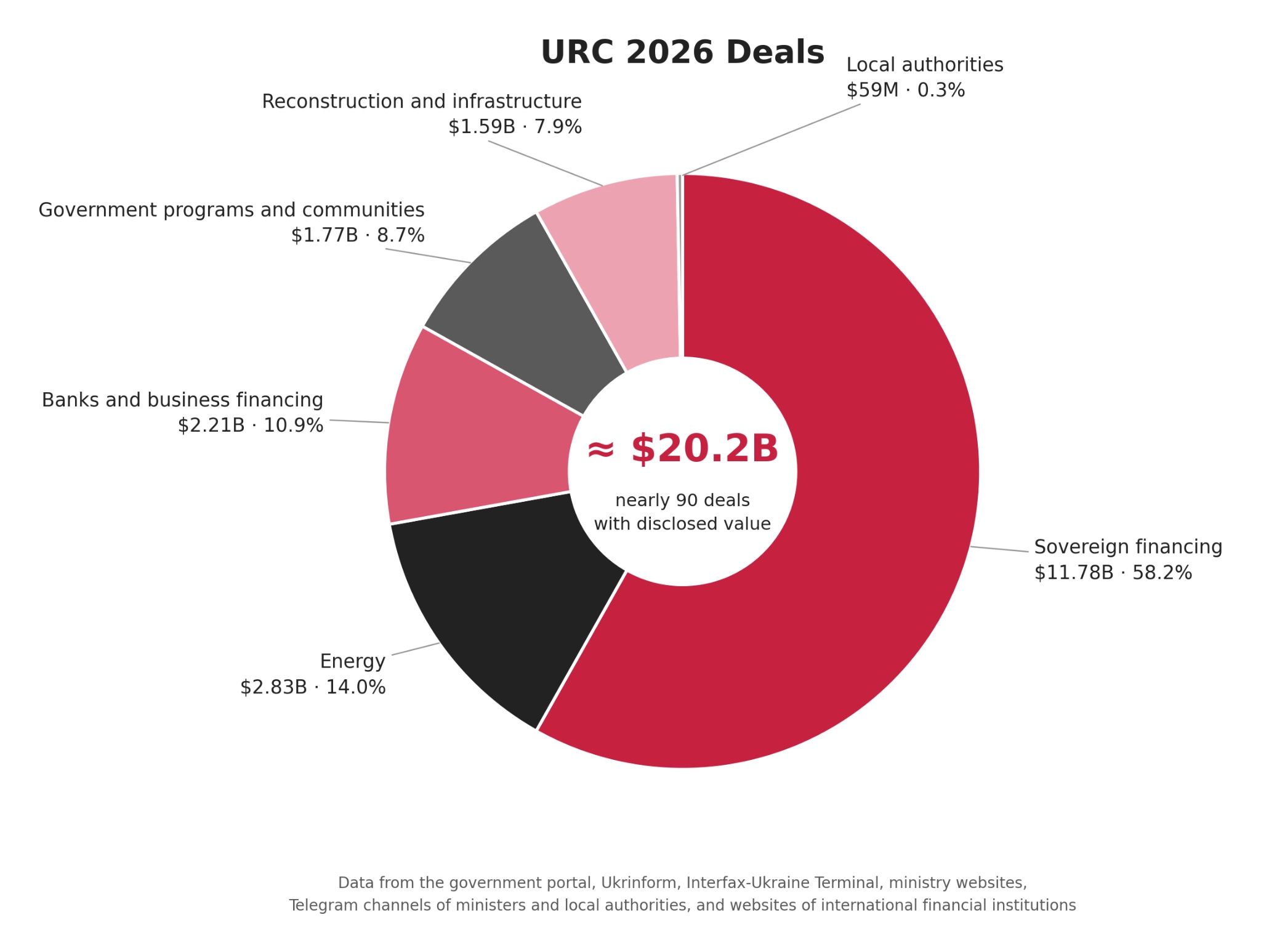
The Ukraine Recovery Conference (URC) in Gdańsk closed with an official tally of 160 signed documents worth more than €10 billion ($11.4 billion), organizers announced. Kyiv Post went through the individual press releases published by the government, international financial institutions, banks and companies, and found closer to $20 billion across nearly 90 agreements that actually disclosed a number, spanning energy generation, defense manufacturing, banks, and sovereign lending.
And while the URC was shadowed by Ukraine and Poland navigating a period of strained bilateral relations, businesses, international financial organizations and donors carried on as usual – signing financing agreements, cooperation memorandums, and live-money deals destined for Ukrainian projects. Several of the largest announcements remain memoranda of understanding without disclosed terms, while others signed deals with real money attached.
Among the largest deals signed, the European Bank for Reconstruction and Development (EBRD) and Ukraine’s largest state-owned bank PrivatBank stood out the most. The EBRD signed a suite of agreements comprising more than €500 million ($571 million) of finance. Ukraine’s largest bank, PrivatBank, signed two deals worth over $1 billion for risk-sharing and an EU-backed financing facility for businesses.
Out of a portfolio of more than 30 public-private partnership projects Ukraine’s Ministry of Communities showcased at URC, the most intriguing one is a concession project for the ferry terminal at the Chornomorsk seaport. The 35-year concession requires at least $40 million in investment, annual concession payments to the state budget, and cargo capacity of around 2 million tons per year. Four bidders advanced to competitive dialogue, including APM Terminals, Yilport Holding, a Mariner-TAS consortium, and a consortium of Abu Dhabi Ports Company and SKF Holdings UK, Deputy Prime Minister for Recovery Oleksiy Kuleba announced in the ministry’s press release.
Ukraine’s foreign minister proposed new diplomatic, historical and religious dialogue initiatives during talks in Warsaw.
Kyiv Post has compiled a list of the deals signed at URC – presented here in a single article.
Graph by Olena Hrazhdan
Sovereign financing
The EU disbursed €7 billion ($7.98 billion) to Ukraine under the Ukraine Support Loan in the days surrounding URC 2026, and the World Bank signed a $3.39 billion development policy operation during the conference.
Although these programs were agreed upon last year, the URC was chosen as the platform for signing the financing deals with Ukraine’s Minister of Finance.
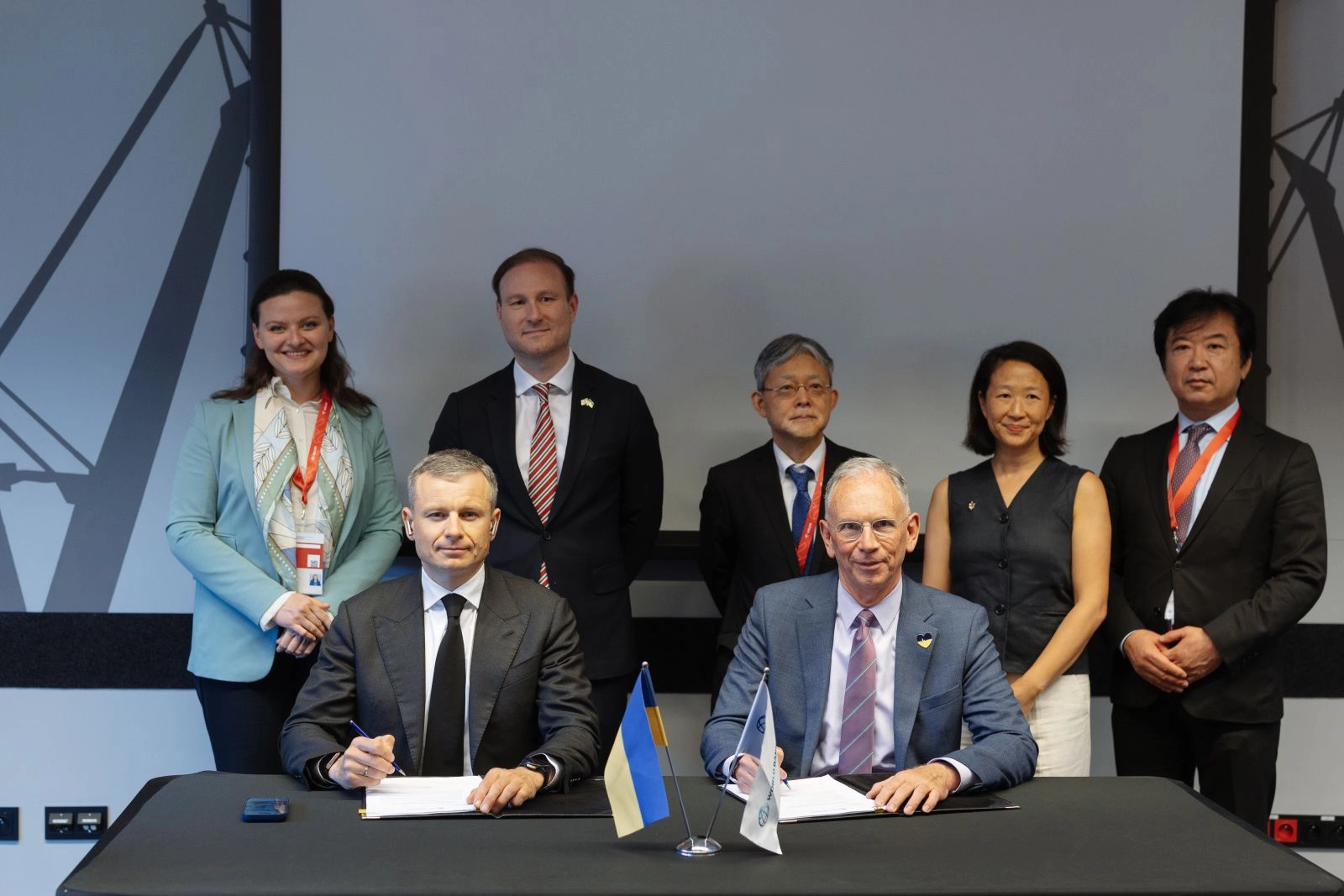
Minister of Finance Sergiy Marchenko and World Bank Regional Country Director for Eastern Europe Bob Saum signed a package of agreements worth $3.39 billion under the First Ukraine Jobs and Private Sector Growth Development Policy Operation (DPO).
Ukraine’s Minister of Finance, Sergiy Marchenko (center left), and World Bank Regional Country Director for Eastern Europe, Bob Saum (center right), Deputy Finance Minister Olha Zykova (far right) at the Ukraine Recovery Conference 2026 in Gdańsk, Poland, on June 25, 2026. (Photo courtesy of the Ministry of Finance of Ukraine press service)
The bulk of the funds, $3.35 billion, is expected to reach Ukraine’s state budget by end of June 2026, directed at macro-financial stability and priority expenditures, according to Ukraine’s finance ministry’s press release. The operation was conditioned on the adoption of 13 laws and seven secondary legislative acts covering public procurement, energy market integration with the EU, agricultural sector reform, and veteran entrepreneurship, among other areas.
Separately, the World Bank announced an additional $286 million for Ukraine’s education system under the LEARN program, fully financed by Japan and tied to results including training 60,000 teachers and providing free textbooks to 600,000 pupils.
At the Ukraine Recovery Conference, European Commission President Ursula von der Leyen announced the disbursement of the Ukraine Support Loan. The instrument was actually approved by the European Parliament in late autumn 2025, with the legislative framework finalized over the following winter.
The instrument emerged after Western partners failed to reach consensus on confiscating the full body of immobilized Russian sovereign assets – a more ambitious proposal that stalled amid legal and political objections – leaving the EU to design an alternative large-scale financing mechanism. The Ukraine Support Loan filled that gap, structured as a multi-year lending facility backed by the EU budget and premised on future Russian reparations as the repayment source.
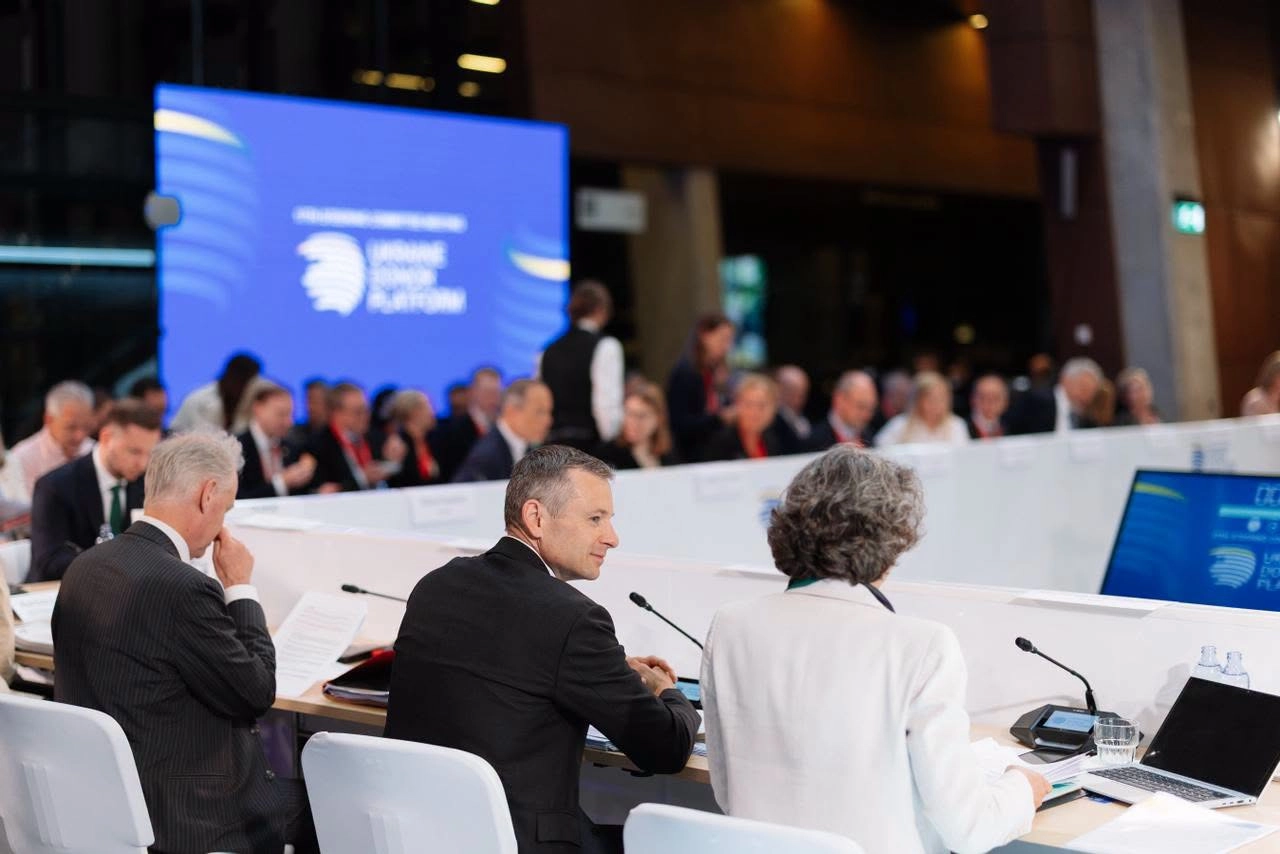
Ukraine’s Minister of Finance Sergiy Marchenko during the 17th Steering Committee meeting of the Ukraine Donor Platform on the sidelines of the Ukraine Recovery Conference 2026 in Gdańsk, Poland. (Photo courtesy of the Ministry of Finance of Ukraine press service)
On June 25, Ukraine received the first €3.2 billion ($3.65 billion) budget support tranche under the Ukraine Support Loan, aimed at macro-financial stability and priority state budget expenditures. Five days later, on June 30, a €3.9 billion ($4.45 billion) first tranche was announced, earmarked for drone production, defense industry capacity, and frontline supplies.
The Ukraine Support Loan is the EU’s new two-year financial instrument for 2026-2027, with a total envelope of up to €90 billion ($102.6 billion): €30 billion ($34.2 billion) allocated for economic and budget support, and €60 billion ($68.4 billion) for defense needs. In 2026 alone, Ukraine expects to receive up to €45 billion ($51.3 billion) under the instrument, including €28.3 billion ($32.3 billion) from the defense component. The loan is financed through EU borrowing on capital markets and is expected to be repaid through future Russian reparations.
PrivatBank: URC blockbuster
PrivatBank, Ukraine’s largest state-owned bank, turned out to be a blockbuster of the conference, signing deals worth more than €1.18 billion ($1.35 billion) that underpin two support programs for Ukrainian business with EBRD and the European Investment Fund (EIF), part of the European Investment Bank (EIB) Group. The latter is signed under the Ukraine Partial Portfolio Guarantee Facility.
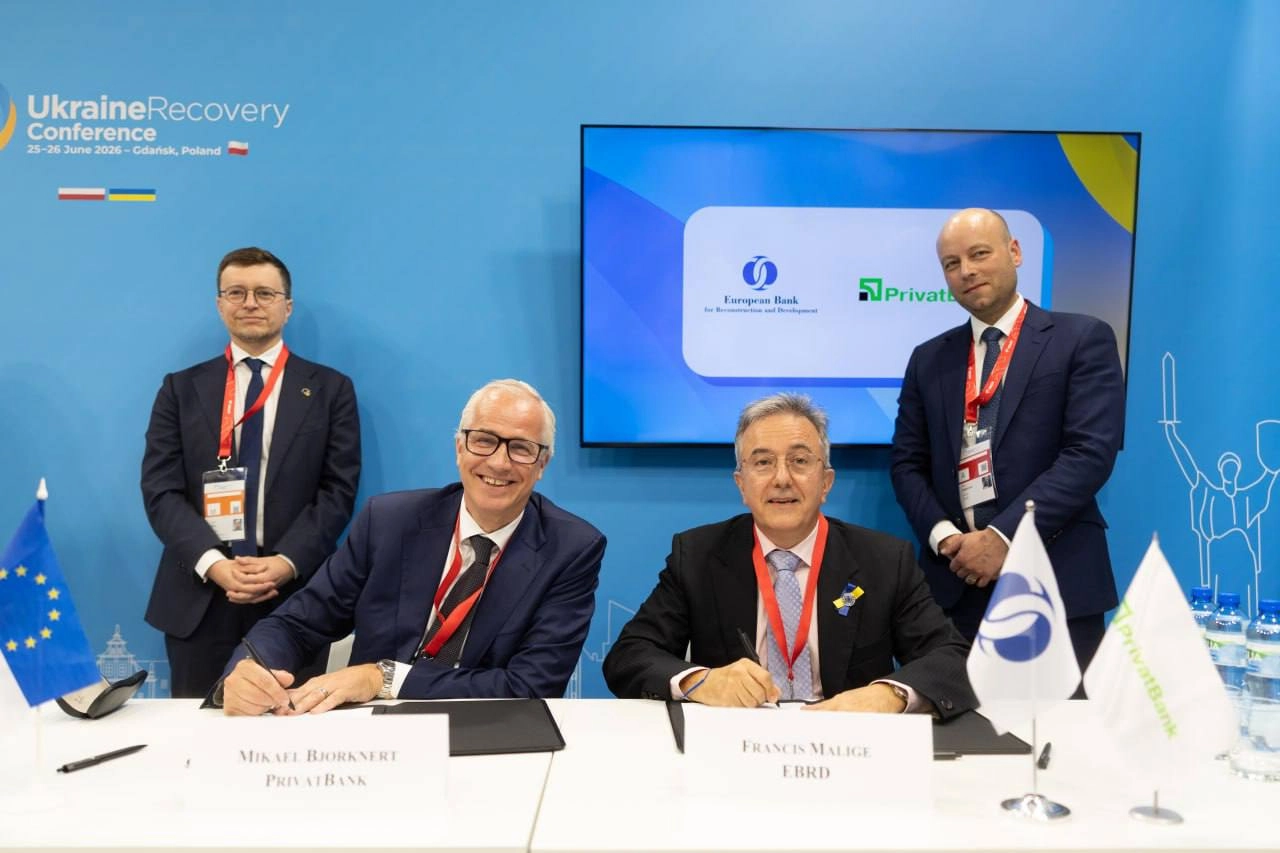
PrivatBank Management Board Chairman Mikael Björknert (centre left) and Francis Malige, managing director and head of the Financial Institutions Group at the EBRD (centre right), sign a portfolio risk-sharing agreement worth up to €825 million ($941 million) at the Ukraine Recovery Conference 2026 in Gdańsk, Poland, on June 26, 2026. Standing at right is Yuriy Draganchuk, Ukraine’s deputy minister of finance for European integration. Photo courtesy of PrivatBank press service.
The PrivatBank-EBRD deal on a risk-sharing agreement for Ukraine’s market is worth a total of €825 million ($941 million), under which the parties signed off on a first tranche of €265 million ($302 million). The EBRD wrote the facility is aimed at new lending to MSMEs and mid-size corporates, with up to 17% of subloans for long-term capex investments under the EU4Business-EBRD Credit Line to help align with EU standards and green technologies.
“The new lending program will work effectively alongside the Enterprise Security Enhancement program we launched jointly with the EBRD. This means that if property financed under the PrivatBank-EBRD program is damaged or destroyed as a result of the war, the client will be able to receive partial compensation for the losses,” the press release said, quotig Mikael Björknert, PrivatBank management board chairman.
Separately during the conference, PrivatBank and the EIF signed a portfolio guarantee agreement under the Ukraine Partial Portfolio Guarantee Facility. The new mechanism will allow Ukrainian businesses to raise nearly €357 million ($407 million) in credit financing and will become one of the largest instruments of wartime support for entrepreneurs introduced with EU involvement.
According to the program, the EIF will cover up to 70% of the risk on each loan. PrivatBank wrote in its press release sent to journalists that it will aim at companies that typically have limited access to financial resources due to high wartime risks, including businesses located in higher-risk regions. 80% of the financing will go to micro, small, and medium-sized enterprises, “in manufacturing, energy, the agricultural sector, logistics, and other areas that shape the country’s economy”, according to Yevhen Zaihraiev, PrivatBank board member for corporate business and SMEs.
EBRD again brings risk-sharing to every Ukrainian bank counter
The EBRD also signed deals with its best-selling partners – Ukrainian banks, broadening the risk-sharing facilities to enable banks to decrease the war risks and increase its appetite for lending more. The institution signed transactions worth €303 million ($345 million) with eight Ukrainian banks, enabling a total of €845 million ($963 million) in new credit to Ukrainian borrowers, according to its press release.
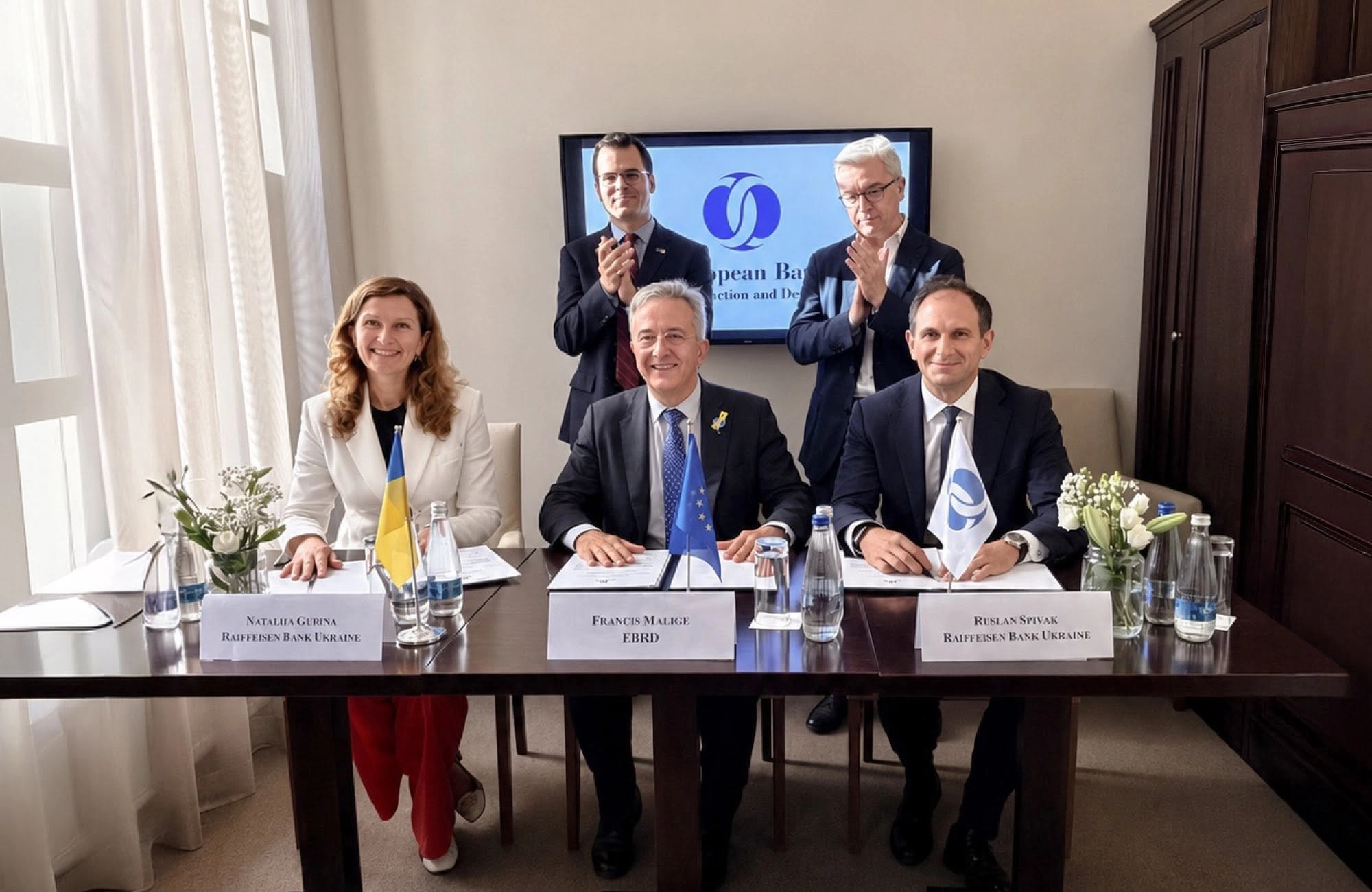
Raiffeisen Bank Ukraine’s CEO Nataliia Gurina (left) and Corporate Business Director Ruslan Spivak (right), sign a €50 million ($57 million) risk-sharing facility with Francis Malige, managing director and head of the Financial Institutions Group at the EBRD (centre), at the Ukraine Recovery Conference 2026 in Gdańsk, Poland, on June 26, 2026. Photo courtesy of EBRD press service
This includes risk-sharing facilities with:
PrivatBank – €265 million ($302 million) for MSMEs and mid-size corporates, with up to 17 percent of sub loans for long-term capex under the EU4Business-EBRD Credit Line, helping businesses align with EU standards and adopt green technologies
Oschadbank – €150 million ($171 million) for MSMEs and mid-size corporates, with up to 13 percent of sub loans for long-term capex (the largest deal in the history of the bank’s cooperation with the EBRD)
Ukrgasbank – €148 million ($169 million), primarily for MSMEs, with up to 20 percent of sub loans for long-term capex
Kredobank – €70 million ($80 million) for mid-sized businesses and SMEs, with close to 13 percent of sub loans for long-term capex
UKRSIBBANK – €52 million ($59 million) for MSMEs, with up to 20 percent of subloans for long-term investments and up to 4 percent allocated to residential households under the Energy Security Support Facility for decentralized generation, storage, and energy efficiency
Bank Lviv – €50 million ($57 million), plus a €10 million ($11 million) local-currency tranche within a €40 million ($46 million) senior loan backed by partial risk cover from British International Investment, with up to 25 percent of sub loans for long-term investments
Ukreximbank – €50 million ($57 million), primarily for MSMEs, with up to 20 percent of subloans for long-term capex
Raiffeisen Bank Ukraine – €50 million ($57 million), with up to 20 percent of sub loans for long-term capex
The EBRD was a proactive deal-signer, but not the only one. Oschadbank and the European Fund for Southeast Europe Development Facility (EFSE), backed by the EU, signed a grant agreement worth up to €2 million ($2.28 million) to support micro, small, and medium-sized Ukrainian enterprises, to be combined with Oschadbank’s own lending. The program, the press release says, targets agribusiness, war-affected companies, and businesses led by women, veterans, and displaced people, with individual grants of up to €100,000 ($114,000).
The French Development Agency (AFD) and a state-owned Ukrgasbanksigned a statement of intent on a financing package worth up to €45 million ($51 million) for Ukrainian municipalities, backed by the European Commission — a €25 million ($28 million) credit line, €10 million ($11 million) in guarantees, and up to €10 million ($11 million) in grants for recovery projects in war-affected regions. Separately, Ukrgasbank and the EIF signed a portfolio guarantee under the EU’s Ukraine Facility, unlocking up to €143 million ($163 million) for MSMEs investing in reconstruction, green transformation, and energy efficiency.
Energy
DTEK and GE Vernova signed a memorandum to develop a missile-resistant gas-fired power plant at the Burshtyn TPP, which DTEK valued at €900 million ($1.03 billion). DTEK said in a press release it aims to launch its operation before 2032.
The company is also creating a joint venture with Octopus Energy Group, Britain’s largest energy provider, to finance Project RISE, a €100 million ($114 million) initiative to roll out rooftop solar and battery storage for businesses and public sector organizations across Ukraine as Russia keeps attacking large-scale energy infrastructure. The product has already launched through DTEK’s retail arm YASNO, Natalya Yemchenko, Chief Corporate Affairs Officer at SCM, wrote in her LinkedIn post.
Metinvest, part of Rinat Akhmetov’s SCM, signed a €20 million ($22.8 million) loan agreement with the Black Sea Trade and Development Bank to support its energy sustainability, including the installation of the company’s first solar power plants with a combined capacity of 37 MW, Yemchenko also wrote on LinkedIn.
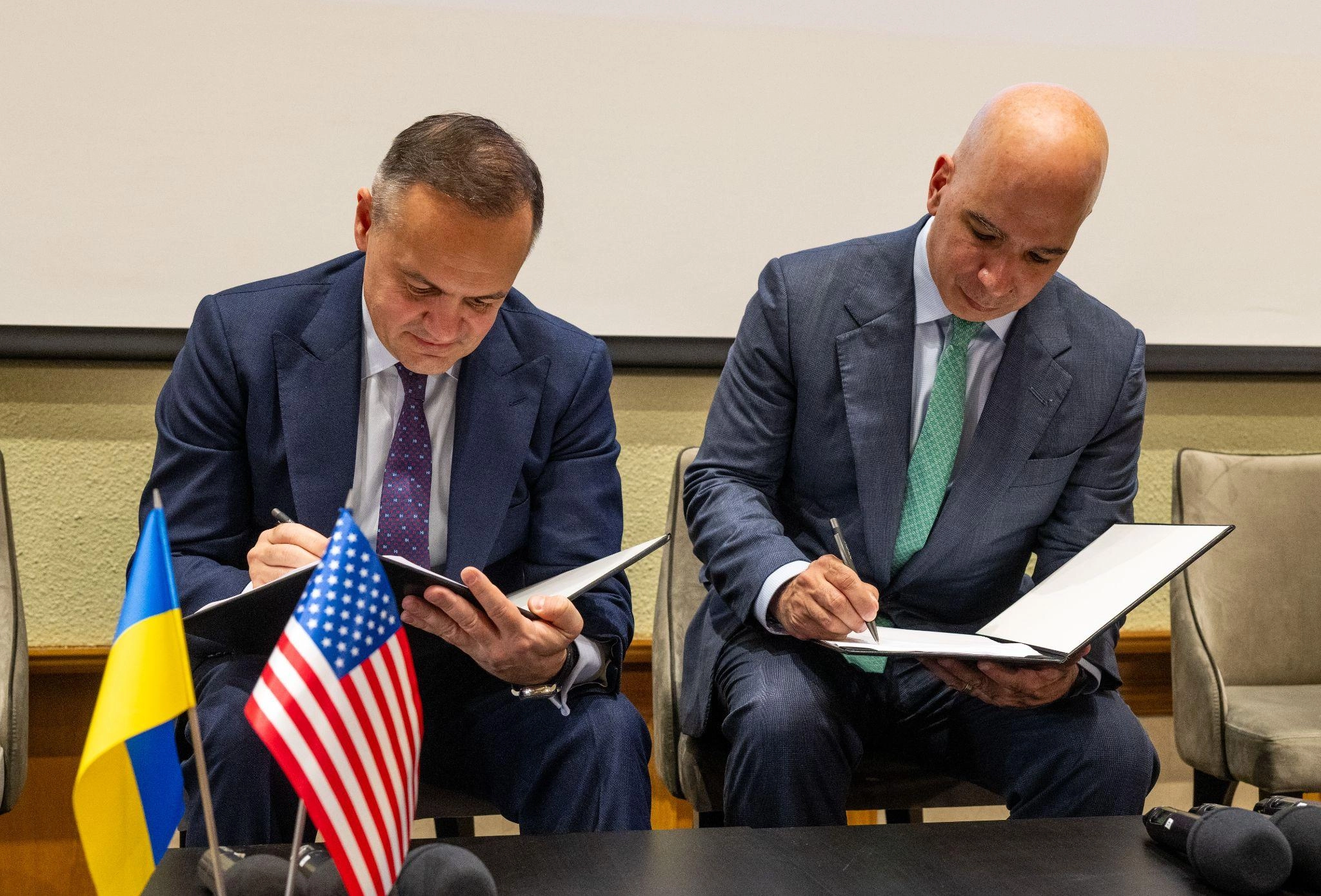
DTEK CEO Maksym Tymchenko (left) and Roger Martella, chief corporate officer & chief sustainability officer of GE Vernova at the Ukraine Recovery Conference 2026 in Gdańsk, Poland, on June 26, 2026. Photo courtesy of DTEK press service.
The EBRD signed a mandate letter at URC 2026 in Gdańsk with Amber Dragon Ukraine Infrastructure Fund I and Ukrainian energy company Negen to support Phase II of Power One, a distributed electricity generation project, Dragon Capital announced in a press release.
The EBRD’s debt financing will support six new sites adding nearly 170 MW of capacity, at a total project cost of more than €90 million ($103 million). The deal follows a Phase I mandate letter signed at URC 2025 in Rome for €21.1 million ($24.1 million), with 28.4 MW already operational. Upon completion, Power One’s battery storage portfolio is expected to exceed 750 MWh.
Naftogaz Group announced in its press release it signed 12 deals in total, but only disclosed details about four of them.
The energy giant secured a $300 million facility from the US Export-Import Bank (US EXIM Bank), enabling Naftogaz Group companies to procure equipment from US suppliers. Naftogaz also signed a separate cooperation agreement with the IFC, aimed at technical and advisory support to allocate more capital to Ukraine’s energy sector.
With Polish energy giant Orlen, the company signed two deals for cooperation in assessing increased gas volumes and jointly using regasification terminals and gas transmission infrastructure across the Baltic region, Central and Eastern Europe, and another deal to improve energy efficiency and reduce methane emissions.
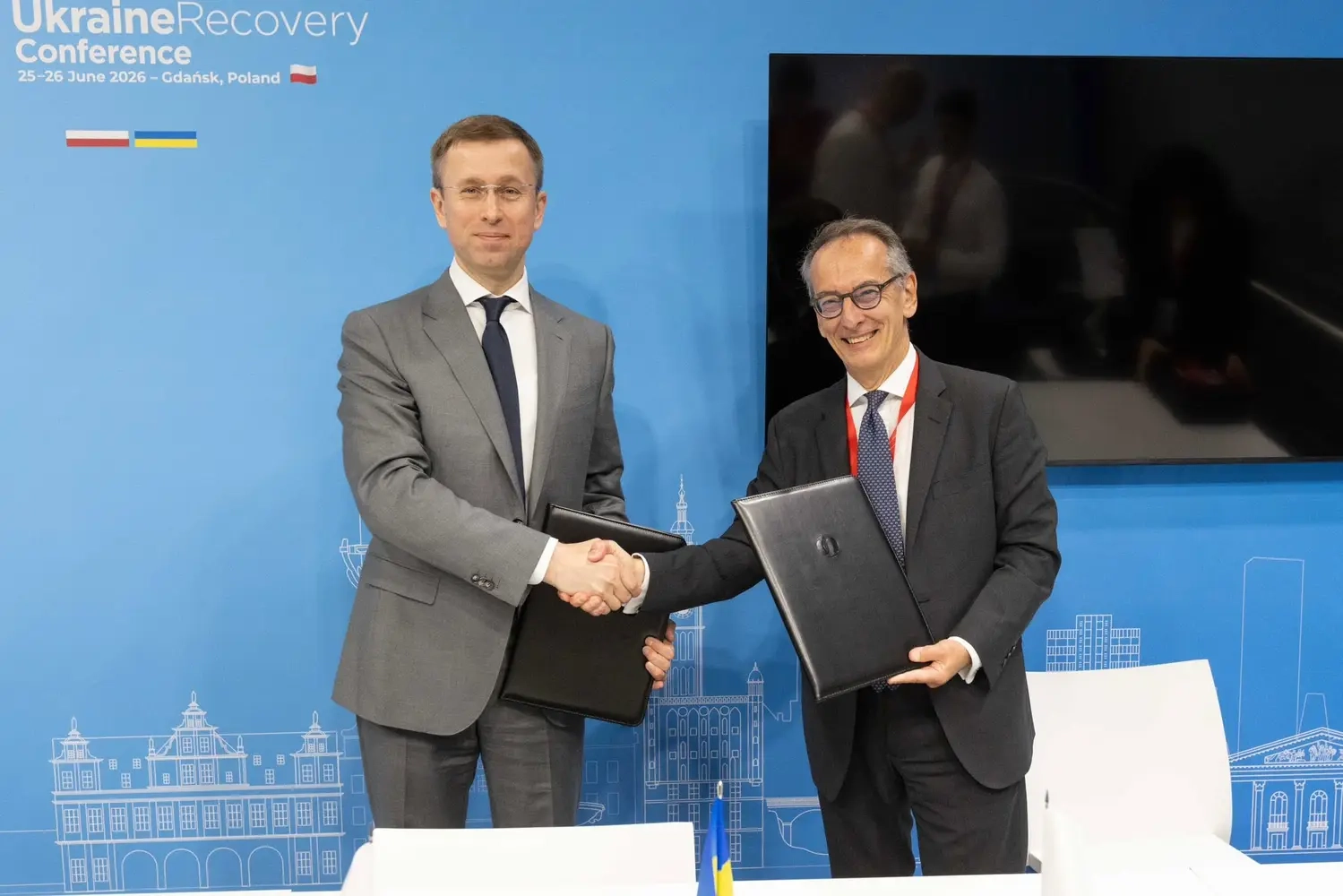
Naftogaz Group CEO Serhiy Koretskiy (left) and EBRD Vice-President Matteo Patrone during the 2026 Ukraine Recovery Conference in Gdańsk. (Photo courtesy of Naftogaz press service).
The EBRD signed a package of energy agreements to support renewable generation and Ukraine’s energy security.
This includes:
a €90 million ($103 million) loan to Ukrenergo for substation reconstruction and to strengthen corporate governance, compliance, and anti-corruption functions
a €50 million ($57 million) loan to OKKO Group (GNG Group/Galnaftogaz) for a 189-megawatt wind power plant, backed by a consortium including the Black Sea Trade and Development Bank, British International Investment, the International Finance Corporation, and Swedfund, with a first-loss guarantee under the EU’s Ukraine Investment Framework
a €65 million ($74 million) loan to German developer Notus Energy for a 120-megawatt wind plant, the first transaction under the IFC-EBRD Mutual Reliance Framework
a €44.6 million ($51 million) grant to Ukrnafta, supported by Norway and the Netherlands, for distributed generation; pre-financing agreements for new battery storage projects developed by Power One and Kvant Yug
and letters of intent with Germany (€45 million, $51.4 million) and Norway (€10 million, $11.4 million) for the RAMP-UP price stabilization mechanism, designed to unlock private investment and expected to mobilize up to 1 gigawatt of new renewable capacity
Ukraine’s power grid operator Ukrenergo signed an €11 million ($12.5 million) grant agreement with Germany’s state development bank, KfW, to improve transmission efficiency across Ukraine’s high-voltage grid, the Energy Ministry said in its press release.
The UK confirmed £210 million ($280 million) in loan guarantees through UK Export Finance to secure enriched uranium supplies from Urenco to Ukraine’s nuclear plants over the next two years, under an agreement Energoatom and Urenco signed at the conference.
The UK’s package at the conference totaled nearly £290 million ($387 million), Foreign Secretary Yvette Cooper announced — beyond the Urenco nuclear fuel guarantee, it includes up to £13 million ($17 million) toward the European Flagship Fund through British International Investment, £12 million ($16 million) for justice and anti-corruption programs, and support for feasibility studies on expanding Lviv airport and modernizing schools in the Vinnytsia region.
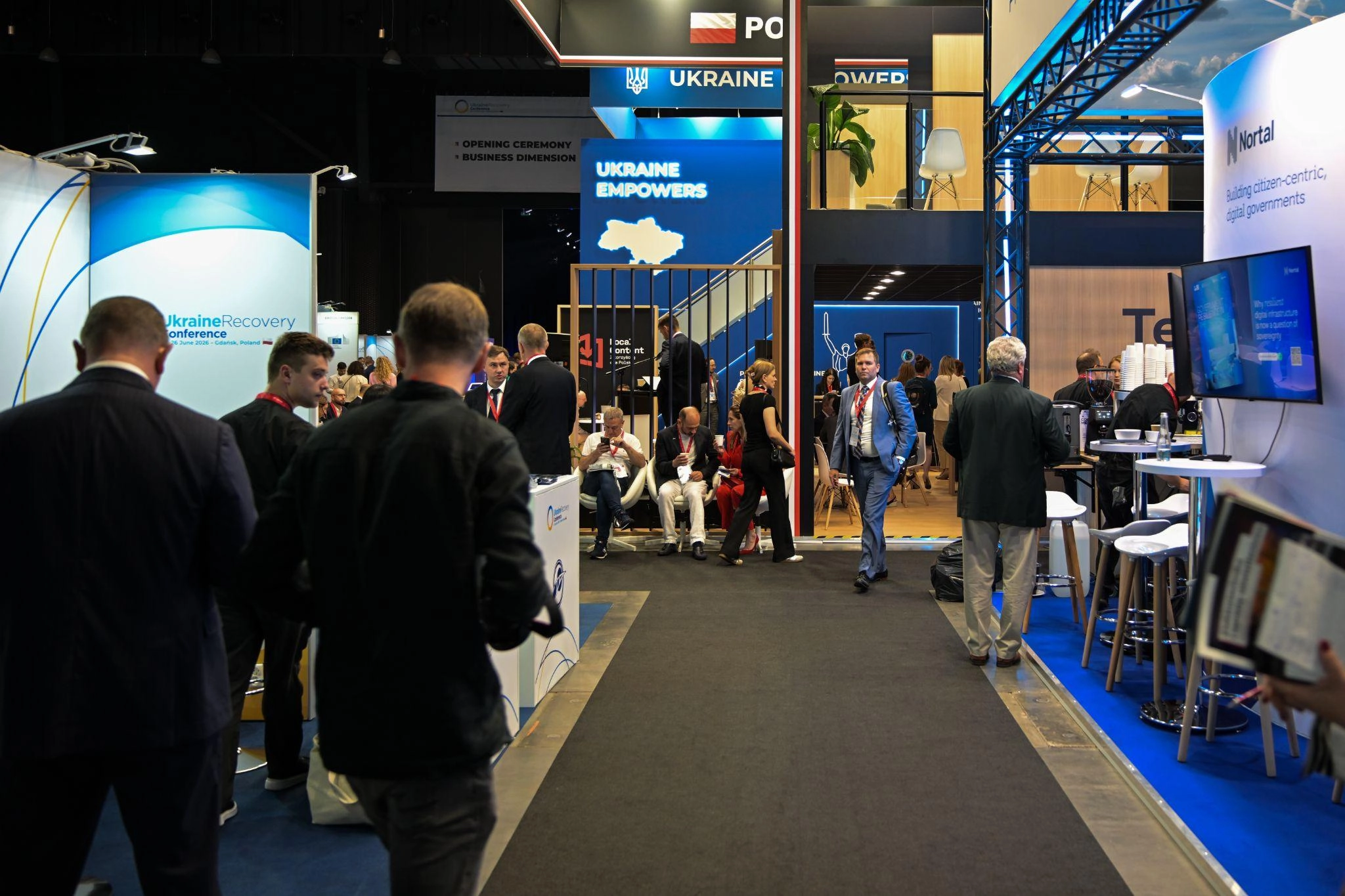
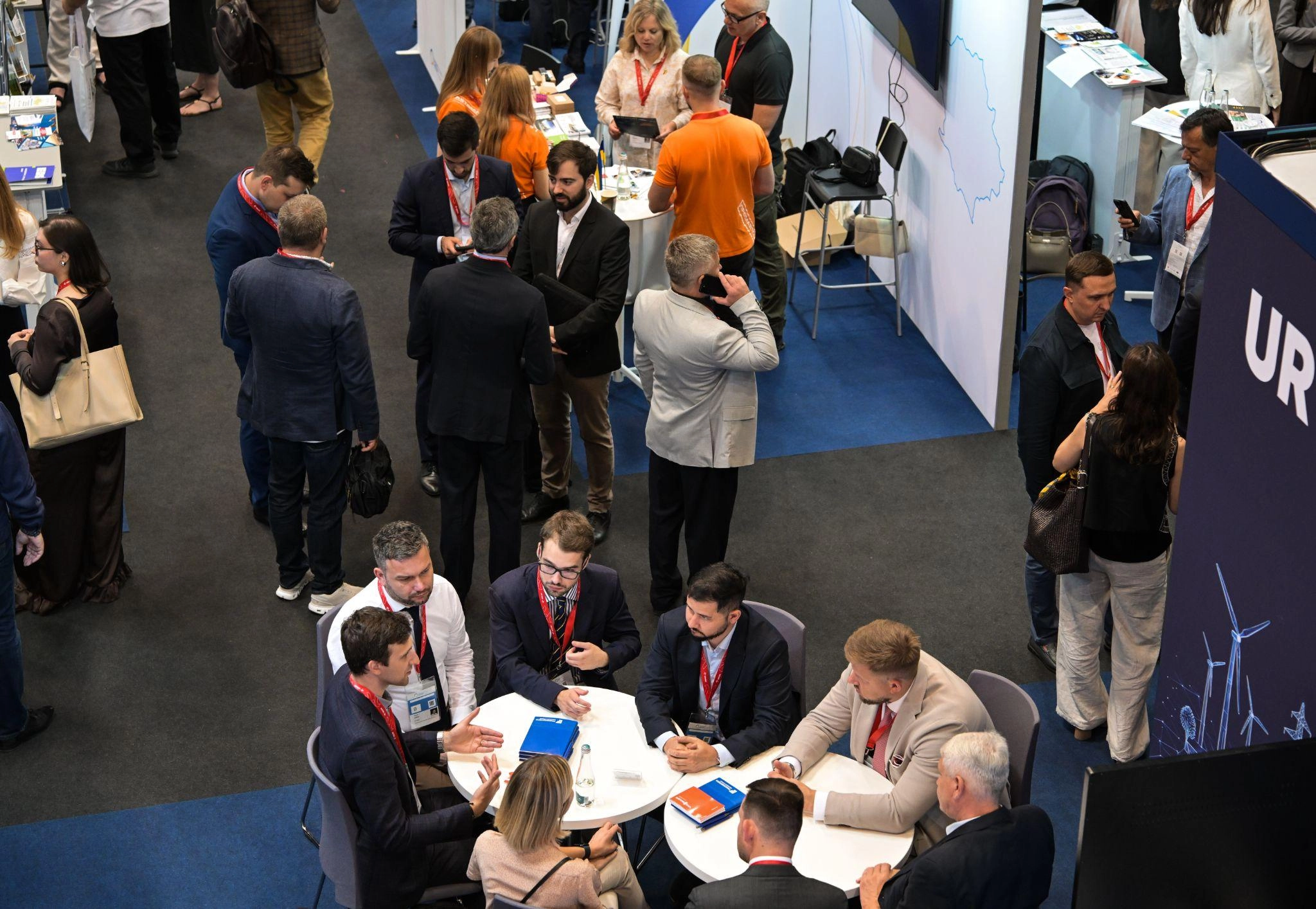
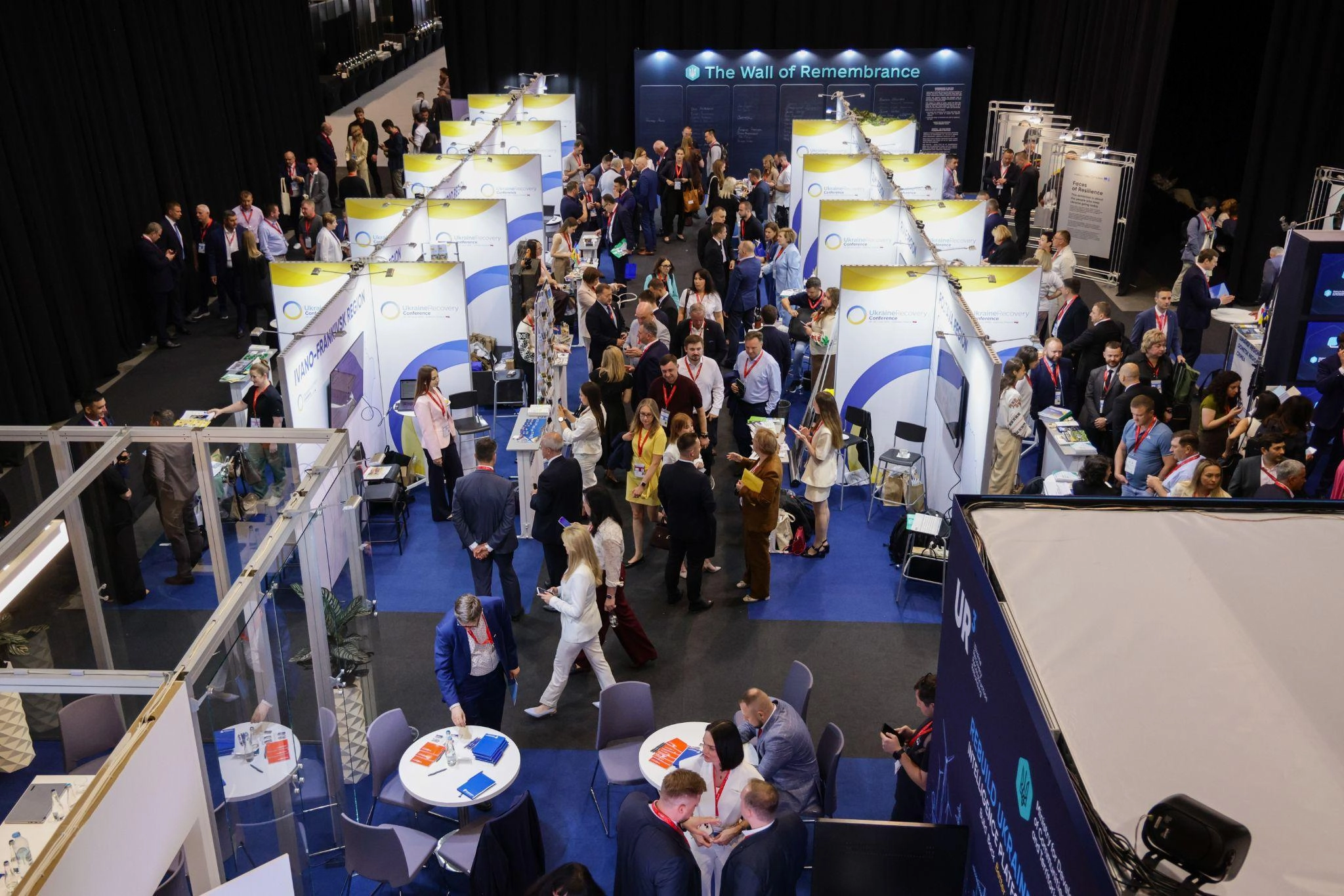
Visitors of the 2026 Ukraine Recovery Conference in Gdańsk. (Photo courtesy of URC’s press service).
Energy deals kept piling up in First Deputy Prime Minister and Energy Minister Denys Shmyhal’s Telegram feed. The Netherlands will allocate €178 million ($203 million) to prepare Ukraine for the heating season and develop distributed generation, alongside handing over decommissioned gas turbines. Interfax-Ukraine reported that at the “energy Ramstein” meeting, partners announced at least €375 million more ($427 million) more: $175 million from the US, €137 million ($156 million) from Sweden, €77 million ($88 million) from Norway, and smaller sums from Lithuania, Estonia, and Iceland. Unfunded energy needs still exceed €650 million ($741 million).
The World Bank presented a list of eight priority investment areas in Ukraine’s energy sector worth a combined $26 billion, Managing Director of Operations Anna Bjerde said at the conference’s energy forum, Interfax-Ukraine reported.
Wind power leads the list with 5 GW requiring $6.5 billion in private capital, followed by nuclear ($6.9 billion), distributed generation ($5 billion), and pumped storage ($2.2 billion), with wind, solar, and gas generation ready for immediate investment through contracts for difference. Bjerde said the RAMP-UP price guarantee fund could launch some 500 MW of wind and solar in 2026-2027, scaling to roughly 800 MW of new CfD auctions annually.
Defense and dual-use manufacturing
Although URC organizers hesitated for years to create a dedicated defense platform, its second year at the conference brought fruitful joint ventures and memorandums that will start building trust between Ukrainian manufacturers and global companies.
In a first-of-its-kind arrangement, Ukrainian drone maker SkyFall and Poland’s state development bank Bank Gospodarstwa Krajowego (BGK) signed a memorandum on attracting EU financing for Ukrainian defense technologies – opening the door for institutional development finance to flow into the defense sector.
The parties will explore cooperation on projects that BGK could finance under Pillar II of the European Commission’s Ukraine Facility, aimed at expanding capabilities in dual-use technologies and unmanned systems. SkyFall did not disclose further details in the press release sent to Kyiv Post.
Germany’s ARX Robotics and Ukraine’s Roboneers announced a joint venture, ARX Industries, to produce Rys Pro unmanned ground vehicles for Ukraine’s Defense Forces under the Build with Ukraine program, with facilities split between Germany and Ukraine. The venture plans to assemble thousands of units in its first year, scaling to tens of thousands annually, Defender Media reported.
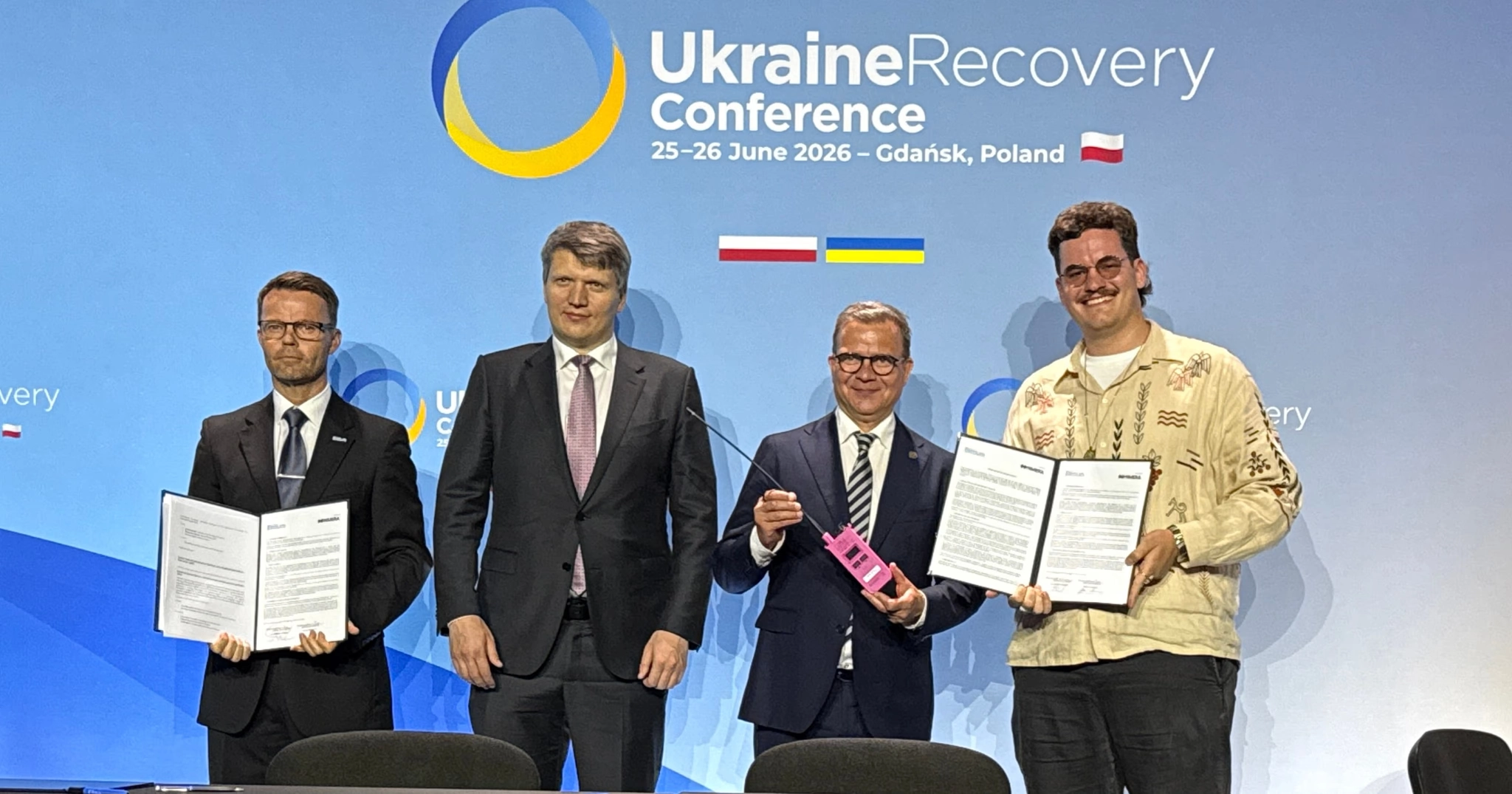
Ukrainian secure communications maker HIMERA and Finland’s Bittium signed a memorandum to explore integrating their tactical communications technologies for the defense forces of both countries, with potential to grow toward NATO needs. “We face many of the same security challenges,” the manufacturer’s press release quoted Misha Rudominski, co-founder and CEO of HIMERA.
Misha Rudominski, co-founder and CEO of HIMERA (left) and and representatives of Finland’s Bittium after signing a memorandum of understanding at the Ukraine Recovery Conference 2026 in Gdańsk, Poland, on June 25, 2026. (Photo courtesy of HIMERA)
Ukrainian defense technology company TAF Industries and Polska Grupa Zbrojeniowa (PGZ), one of Europe’s largest defense conglomerates, signed a letter of intent to localize production of drones and counter-UAV systems in Poland under the Build with Ukraine initiative. TAF Industries manufactures over 30 types of defense products, including FPV drones, interceptors, and electronic warfare systems, according to the press release announcing the signing.
Ukrainian ground robotics maker DevDroid and Norway’s Kongsberg Defence & Aerospace signed a memorandum opening the way for long-term cooperation on producing existing and developing new remotely operated combat robotic systems, Defender Media reported.
Poland’s Unimot SA, its subsidiary PZL Defence, and Ukrainian aircraft engine designer Ivchenko-Progress signed a memorandum on developing, producing, and commercializing small-size turbojet engines for the aviation and defense sectors – a technology in high demand as the drone market grows. Ivchenko-Progress designed the engines for the An-225 Mriya, the world’s largest transport aircraft, while PZL Defence brings industrial capacity and access to EU and NATO markets, Unimot’s press release wrote.
Reconstruction financing
The European Flagship Fund for the Reconstruction of Ukraine announced approximately €260 million ($296 million) in initial commitments at URC 2026, with €220 million ($251 million) in subordinated equity from the European Commission and four EU member states – France, Germany, Italy, and Poland – channeled through their national development finance institutions and the EIB.
The fund is also co-managed by Amber Infrastructure and Dragon Capital, and will deploy equity into energy, digital infrastructure, transport, and SMEs, targeting a long-term total of approximately €1 billion ($1.14 billion).
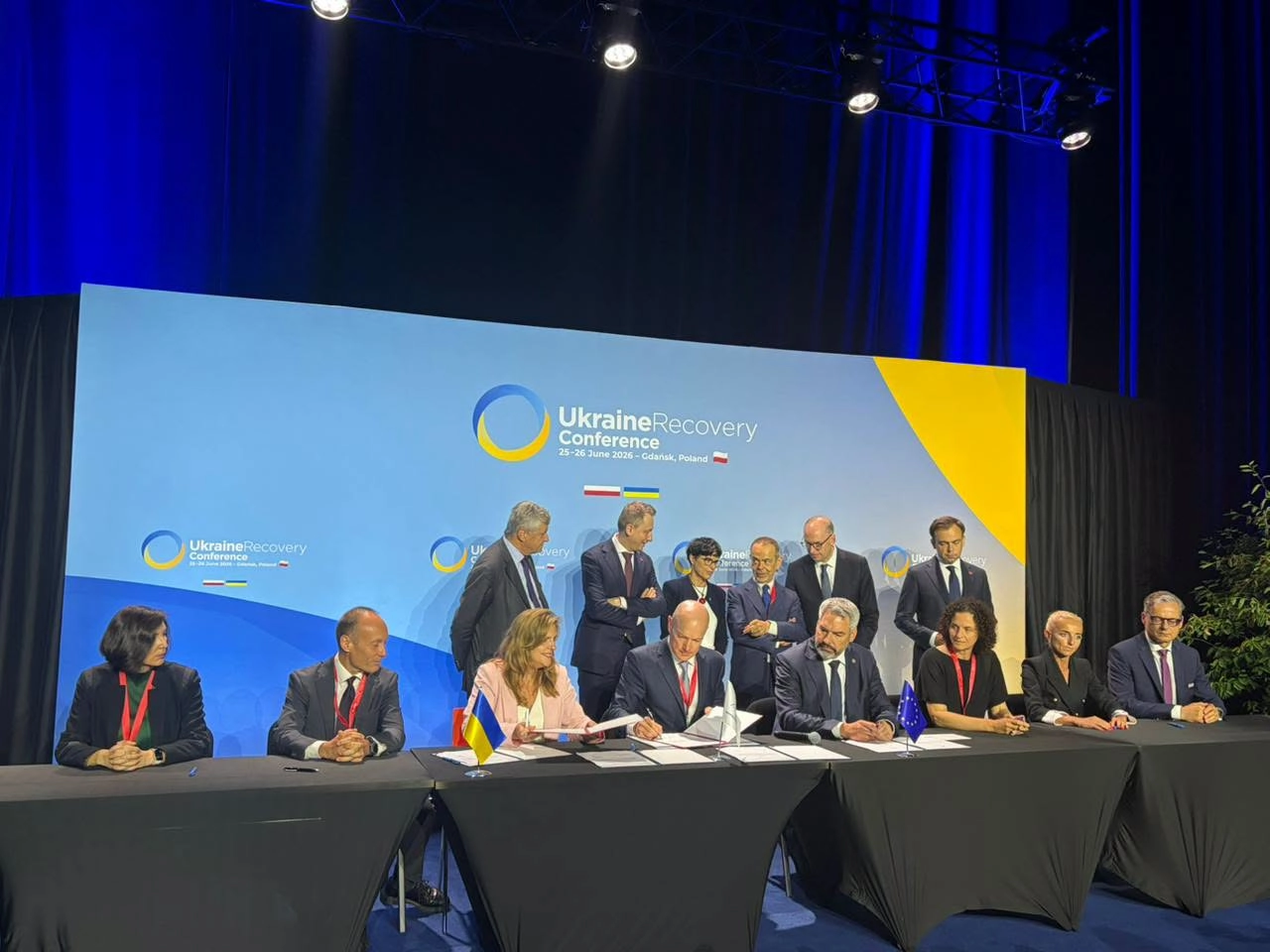
Representatives of the European Investment Bank, Germany’s KfW, Italy’s Cassa Depositi e Prestiti, Poland’s Bank Gospodarstwa Krajowego, and France’s Proparco sign commitment agreements for the European Flagship Fund for the Reconstruction of Ukraine at the Ukraine Recovery Conference 2026 in Gdańsk, Poland, on June 25, 2026. (Photo courtesy of Dragon Capital)
Another important milestone – tbe World Bank’s Multilateral Investment Guarantee Agency (MIGA) and the US International Development Finance Corporation (DFC) signed a cooperation agreement creating a political risk insurance mechanism for projects of the US-Ukraine Reconstruction Investment Fund, the fund launched under the “minerals deal.” Until now, MIGA had insured only a handful of Ukrainian projects, Minister of Economy Oleksiy Sobolev told Interfax-Ukraine.
Ukraine’s healthcare sector attracted more than $900 million in agreements and partnerships in Gdańsk, Ukrinform quoted Deputy Health Minister Mariia Karchevych, without disclosing many details on the projects and whether they overlap the existing signing agreements announced by the government.
The European Investment Bankannounced more than €470 million ($535 million) in new financing, mostly loans backed by EU guarantees. Apart from the Flagship Fund and bank guarantees described above, the EIB signed €100 million ($114 million) in combined loan and grant financing for social housing in five cities, expected to deliver 1,000 to 1,600 units; a €96 million ($109 million) loan for roads, bridges, and border infrastructure; a €25 million ($28 million) grant for water recovery; and €100 million ($114 million) to Ukreximbank for SME energy efficiency lending.
Vodafone Ukraine, the country’s second-largest mobile operator, secured €30 million ($34 million) in export credit financing to modernize its network, arranged by ING and backed by Finland’s Finnvera. The funds will go toward network resilience, Nokia equipment, and digital infrastructure, Interfax-Ukraine reported.
Government initiatives
Ukraine’s government also signed agreements that will unlock new programs for infrastructure, workforce development, housing, and social support.
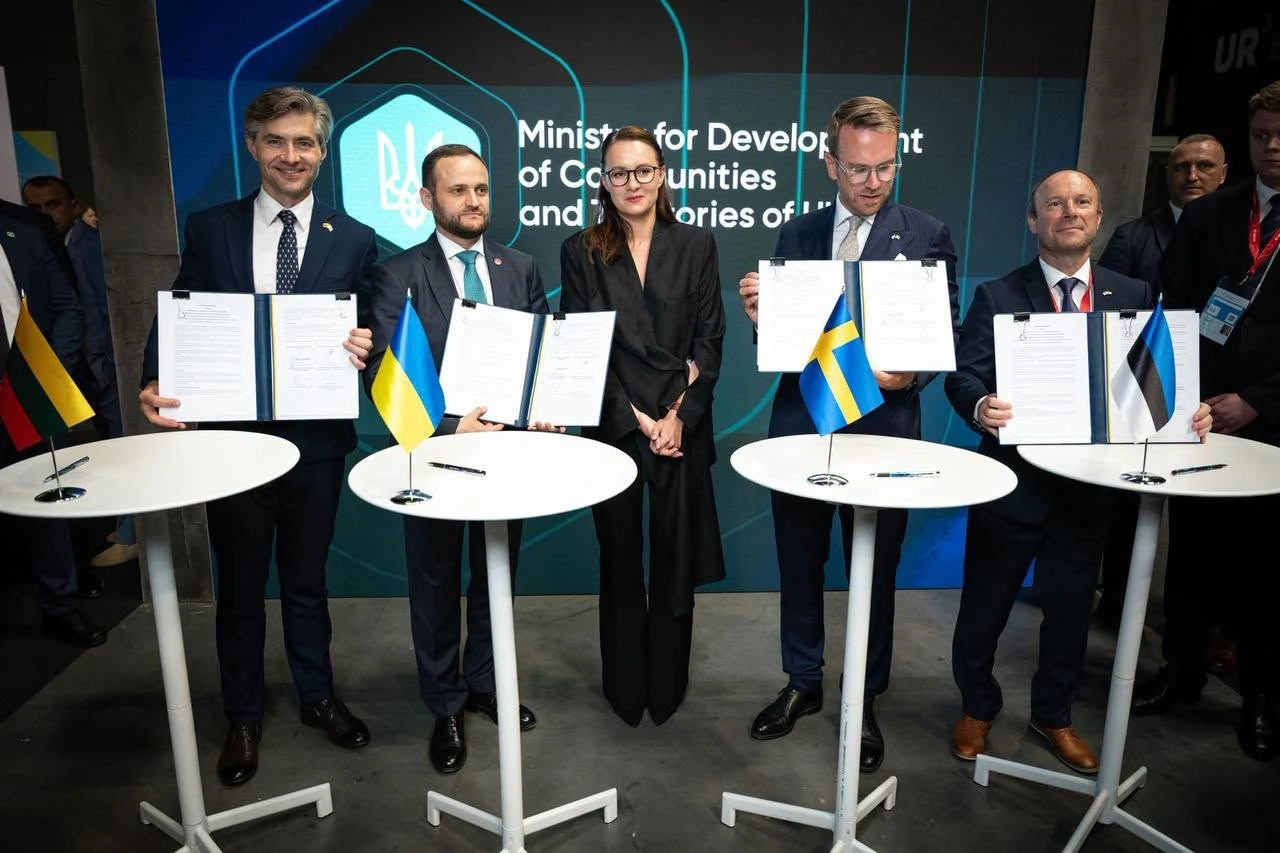
Ukraine and its partners signed a declaration launching the Ukraine Transport Support Fund (UTSF), a new international mechanism for financing the country’s transport infrastructure. Lithuania, Sweden, and Norway pledged roughly €1 million ($1.14 million) each, and Estonia €100,000 ($114,000), with the funds directed at restoring roads, bridges, ports, railways, and border and airport infrastructure. Lithuania’s Central Project Management Agency will administer the fund, while Ukraine itself will set the financing priorities.
Ukraine’s Prime Minister Yulia Svyrydenko (center) and Deputy Prime Minister for Recovery Oleksiy Kuleba (second from left), alongside representatives of Lithuania, Sweden, and Estonia, after signing the declaration launching the Ukraine Transport Support Fund at the Ukraine Recovery Conference 2026 in Gdańsk, Poland, on June 26, 2026. (Photo courtesy of the Ministry for Development of Communities and Territories of Ukraine press service)
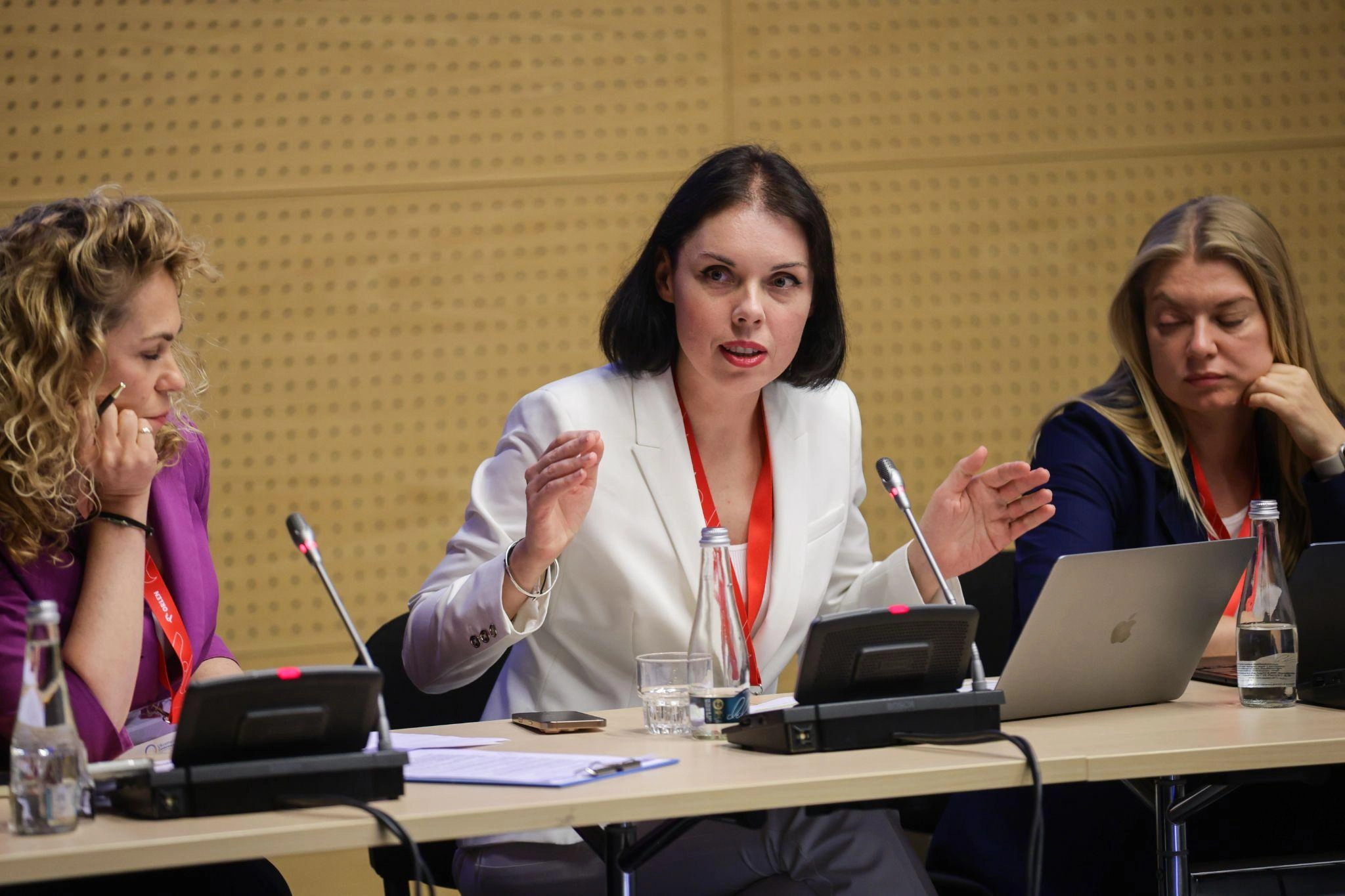
The Economy Ministry, the Social Policy Ministry, and nonprofit Ukraine Global Scholars signed a memorandum to develop Back2Impact Ukraine, a digital career platform designed to connect Ukrainians abroad – international university graduates, professionals with foreign work experience, and diaspora members – with jobs in Ukrainian private business, state companies, and reconstruction projects. “For Ukraine, the return of talent is not an abstract question but part of economic recovery,” the ministry’s press release quoted Deputy Economy Minister Dariia Marchak.
Ukraine’s Deputy Economy Minister Dariia Marchak speaks at a panel discussion during the Ukraine Recovery Conference 2026 in Gdańsk, Poland. (Photo courtesy of the URC2026 press service)
The Economy Ministry also announced a mentorship project for young people from frontline communities, run with Projector Foundation and financed by the governments of Britain, Estonia, Canada, Norway, Finland, Switzerland, and Sweden. The course will help participants aged 18 to 25 build business plans and apply for state grants of up to Hr. 200,000 ($4,470).
Ukraine and Poland also signed two environmental documents: a letter of intent with Poland’s National Fund for Environmental Protection on green financing and administering EU structural funds, and a memorandum with Poland’s Bureau for Chemical Substances on chemical safety under Ukraine’s EU integration commitments.
Skills and workforce initiatives formed a cluster of their own. Ukraine and Germany signed a joint declaration launching the Skill Partnerships competition under the Skills Alliance, letting companies pair with training providers and receive between €50,000 and €200,000 ($57,000–$228,000) in co-financing to train workers in construction, energy, logistics, manufacturing, and agriculture. With the Netherlands, Ukraine signed a letter of intent to develop the skills of Ukrainians temporarily living there for future reconstruction needs. Google announced a $5 million grant to scale up Obriy, the government’s digital labor market ecosystem for matching job seekers with vacancies and training.
On the sidelines, Prime Minister Yulia Svyrydenko met UAE Minister of State for International Cooperation Reem Al Hashimy, with the two discussing energy and housing reconstruction as the Ukraine-UAE Comprehensive Economic Partnership Agreement enters into force next month.
The Education Ministry and the UN World Food Program signed a financing agreement worth almost Hr. 350 million ($7.8 million) to keep providing free meals for pupils in grades 1-4 in frontline communities through the 2026/2027 school year, covering schools in eight regions including Kharkiv, Kherson, and Zaporizhzhia. Roughly 2 million Ukrainian schoolchildren currently receive free hot meals under the reform launched in 2020.
The Finance Ministry and Germany’s KfWsigned a €780,000 ($888,000) grant to help Ukraine’s National Development Institution pass the EU Pillar Assessment – a prerequisite for direct access to EU funds. Separately, KfW, the EU, and the ministry are preparing a €140 million ($159 million) EU-guaranteed loan to capitalize the institution.
The Culture Ministry and the international humanitarian organization Mercy Corps signed a memorandum of understanding under which Mercy Corps will allocate $300,000 to support micro, small, and medium-sized businesses and creative-industry enterprises in Ukraine, the ministry’s press release says.
Visitors of the 2026 Ukraine Recovery Conference in Gdańsk. (Photo courtesy of URC’s press service).
The Development Ministrycounted more than €1.5 billion ($1.71 billion) attracted across its portfolio at the conference. The Council of Europe Development Bank will provide over €251 million ($286 million) for housing programs, including €100 million ($114 million) for eVidnovlennya compensation payments split with Italy, €80 million ($91 million) for housing vouchers for displaced people from occupied territories, and €60 million ($68 million) to launch a veterans’ housing program with some 1,500 preferential mortgages.
Another €524 million ($597 million) went to municipal infrastructure under the Ukraine Investment Framework – €276 million ($314 million) from France’s AFD, €109 million ($124 million) from NEFCO, and €139 million ($158 million) from Poland’s BGK – while more than 150 communities presented 528 projects and signed over 30 agreements worth around €300 million ($342 million).
Ukraine’s state railways Ukrzaliznytsia attracted almost $18 million at the conference, Kuleba also wrote – including $10 million under the RELINC project for critical rail infrastructure, plus smaller sums for the Verkhrata line, Lviv station accessibility, and ERTMS adoption.
The EU and Expertise France signed EU4SAR, a €4.5 million ($5.1 million) three-year program to support the Economy Ministry and the State Property Fund in modernizing corporate governance of state-owned assets and preparing them for privatization, the EU Delegation to Ukraine wrote in its LinkedIn post.
Local communities were also signing deals
Ukrainian cities and regions used the sidelines of URC to strike their own deals: Lviv, Kharkiv, Khmelnytsky region and Kyiv’s St. Nicholas Roman Catholic Church.
Lviv signed six agreements worth more than €2.5 million ($2.85 million) at the Lviv Resilience Day event a day before the conference opened, Mayor Andriy Sadovyi wrote on Telegram. Lithuania committed over €1 million ($1.14 million) for the St. Nicholas children’s hospital and Unbroken University programs, Swedfund allocated €500,000 ($570,000) for a heating system modernization project, and the city signed memorandums on a German Desk investment office and with France’s TAP Holding.
Kharkiv secured €47 million ($54 million) a day before the conference opened, Mayor Ihor Terekhov wrote on Telegram: a €15 million ($17 million) EBRD loan for emergency liquidity support and €32 million ($36 million) in EBRD lending and EU grants for modernizing the city’s heating system.
Visitors of the 2026 Ukraine Recovery Conference in Gdańsk. (Photo courtesy of URC’s press service).
The conference also launched an initiative to save St. Nicholas Roman Catholic Church in Kyiv, worth around €1 million ($1.14 million). Poland’s Polimex Mostostal will provide scaffolding for emergency works free of charge until restoration is complete, and signed a letter of intent with PZU SA on a “rescue coalition” for further restoration, the parish wrote on Facebook.
The Khmelnytsky region secured a €500,000 ($570,000) grant from Slovenia’s Centre for International Cooperation and Development to reconstruct the water supply network in the village of Novostavtsi, part of a €600,000 ($684,000) project to modernize wells and worn-out pipes, regional governor Serhiy Tyurin wrote on Telegram.
Memorandums, memorandums everywhere
A lot of businesses signed memorandums of understanding without disclosing much information about the extent of use it will bring to both sides. The specific impact of such agreements will be seen over time, unlike deals for real money signed here and now.
Representatives of the Economy Ministry and the heads of Raiffeisen Bank, UKRSIBBANK, Ukrgasbank, PUMB, and Sense Bank after signing a letter of intent on the Human Capital Resilience Charter at the Ukraine Recovery Conference 2026 in Gdańsk, Poland, on June 26, 2026. (Photo courtesy of the Ministry of Economy, Environment and Agriculture of Ukraine press service)
Kyivstar Group (Nasdaq: KYIV) and Ukraine’s National Securities and Stock Market Commission signed a memorandum of cooperation to give Ukrainian investors direct access to Kyivstar’s Nasdaq-listed shares, Kyivstar announced in a press release sent to journalists.
It remains unknown how the memorandum might help give access to shares, especially including the fact that the commission’s role in enhancing capital markets in Ukraine is becoming weaker. An alternative is looming on the horizon: Ukraine’s central bank, the National Bank of Ukraine (NBU), is working with the EBRD to create a vertically integrated capital markets holding company — a single structure that would consolidate trading, clearing, settlements, and the securities depository under one roof, with a reputable international strategic investor to be selected through an open tender.
The Economy Ministry, Kyivstar, and its international parent VEON signed a memorandum to explore building a sovereign AI Data Center in Ukraine – computing infrastructure that would keep data storage and processing on Ukrainian soil for the public sector, defense technologies, science, and business.
Ukrenergo also signed a memorandum of understanding with Swedish state development finance institution Swedfund covering transmission resilience, integration of renewables and energy storage, and digitalization of grid management.
Ukraine’s state-owned nuclear giant Energoatom and Czech nuclear engineering company ŠKODA JS signed a memorandum on strategic partnership covering construction, operation, and maintenance of Ukrainian nuclear power units, safety upgrades, and spent fuel and radioactive waste management – without disclosed financial terms.
BGV Group Management and the EBRD signed a letter of intent to prepare the BGV Graphite project – a mining plant at the Balakhivske deposit in the Kirovohrad region and a spherical graphite plant for lithium-ion batteries – for potential bank financing, according to the company’s press release. The company also signed a memorandum with Finland’s Metso and export credit agency Finnvera on jointly developing critical minerals projects in Ukraine, from extraction to integration into European markets, its press release says.
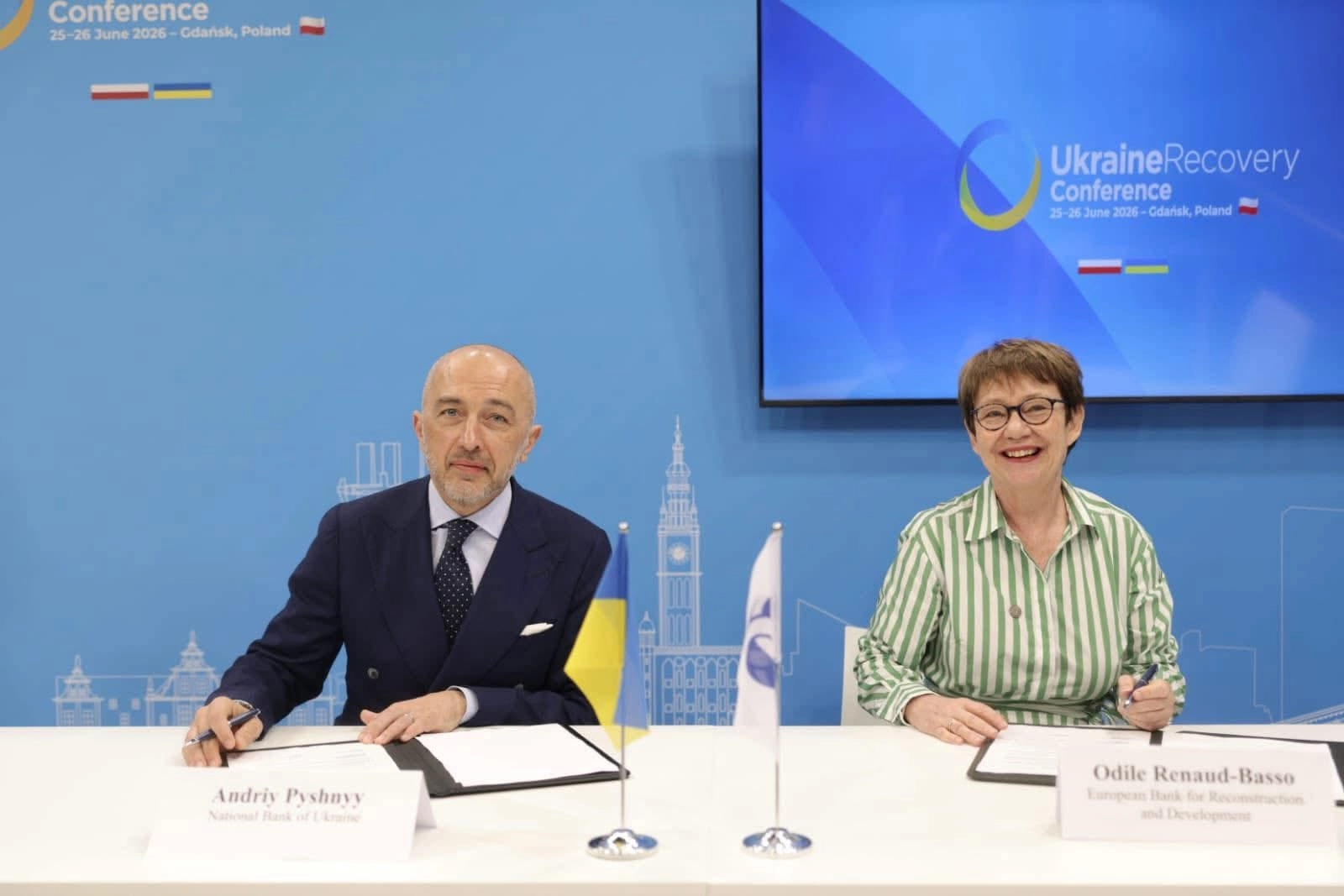
NBU Governor Andriy Pyshny (left) and EBRD President Odile Renaud-Basso (right) sign a memorandum on strengthening corporate governance in Ukraine’s financial sector at the Ukraine Recovery Conference 2026 in Gdańsk, Poland, on June 26, 2026.
The NBU and the EBRD signed a memorandum on strengthening corporate governance across the financial sector, including insurance, with the EBRD supporting implementation of the NBU’s existing and future regulations.
State-owned Ukreximbank and Poland’s BGKsigned a memorandum on institutional development and preparing reconstruction projects in infrastructure, energy, trade facilitation, and SME support.
The Economy Ministry and five leading banks – Raiffeisen Bank, UKRSIBBANK, Ukrgasbank, PUMB, and Sense Bank – signed a letter of intent on the next stage of the Human Capital Resilience Charter, a responsible-employment initiative launched at last year’s URC, according to PUMB’s press release.
The first year was spent on “forming a shared vision,” according to the ministry, and with no reported implementation results so far, the practical impact of the new signing remains to be seen. The plans include a toolkit library for employers on veteran integration and inclusive hiring, a banking committee, and an eventual HCR Index to move companies from self-declaration to measured impact.
URC 2026 drew nearly 8,000 participants – almost double the previous year’s conference in Rome – making it “the largest and most practical” edition yet, Interfax-Ukraine quoted Minister of Economy Oleksiy Sobolev at the closing press conference. The business fair alone brought together 220 companies, including Ukraine’s largest-ever delegation of 82 firms, while organizers counted roughly 200 signed documents in total.