49 minutes ago
Martin Yip,Hong Kongand
Kelly Ng
Those who do not comply can be jailed for up to a year and fined up to HK$100,000 ($12,700; £9,600).

49 minutes ago
Martin Yip,Hong Kongand
Kelly Ng

 Getty Images
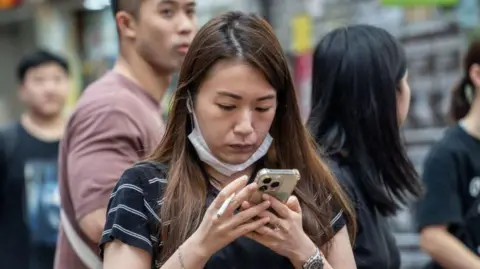
Hong Kong police can now demand phone or computer passwords from those who are suspected of breaching the wide-ranging National Security Law (NSL).
Those who refuse could face up to a year in jail and a fine of up to HK$100,000 ($12,700; £9,600), and individuals who provide "false or misleading information" could face up to three years in jail.
It comes as part of new amendments to a bylaw under the NSL that the government gazetted on Monday.
The NSL was introduced in Hong Kong in 2020, in wake of massive pro-democracy protests the year before. Authorities say the laws, which target acts like terrorism and secession, are necessary for stability - but critics say they are tools to quash dissent.
The new amendments also give customs officials the power to seize items that they deem to "have seditious intention".
Monday's amendments ensure that "activities endangering national security can be effectively prevented, suppressed and punished, and at the same time the lawful rights and interests of individuals and organisations are adequately protected", Hong Kong authorities said on Monday.
Changes to the bylaw was announced by the city's leader, John Lee, bypassing the city's legislative council.
While law enforcement officials in many parts of the world have the authority to demand access to electronic devices as part of criminal investigations, the NSL covers a sweeping range of vaguely defined offences from secession, subversion, terrorism and collusion with external forces.
The NSL also allows for some trials to be heard behind closed doors.
The city has seen the arrests of hundreds of protesters, activists and former opposition lawmakers since the introduction of the NSL.
Also in February, media tycoon Jimmy Lai was sentenced to 20 years in jail after being convicted of foreign collusion and publishing seditious material under the NSL.

The ripples of the war against Iran by the US and Israel are exerting inflationary pressures across Africa through higher energy and fertiliser prices, threatening an already fragile economic recovery. Most of Africa’s 54 countries depend on fuel imports and have experienced sharp increases in fuel

The International Energy Agency chief said the war could lead to the world's worst energy crisis in decades.

China has cut exports of two metals used in military technology to Japan while increasing shipments of rare earth magnets, in what could signal a muted warning after geopolitical tensions between the two Asian economies flared last year. Exports of gallium to Japan registered zero volume in the firs

Chinese scientists have discovered a way to turn cheap coal into valuable ingredients for medicine. This was once a long and difficult process, but now they have found a surprising short cut. In a study published on March 16 in the journal Nature, Jiao Ning’s team at Peking University solved a chemi