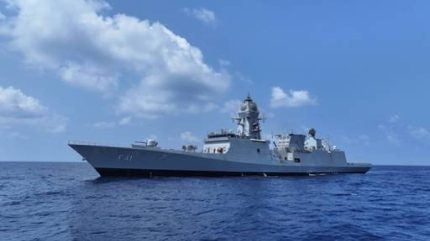
Indian Navy inducts INS Taragiri, fourth Project 17A platform
The Indian Navy has commissioned its latest stealth frigate INS Taragiri on 3 April 2026 in Visakhapatnam, Andhra Pradesh.
The post Indian Navy inducts INS Taragiri, fourth Project 17A platform appeared first on Naval Technology.
Naval Technology
75
3 мин чтения
0 просмотров
The vessel carries supersonic surface-to-surface missiles, medium-range surface-to-air missiles, and an indigenous anti-submarine suite.
Indian Navy’s latest stealth frigate INS Taragiri. Credit: India Ministry of Defence.
The Indian Navy has commissioned its latest stealth frigate INS Taragiri on 3 April 2026 in Visakhapatnam, Andhra Pradesh.
Officials present in the ceremony included Indian Defence Minister Rajnath Singh, Chief of the Naval Staff (CNS) admiral Dinesh K Tripathi, and Chief of Defence Staff general Anil Chauhan, among others.
Discover B2B Marketing That Performs
Combine business intelligence and editorial excellence to reach engaged professionals across 36 leading media platforms.
Find out more
INS Taragiri, which is the fourth platform in the Project 17A class, joins the Eastern Fleet on India’s eastern seaboard.
Project 17A, also known as the Nilgiri-class, follows the Project 17 Shivalik-class frigate programme. It includes seven guided-missile frigates, four to be built by Mazagon Dock Shipbuilders and three by Garden Reach Shipbuilders & Engineers (GRSE), at an estimated total cost of about Rs500bn ($5.3bn).
INS Taragiri is a multi-role stealth frigate with a displacement of about 6,670 tonnes (t), designed by the Warship Design Bureau and built by Mazagon Dock Shipbuilders with support from more than 200 micro, small and medium enterprises (MSMEs).
According to a press release from the Ministry of Defence, the ship has more than 75% indigenous content and was built on shortened timelines.
The vessel uses stealth technology intended to reduce radar signature. It is equipped with range of supersonic surface-to-surface missiles, medium range surface-to-air missiles, and an advanced indigenous anti-submarine suite.
In addition, INS Taragiri uses Combined Diesel or Gas propulsion and an Integrated Platform Management System.
Rajnath Singh said: “This ship is capable of high-speed transit and can remain deployed at sea for extended periods. It is equipped with systems designed to monitor enemy movements, ensure its own security, and if necessary, deliver an immediate response.
“It features modern radar, sonar, and missile systems, such as BrahMos and surface-to-air missiles, which further augment its operational prowess. From high-intensity combat to maritime security, anti-piracy operations, coastal surveillance, and humanitarian missions, it fits perfectly into every role, making it a unique naval platform.”
Mazagon Dock Shipbuilders constructed the warship using about 4,000t of special grade steel plates supplied by Steel Authority of India Limited (SAIL), an Indian government-owned firm.
SAIL also supplied special steel for several critical naval platforms, including the indigenous aircraft carrier INS Vikrant and the first three ships of the Project 17A class including INS Nilgiri, INS Himgiri, and INS Udaygiri.
Recently, the Indian Navy took delivery of two vessels, the fifth Nilgiri-class frigate Dunagiri (Yard 3023) and the survey ship Sanshodhak (Yard 3028), from GRSE in Kolkata.